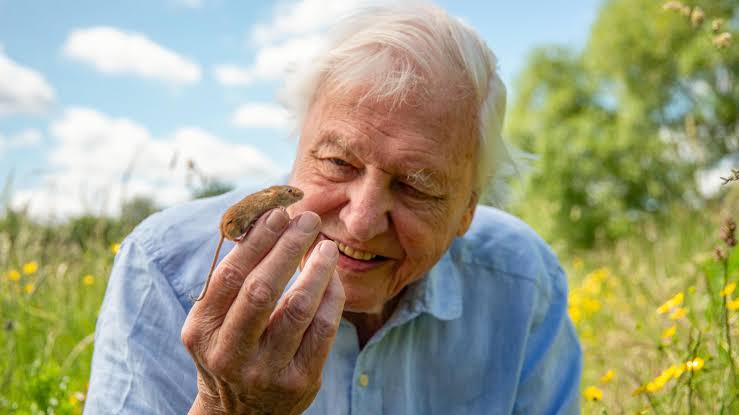
David Attenborough
He joined the BBC in 1952, when almost nobody in Britain owned a television, and he turned 100 in May 2026 with another series announced. In between: collecting animals for London Zoo on camera in the 1950s, shot on 16mm colour stock the BBC insisted on because it made a better black and white picture, so the films came back in colour by accident and sat unseen for sixty years. Then running BBC Two, then giving that up to go back to the field. Life on Earth in 1979, and the gorillas at Karisoke. Reefs, ice, deserts, and a camera department that kept inventing the equipment as it went. Latterly the arguing: about plastic, about extinction, about how late he came to saying so, and about films that showed a world of animals without showing what was happening to it. This archive covers the work and the arguments, and it names the people behind the camera, several of whom no photograph of exists anywhere.
A chronological documentary of 771 moments spanning 1835–2026 on Loreline.
Curated by Olivier · last updated 2026-09-20
Eras
- Expeditions, The Zoo Quest years, 1954 to 1963, when the format was flying to Sierra Leone or Borneo or Paraguay and bringing animals back alive for London Zoo. A model that reads very differently now, and the archive says so rather than tidying it. He got the job because Jack Lester, the reptile curator who was to present, fell ill: the story is usually told as a charming lucky break, and its ending is usually dropped, which is that Lester died in 1956 aged forty-seven. The films were shot on 16mm colour and broadcast in black and white, not out of foresight but because colour stock was the BBC's condition for letting him use the lighter camera.
- Studio, The other half of the job: pieces to camera, presentation, and above all narration, which is the thing most people would recognise him by and which is almost never filmed. There is no narration-booth footage in the free record. What stands in for it is the interviews, the studio stills from 1955 and 1956 of him presenting Vivian Fuchs and Edmund Hillary, and the later work with animation and computer graphics.
- Fieldwork, Him on location across seven decades: jungle, ice, reef, desert. Note what is missing and why. There is no freely licensed photograph of him doing fieldwork before 2002, because that entire record is BBC-owned, so this segment carries the video and then the places themselves: Dian Fossey's cabin at Karisoke and the graves beside it, where the mountain gorilla sequence was filmed in January 1978, the volcanic coast of Fernandina, the Zambezi valley as the Kariba dam was closing it in 1955.
- Broadcasting, The years he spent running things rather than presenting them, 1965 to 1973, which are the thinnest part of the visual record: almost no footage of the period survives. BBC Two under his controllership carried Britain's first regular colour service from 1 July 1967, which happened because it was the 625-line channel already built for colour, not because he introduced colour television. Civilisation and Monty Python went out in that window; The Ascent of Man did not, transmitting in 1973 after he left. The story that he turned down the Director-Generalship is repeated everywhere and is not established.
- Cameras, The equipment, which is half the story of why these films look the way they do. From the Bolex and 16mm reversal stock through to image-stabilised long lenses, thermal and starlight cameras, macro probes, submersibles, camera traps and drones. Much of the technique did not exist before a series needed it, and the behind-the-scenes strands where the crews explain what they built are among the most substantial documentary material in the whole archive.
- Crew, The people behind the camera, who are usually invisible in accounts of his work and who are named here. Charles Lagus, the first cameraman the BBC engaged specifically for natural history, on Zoo Quest from 1954, of whom no photograph exists on any free image source. Doug Allan, the principal polar and underwater cameraman across The Blue Planet, Planet Earth and Frozen Planet, who died on 8 April 2026, four weeks before Attenborough's hundredth birthday. Alastair Fothergill, Mike Gunton, Keith Scholey, Sophie Darlington, Vanessa Berlowitz, Gavin Thurston, and the Bristol unit that Desmond Hawkins built and that is routinely miscredited to Attenborough.
- Species, The largest segment, and the most surprising one. At least fifty-nine species and genera carry his name, living and extinct, and about half of them are photographed and freely licensed. A pitcher plant from Palawan, a Cambrian animal called Auroralumina, a Devonian fish that was fossilised while giving birth, a plesiosaur, an echidna, a fossil crustacean called Cascolus ravitis whose name is a Latin pun on his family, and a wasp described for the centenary in May 2026. Also the research ship, which is here as a ship and not as him, and which the public voted to call something else.
- Awards, Ceremonies, investitures, honorary degrees, BAFTAs and the rest, which are also the part of his life that free photography actually covers, because press and government photographers were there and the BBC owned everything else. The centenary in May 2026 belongs here: a Royal Albert Hall gala broadcast as a ninety-minute programme, and the announcement that he would narrate Blue Planet III.
- Animals, The subjects. Deliberately held to under a tenth of this archive, because a career this long generates effectively unlimited wildlife footage and the archive is about the work rather than a nature reel. What is here is chosen for the sequences that mattered to the programmes: the gorillas, the birds of paradise, the lyrebird, the reef.
- Advocacy, The turn from describing the world to arguing about it. The usual account has him publicly quiet until the mid 2000s, and that is too strong: he was talking about the natural world being in grave danger in 1980. What is fair is that his explicit climate advocacy is late, which he concedes himself, and that the films long showed animals without showing what was happening to them. This segment carries the speeches, the UN and COP platforms, the Witness Statement, and the criticism, which is part of the record and is attributed rather than adjudicated. On plastics, keep two things apart: the government cited Blue Planet II when it launched the 25 Year Environment Plan, and a peer-reviewed study found public knowledge rose while plastic-choice behaviour did not significantly change.
- - The Zoological Gardens, Regent's Park. A nineteenth century view of the zoo in Regent's Park. Collecting for menageries is far older than television, and Zoo Quest inherited a Victorian institution and its assumptions along with its staff and its animals.
- - The aviary at Regent's Park. Crowds at the aviary in the early years of the Zoological Society's gardens. When Zoo Quest set out in 1954 the object was to bring animals back alive to enclosures descended from these, and the programme was as much about the acquisition as about the animal.
- - Regent's Park zoological gardens, nineteenth century. The Zoological Society of London's gardens as they looked a century before television. The institution, its collecting habits and its assumptions were all inherited whole by the programme that made Attenborough's name.
- - Visitors at the Zoological Gardens. Crowds at Regent's Park in the 1830s. The zoo was founded in 1826 for scientific study and opened to the public in 1847, and it supplied both the destinations and the expertise for the collecting programmes of the 1950s.
- - A lion at London Zoo, nineteenth century. An early photograph of a captive lion in Regent's Park. Photographing animals in enclosures was for decades the only practical way of picturing exotic species, and the shift to filming them in the wild is the change Attenborough's career sits astride.
- - The Penguin Pool, London Zoo, 1938. Berthold Lubetkin's modernist penguin pool, opened in 1934 and among the best known pieces of British modernist architecture. This is the zoo Attenborough's first television work took its animals to, sixteen years before Zoo Quest began.
- - Birds at London Zoo, 1938. The zoo as it was before the war and before television. Attenborough joined the BBC in 1952, when television was one channel, largely live, watched in a small minority of British households.
- - London Zoo Aka Holiday Sport (1952). London Zoo in 1952, the year Attenborough joined the BBC as a trainee producer in the Talks department. Regent's Park is where the Zoo Quest partnership with the Zoological Society began.
- - British troops embarking for British Guiana, 1953. Troops leave for British Guiana in October 1953 after the colonial government suspended the constitution. Zoo Quest to Guiana was filmed in the same territory in the mid 1950s, a reminder that the collecting expeditions travelled through a working empire and used its transport and permissions.
- - Experience David Attenborough's first expedition in colour | BBC Global. Attenborough's first expedition, to Sierra Leone in 1954, seen in colour. Charles Lagus shot it on colour 16mm because the BBC made colour stock the condition of allowing the lightweight format, and it transmitted in black and white.
- - Interviewing the Trans-Antarctic Expedition, 1955. Three years after joining the BBC as a trainee producer in the Talks department, Attenborough is already presenting live studio interviews on subjects far outside natural history. The Talks department handled spoken-word non-fiction of every kind, and he was hired as neither a natural history specialist nor a presenter. Television at this point runs a single channel, largely live, from Alexandra Palace and Lime Grove.
- - When Sir David Attenborough had to catch a HUGE python | David Attenborough's Zoo Quest in Colour. Attenborough catches a python during a Zoo Quest expedition, restored from the colour negatives. Nobody preserved the colour farsightedly; an archivist identified the negatives as colour in 2015 and the restoration aired as 90th birthday programming.
- - Kariba Dam under construction. The dam that flooded the Zambezi valley and created Lake Kariba. Charles Lagus, the cameraman on Zoo Quest and the first cameraman the BBC engaged for natural history, directed the film Kariba in 1959 and wrote Operation Noah about the rescue of animals from the rising water. Lagus was born on 8 September 1928 and lives in Mauritius.
- - Kariba, the Zambezi valley being dammed. Operation Noah was the campaign to move animals off the islands that formed as the reservoir filled. Lagus is one of the genuinely under credited figures in this whole story: he shot the material that made Attenborough's early reputation and is rarely named in retellings of it.
- - British Guiana Airways Grumman Goose. An amphibious aircraft of the kind that carried people and cargo into the interior of British Guiana in the 1950s. Expeditions of this era reached the forest by boat and light aircraft with equipment that had to survive humidity, and every foot of film had to be flown home to be processed.
- - Mounted police on parade, Georgetown. Georgetown in March 1955, the capital of the colony that Zoo Quest to Guiana set out from. The Zoo Quest format was animal collecting: expeditions travelled with London Zoo staff to take named target animals for the zoo's collection, standard practice then and not defensible now.
- - Young Attenborough Catches a Python | #Attenborough90 | BBC Earth. A young Attenborough catches a python during a Zoo Quest expedition, restored in colour for the 90th birthday programming. He was in his late twenties when the series began.
- - Attenborough Enters the Bat-Eating Snakes' Cave | Zoo Quest for a Dragon | BBC Earth. Attenborough enters a cave of bat eating snakes during the Zoo Quest for a Dragon expedition. Cave filming in 1956 meant carrying lights and film stock in by hand.
- - Vivian Fuchs and Edmund Hillary in the studio, 1956. Two of the best known explorers of the day sit for a live interview in March 1956, the year Zoo Quest was already running and the year Jack Lester died. Lester, Curator of Reptiles at London Zoo, was the intended on-screen presenter of Zoo Quest; he withdrew through an undiagnosed tropical illness and died aged 47. The anecdote is usually retold as a lucky break for the producer standing in.
- - Edmund Hillary under studio lights, 1956. Everest had been climbed three years earlier and the Commonwealth Trans-Antarctic Expedition was in preparation. This is the working register of the early BBC: live studio talk, a single channel, film inserts still the exception rather than the rule. The natural history career that would define him was at this point a sideline of the Talks department.
- - Young David Attenborough Looks for an Orangutan | Zoo Quest for a Dragon | BBC Earth. Attenborough searches for an orangutan on the Zoo Quest for a Dragon expedition to Indonesia. The format is animal collecting: the crew travels with London Zoo staff to capture named target animals for the zoo's collection, which was standard practice for the period.
- - Zoo Quest For A Dragon (1956) With Sir David Attenborough | BBC Earth. Zoo Quest for a Dragon, the 1956 expedition to Indonesia in search of the Komodo dragon. Zoo Quest first broadcast on 21 December 1954 and ran to 31 May 1963, seven series and roughly 42 episodes.
- - Attenborough Catches a Komodo Dragon | Zoo Quest for a Dragon | BBC Earth. Attenborough catches a Komodo dragon, the target animal of the 1956 Indonesian expedition. The collecting model was already falling out of favour by the end of the Zoo Quest run in 1963.
- - Attenborough Makes Friends with an Orangutan | Zoo Quest for a Dragon | BBC Earth. Attenborough with an orangutan on the Zoo Quest for a Dragon expedition. He joined the BBC in 1952 as a trainee producer in the Talks department, hired neither as a natural history specialist nor as a presenter.
- - David Attenborough Meets the Temple Monkeys of Bali (1956) | Zoo Quest for a Dragon | BBC Earth. Attenborough meets the temple monkeys of Bali during the 1956 Indonesian expedition. The Zoo Quest programmes mixed animal collecting with travelogue reporting on the places the crew passed through.
- - Good vs Evil Witch: Bali Ceremony with David Attenborough | Zoo Quest for a Dragon | BBC Earth. A Balinese ceremony filmed during Zoo Quest for a Dragon. Charles Lagus shot this material on colour 16mm stock that the BBC transmitted in black and white, a decade before UK colour television.
- - Attenborough Catches a Large Python | Zoo Quest for a Dragon | BBC Earth. Attenborough catches a large python on the Indonesian Zoo Quest expedition. Live capture for the London Zoo collection is the format's organising purpose, not an incidental part of it.
- - Attenborough Cares for a Baby Bear | Zoo Quest for a Dragon | BBC Earth. Attenborough cares for a young bear collected during Zoo Quest for a Dragon. He has repeatedly described the collecting format as belonging to its era and not defensible now.
- - Attenborough Meets a Pangolin | Zoo Quest for a Dragon | BBC Earth. Attenborough handles a pangolin on the Indonesian expedition. Jack Lester, Curator of Reptiles at London Zoo, was the intended on-screen presenter of Zoo Quest and did present before illness forced him out.
- - Attenborough and the Tribal Dancers | Zoo Quest for a Dragon | BBC Earth. Attenborough films dancers during the Indonesian Zoo Quest expedition. The series mixed animal collecting with ethnographic travelogue, a combination normal in 1950s British factual television.
- - Komodo Dragons Feast on a Dead Goat | Zoo Quest for a Dragon | BBC Earth. Komodo dragons feed at a bait site laid by the Zoo Quest crew. Charles Lagus shot the expedition on lightweight 16mm, the format Attenborough had argued for against the BBC's preferred 35mm.
- - Breakfast with the Gibbons | Zoo Quest for a Dragon | BBC Earth. Gibbons filmed on the Indonesian Zoo Quest expedition. Lester died in 1956, aged 47, of the illness that took him off the programme, an ending the anecdote about Attenborough stepping in usually drops.
- - Sir David Attenborough (1961) Best Of Zoo Quest To Madagascar | BBC Earth. Zoo Quest to Madagascar, one of the later expeditions in the run. Charles Lagus is the cameraman across the series, the first cameraman the BBC engaged specifically to shoot natural history footage.
- - Attenborough Finds a Shady Gecko | Zoo Quest to Madagascar | BBC Earth. Attenborough finds a gecko during the Madagascar expedition. Zoo Quest destinations across the run include Sierra Leone, British Guiana, Indonesia, New Guinea, Paraguay and Madagascar.
- - Baby Lemur has Bumpy Ride | Zoo Quest to Madagascar | David Attenborough | BBC Earth. A young lemur travels with the Zoo Quest team in Madagascar. The expedition programmes carried collected animals across long overland journeys before shipping them to London.
- - Harmless Lunatic and the Giant Egg | Zoo Quest to Madagascar | BBC Earth. The Zoo Quest team pursues an elephant bird egg in Madagascar. Zoo Quest ran seven series to 31 May 1963, by which point taking wild animals for zoos was already falling out of favour.
- - The Massive Elephant Bird Egg | Zoo Quest to Madagascar | BBC Earth. An elephant bird egg recovered in Madagascar. The extinct Aepyornis laid the largest eggs of any known bird, and the Zoo Quest Madagascar expedition made the search for one a narrative spine.
- - Cutest Animal in the World? | Zoo Quest to Madagascar | BBC Earth. A small Malagasy mammal filmed on the 1961 expedition. Madagascar was among the last destinations of the Zoo Quest run, which had begun in Sierra Leone in 1954.
- - Scientific Sensation of the Century! Coelacanth | Zoo Quest to Madagascar | BBC Earth. The Zoo Quest crew reports on the coelacanth, the lobe finned fish known from fossils and found alive off south east Africa in 1938. The rediscovery was still recent news when the Madagascar expedition filmed.
- - The Magnificent Ruffed Lemur | Zoo Quest to Madagascar | BBC Earth. A ruffed lemur filmed in Madagascar for Zoo Quest. Lemurs are endemic to Madagascar and were among the target animals for the London Zoo collection.
- - Villagers Worship Crocodiles in Madagascar! | Zoo Quest to Madagascar | BBC Earth. Attenborough reports on crocodile veneration in Madagascar. The travelogue reporting sits alongside the collecting, and both belong to the conventions of 1950s and early 1960s BBC expedition television.
- - The Dog Headed Men? Indri Lemur | Zoo Quest to Madagascar | BBC Earth. The indri, the largest living lemur, filmed for Zoo Quest to Madagascar. Attenborough presented the series after Jack Lester, the intended presenter, was hospitalised with an undiagnosed tropical illness.
- - Celebrating with the Corpses of Their Ancestors | Zoo Quest to Madagascar | BBC Earth. Attenborough films the famadihana reburial ceremony in Madagascar. Zoo Quest first broadcast on 21 December 1954 and its Madagascar series is among the last before the run ended in 1963.
- - Quest under Capricorn - Desert Gods (Episode 1). Desert Gods, the first episode of Quest Under Capricorn, Attenborough's Australian series. This is a third party upload of BBC material and is the takedown prone class the archive should expect to lose over time.
- - Quest under Capricorn - Hermits of Borroloola (Episode 2). Hermits of Borroloola, from Quest Under Capricorn. The series followed the Zoo Quest run, which ended on 31 May 1963, and shifted from collecting to travel and cultural reporting.
- - Quest Under Capricorn - The First Australians (Episode 6). The First Australians, from Quest Under Capricorn. Attenborough's Australian series records Aboriginal communities in the early 1960s, and this is a third party upload rather than an official one.
- - Antarctic field camp, mid-1960s. Scientists' tents during the austral summer. This is the physical scale of Antarctic work in the decade Attenborough was running BBC Two, and it barely changed until the ships and stations of the 2000s. The RRS Sir David Attenborough entered service in 2021 to replace two older British vessels.
- - New Arrivals At London Zoo (1966). New arrivals at London Zoo in 1966, filmed by British Pathe. The Zoological Society of London received the animals that the Zoo Quest expeditions collected between 1954 and 1963.
- - Listening To Recorded Music For The First Time | #Attenborough90 | BBC. People of highland New Guinea hear recorded music for the first time, filmed by Attenborough and restored for the 90th birthday programming. Encounter footage of this kind belongs to the ethnographic strand of his 1960s and 1970s expedition work.
- - Meeting A Lost Tribe | #Attenborough90 | BBC. Attenborough films a first contact encounter in New Guinea, restored for the 90th birthday programming. This material belongs to a period when such filming was normal practice and would not be made the same way now.
…and 721 more moments.
Full text archive: /loreline-text/david-attenborough.md