Funkhaus Berlin
The full history of the Funkhaus on Nalepastraße — built in the 1950s as the broadcasting heart of East Germany, designed by the Bauhaus architect Franz Ehrlich around the legendary Saal 1, one of the most perfect recording halls on Earth. From the voice of the GDR to silence after reunification to its rebirth as a world-class recording and concert campus — Nils Frahm, Boiler Room and a thousand sessions in between.
A chronological documentary of 44 moments spanning 1950–2026 on Loreline.
last updated 2026-07-16
Eras
- Built for the Voice of the GDR — On the bank of the Spree in Oberschöneweide, East Germany builds itself a broadcasting palace. The Bauhaus architect and Buchenwald survivor Franz Ehrlich designs a complex around Saal 1 — a recording hall of near-perfect acoustics.
- The Sound of the East — For three decades the Funkhaus is the single source of recorded sound in the GDR — orchestras, radio plays, choirs and the entire state soundtrack are committed to tape on Nalepastraße.
- Late DDR Broadcasting — The mature broadcasting machine at its height: news, pop and rock for the East, the Rundfunk-Sinfonieorchester, the Amiga sessions and a building running around the clock until the Wall falls.
- Reunification & Silence — After 1990 the GDR broadcasters are dissolved and merge into the new public networks. Most of the Funkhaus empties out; corridors go quiet and the great halls fall into a long limbo.
- The Rebirth — New owners and a generation of producers rediscover the halls. Studios reopen, the equipment is restored, and the Funkhaus begins its second life as a place to make records again.
- The Living Campus — Nils Frahm builds his room here, Boiler Room broadcasts from the halls, and the Funkhaus becomes a global pilgrimage site for musicians — a campus of studios, labels and concerts on the Spree.
- — Franz Ehrlich — the Bauhaus architect. Franz Ehrlich, trained at the Bauhaus in Dessau and imprisoned in Buchenwald — where he was forced to design the camp gate lettering — became the architect of the new East German broadcasting house. His modernist hand shapes the entire complex.
- — A site on the Spree at Oberschöneweide. The Funkhaus rises on Nalepastraße in Oberschöneweide, on the south-east bank of the Spree, partly reusing an existing plywood factory. The river and the industrial quarter frame what will become the GDR's sonic centre.
- — Building the broadcasting complex. Construction of the new Funkhaus begins in 1951 under Ehrlich's plans — a sprawling brick-and-stone complex of studios, offices and technical blocks designed expressly for the production and broadcast of radio.
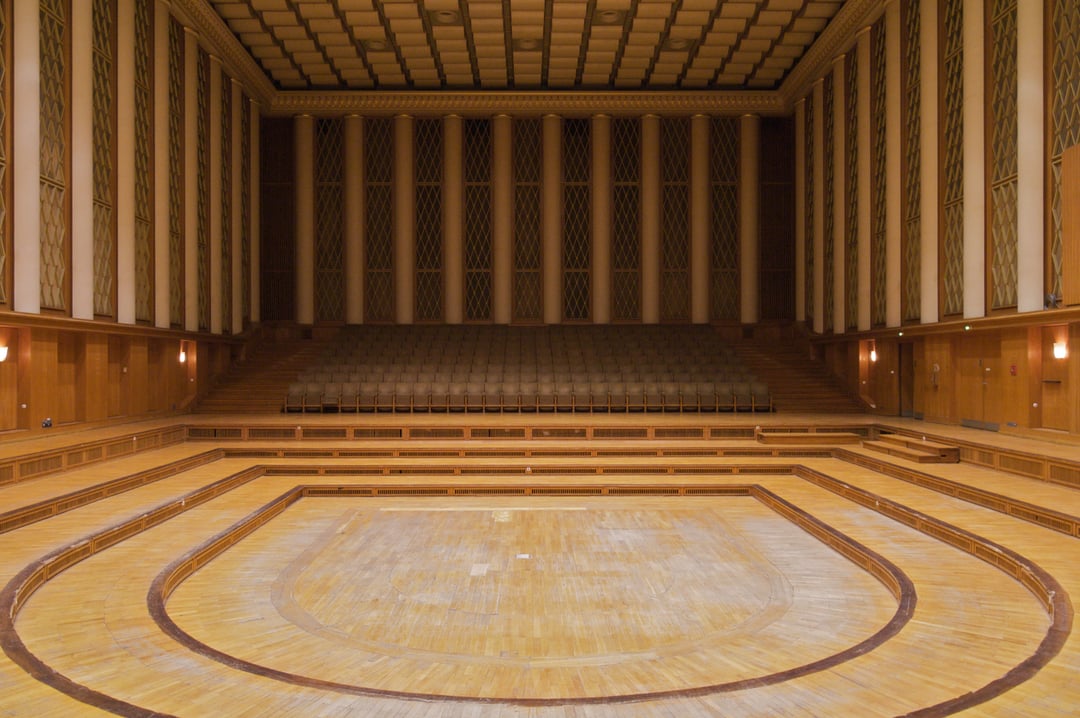
- — Saal 1 — a hall tuned like an instrument. Block B's Saal 1 is engineered as one of the finest recording halls ever built: floating construction, tuned wood and a reverberation tail praised by engineers worldwide. The room itself is the Funkhaus's masterpiece.
- — A hall for chamber concerts. Beyond the great Saal 1, Ehrlich's complex includes smaller halls — among them the Sendesaal für Kammerkonzerte, a dedicated chamber-music recording room, each space tuned for a different kind of sound.
- — The Wandelgang — Ehrlich's modernist promenade. The sweeping foyers and promenades of the Funkhaus show Ehrlich's Bauhaus training: clean lines, daylight and terrazzo, a piece of high modernism hidden inside the GDR's broadcasting machine.
- — The Funkhaus goes on air. By 1956 the central blocks are complete and East German radio moves in. Nalepastraße becomes the production home of the GDR's radio networks — the place where the voice of the East is recorded and transmitted.
- — The Rundfunk-Sinfonieorchester Berlin. The Berlin Radio Symphony Orchestra records in Saal 1, its sound captured by the hall's celebrated acoustics. Decades of symphonic recordings for GDR radio are made in this room.
- — The broadcasting house on Nalepastraße. The completed Funkhaus stands as one of the largest broadcasting complexes in Europe — Ehrlich's brick blocks strung along the Spree, a self-contained city of sound on the eastern edge of Berlin.
- — The Rundfunkchor Berlin. The Berlin Radio Choir, one of the world's leading professional choirs, records its repertoire in the Funkhaus halls — voices wrapped in the same legendary reverberation.
- — Hörspiel — the golden age of radio drama. The Funkhaus's dedicated drama studios produce thousands of Hörspiele — radio plays — a central art form of GDR culture, with Foley rooms and dead-rooms built into Ehrlich's plan.
- — Amiga — the GDR's record label. Amiga, the popular-music label of the state-owned VEB Deutsche Schallplatten, issues the records of the East. Much of its catalogue — pop, jazz, rock and Schlager — is recorded in the Funkhaus.
- — Reinhard Lakomy — early electronic pop. Composer and singer Reinhard Lakomy records pop and pioneering electronic music for Amiga at the Funkhaus, later famous for the beloved "Traumzauberbaum" children's records.
- — Reels, valves and the Magnetophon. German magnetic tape recording — the Magnetophon lineage — fills the Funkhaus's technical blocks: racks of valve amplifiers, custom desks and tape machines that define the building's sound. This photograph dates from 1970.
- — Manfred Krug records his jazz albums. Actor and singer Manfred Krug, one of the GDR's biggest stars, records his celebrated jazz albums for Amiga at the Funkhaus before his 1977 emigration to the West — a high point of East German popular music.
- — City — "Am Fenster". The Berlin rock band City records "Am Fenster", a seven-minute epic with a soaring violin that becomes one of the most famous East German rock songs ever — and a surprise hit in the West.
- — Puhdys — the rock band of the GDR. The Puhdys, the most successful rock band of East Germany, cut Amiga records and broadcast sessions at the Funkhaus, their hard-edged sound filling the airwaves of the late DDR.
- — Karat — "Über sieben Brücken". Karat's "Über sieben Brücken musst du gehn" becomes one of the defining songs of the GDR, recorded for Amiga and later a hit across the German-speaking world.
- — Stimme der DDR on the air. The Funkhaus produces the full slate of GDR radio: Berliner Rundfunk, Radio DDR and the international service — newsrooms, music shows and propaganda alike flow out of Nalepastraße.
- — Silly — Tamara Danz and the new wave of the East. Fronted by Tamara Danz, Silly brings a sharper, new-wave edge to GDR rock, recording for Amiga and broadcasting from the Funkhaus in the restless final years of the East.
- — A building that never sleeps. At its peak the Funkhaus employs thousands and runs around the clock — studios, archives, canteens and workshops forming a self-contained broadcasting city on the Spree.
- — The Wall falls. On 9 November 1989 the Berlin Wall opens. Within a year the GDR — and the state broadcasting apparatus run from the Funkhaus — will cease to exist, throwing the future of Nalepastraße into question.
- — The GDR broadcasters are dissolved. After reunification the East German radio and television institutions are wound up at the end of 1991; their successors and archives are folded into the new federal public broadcasters. The Funkhaus loses its purpose.
- — The networks move out. Through the 1990s the surviving radio operations relocate to other Berlin sites. Block by block the Funkhaus empties; the technical halls and offices that once ran the GDR fall silent.
- — Listed as a monument. The Funkhaus complex is placed under monument protection, recognising Ehrlich's architecture and the irreplaceable acoustics of its halls — even as much of the building stands empty and uncertain.
- — A new chapter begins. New ownership and a fresh generation of producers begin reviving the Funkhaus as a working music site, recognising that its halls and surviving equipment are an irreplaceable recording resource.
- — Restoring the studios. The historic control rooms, tape machines and the great Saal 1 are restored and brought back into service, re-establishing the Funkhaus as a place where records are actually made.
- — The long limbo. For years the vast complex drifts through changing owners and stalled plans. Artists and small studios rent corners of it cheaply, but the great halls mostly wait — a sleeping giant on the river. The subject dates from 2002; this photograph was taken in 2012.
- — Saal 1 records again. Orchestral and film-score sessions return to Saal 1, drawn by its acoustics — the room that recorded the GDR's symphonies once more fills with sound.
- — Electronic music moves in. Producers and electronic musicians take rooms in the Funkhaus, drawn by the cheap space, the river and the legend of the halls — seeding the campus that the building will become.
- — The halls open for concerts. The restored halls begin hosting concerts and events, and the Funkhaus starts to draw audiences back onto Nalepastraße for the first time in a generation.
- — Nils Frahm builds his room. Pianist and producer Nils Frahm builds his celebrated studio inside the Funkhaus — Saal 3 / "the room" — and makes it the centre of his work, drawing a generation of musicians to Nalepastraße.
- — "All Melody" — recorded in the Funkhaus. Nils Frahm records his landmark album "All Melody" almost entirely inside his Funkhaus studio, the building's acoustics and history audible in every track. It carries the Funkhaus name around the world.
- — RY X — "Deliverance" live at the Funkhaus. Singer RY X performs "Deliverance" in the Funkhaus halls, part of the wave of artists who make the building a destination for intimate, beautifully-recorded live sessions on the Spree.
- — The Rundfunk-Tanzorchester Berlin. The radio dance orchestra — the GDR's big-band sound — records swing, jazz and light music in the Funkhaus's dedicated Sendesaal für Tanzmusik, supplying the dance music of the East.
- — Boiler Room broadcasts from the halls. Boiler Room stages sessions inside the Funkhaus, beaming DJ and live sets from its halls to a global online audience and cementing the building's place in contemporary electronic culture.
- — MONOM and the 4DSOUND system. MONOM, a centre for spatial sound built around the 4DSOUND system, opens inside the Funkhaus — turning one of the halls into an immersive, three-dimensional listening space.
- — Maarten Vos in the halls. Cellist and electronic composer Maarten Vos plays the Funkhaus, the GDR concert halls turned into a stage for a new generation of experimental performers on the Spree.
- — Live sets on Nalepastraße. The Funkhaus halls become a regular venue for live electronic performances and label nights, the GDR broadcasting rooms reborn as one of Berlin's most atmospheric stages.
- — Empty halls, streamed to the world. During the 2020 lockdowns the Funkhaus's halls host streamed concerts to empty rooms — musicians playing the great spaces alone, broadcast online, an echo of the building's original purpose.
- — Nils Frahm — "Old Friends New Friends". Frahm releases music made across years in the Funkhaus, the building now inseparable from his sound and a destination for musicians worldwide who want to record in its rooms.
- — A Winged Victory for the Sullen — recorded in Saal 1. The modern-classical duo record in Saal 1, drawn like so many others to the room's acoustics — the hall built for GDR symphonies giving its sound to a new century of music.
- — A campus of labels and concerts. The Funkhaus now houses dozens of studios, labels and rehearsal rooms, and runs a full calendar of concerts and festivals — a living music city on the Spree, born from the silent halls of the GDR.
- — Saal 1, still the best room in Berlin. Seventy years after it first went on air, Saal 1 remains one of the most sought-after recording halls in the world — film scores, orchestras and pop records still chase the sound Franz Ehrlich tuned into its walls.
Full text archive: /loreline-text/funkhaus-berlin.md