Isle of Man
Ellan Vannin: a self-governing Crown Dependency in the middle of the Irish Sea, about 85,000 people, not part of the United Kingdom and never part of the European Union. It has its own parliament, Tynwald, which still promulgates its laws outdoors on a mound at St John's every July, and whose surviving record begins in 1417 rather than in the 979 that gets quoted. It has its own Celtic language, Gaelg, which was written down using a spelling system borrowed from Elizabethan English, was declared dead by UNESCO in 2009 while hundreds of people spoke it, and is now taught to children at the Bunscoill Ghaelgagh. Norse kings ruled here for centuries and left runic crosses instead of portraits. The island gave some women the vote in 1881, and the restriction on that came from the unelected chamber, not the elected one. It held twenty thousand civilians behind barbed wire at Knockaloe in one war and interned Jewish refugees as enemy aliens in the next. It has the oldest motorcycle race in the world and a mountain course that has killed more people than anyone officially counts. And it has a wheel, a herring fleet, an electric railway, a tailless cat and a folklore in which you greet the fairies on the way past.
A chronological documentary of 1,174 moments spanning 1830–2026 on Loreline.
Curated by Olivier · last updated 2026-09-03
Eras
- Tynwald, The parliament and the ceremony. Tynwald claims to be the oldest continuous parliament in the world, and that claim survives only on the word continuous: Iceland's Althing is older, founded in 930, but was disbanded in 1800 and restored in 1845. The traditional date of 979 has no documentary support and appears to have been chosen so that a millennium could be celebrated in 1979; the earliest surviving House of Keys record is 1417. What is not in doubt is the practice: laws are still promulgated outdoors in Manx and English on Tynwald Hill at St John's every July. Also the Revestment of 1765, the Lord of Mann, the deemsters, and the 1881 Act that gave some women the vote, where the elected House of Keys wanted to go further than the appointed Legislative Council allowed.
- Stones, What the deep past actually left: megalithic tombs like Cashtal yn Ard and King Orry's Grave, the Meayll stone circle, the keeills that are early Christian chapels, and above all the Manx runic crosses and cross slabs, which carry Norse names and Norse myth cut into Christian monuments. This is where the Viking centuries live, because no contemporary image of any king of Mann exists and no honest archive can invent one. Also Castle Rushen and Peel Castle, Rushen Abbey, and the excavations that produced the Viking burials and the silver hoards.
- Land, Inland and agricultural: the glens, Snaefell and North Barrule, the curraghs, sod hedges and stone walls, the upland and the farms. The Manx Loaghtan, the native four-horned sheep, and Cregneash, the crofting village kept as a working museum. Also the Manx cat, which is a genuine and documented mutation of the Brachyury gene rather than a tourist invention, but which carries Manx syndrome, a real spinal welfare problem that an honest archive shows alongside the charm.
- The Season, From the 1870s the island sold itself to industrial Lancashire and Yorkshire as a holiday, and for a century that was the economy. Steam Packet paddle steamers into Douglas, boarding houses along the promenade, the Gaiety Theatre, the Villa Marina, Derby Castle, wakes weeks, deckchairs and the camera obscura. Then the collapse when cheap flights to Spain arrived, and what the island became instead. The Summerland fire of 2 August 1973, in which fifty people died at the Douglas leisure complex, belongs to this segment and is handled soberly.
- Folklore, Labelled as folklore throughout, never as fact. Manannan mac Lir, the sea god who shrouds the island in mist and may or may not have given it its name. The Moddey Dhoo, the black dog of Peel Castle, first written down in the 1700s. The Buggane, the Phynnodderee, and the Fairy Bridge at Ballalonna where you greet the Little People as you pass. The taboo words, including the one for rat. Hop tu Naa with its turnip lanterns rather than pumpkins, Yn Chruinnaght, the Manx Folk Awards, and the traditional music and dance that came back with the language.
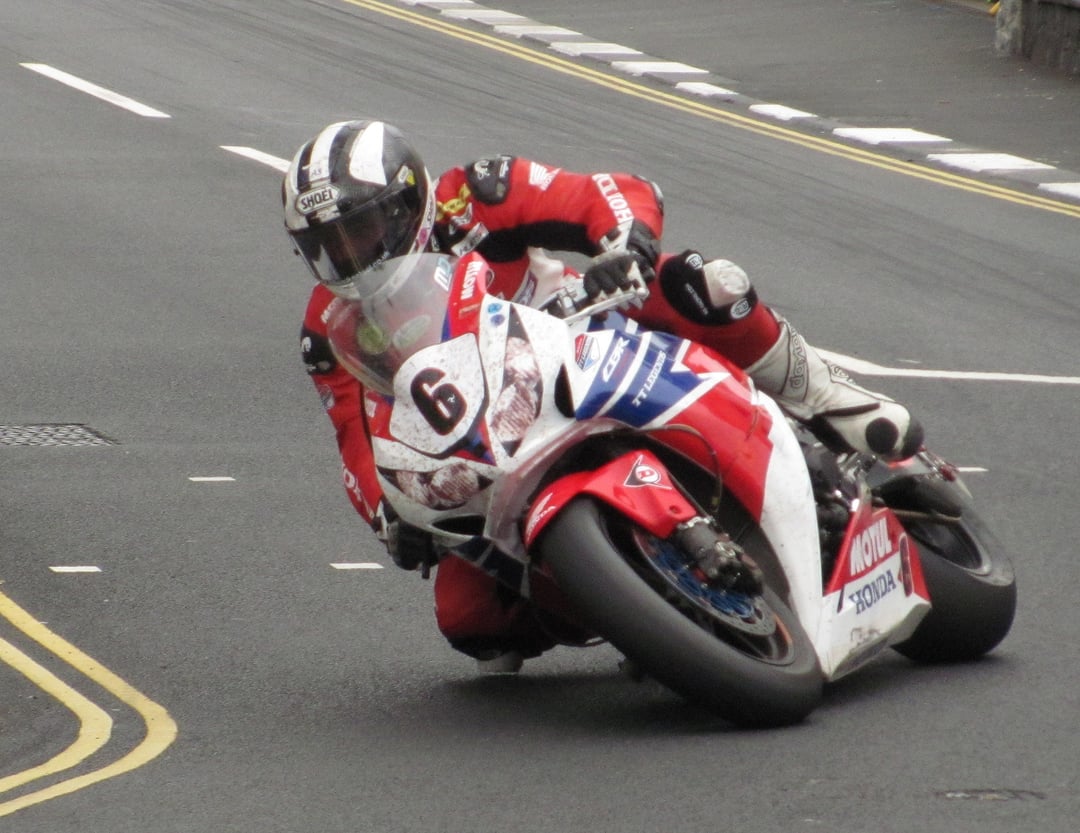
- Racing, The Isle of Man TT and the Manx Grand Prix. The race began in 1907 on the St John's Short Course and moved to the 37 and three quarter mile Snaefell Mountain Course in 1911, which is a public road closed for the occasion and has never been a purpose-built circuit. Held to roughly a tenth of this archive on purpose, because the island is not a racetrack. On the deaths, which are real and heavily quoted: the large published figure covers the entire Mountain Course including the Manx Grand Prix and the Clubman TT rather than the TT alone, the lists separate competitors from officials, marshals and spectators, and no organisation maintains an authoritative count. This archive states scope rather than a bare number, and carries the memorials rather than the crashes.
- Internment, Twice in the twentieth century Britain interned civilians on this island. Knockaloe near Peel held on the order of twenty thousand men in the First World War and was effectively a town. In the Second World War the camps were requisitioned boarding houses with wire around them: Rushen at Port Erin and Port St Mary, which was the women's camp and unlike anything else in the system; Hutchinson in Douglas, which became known as the artists' camp and held Kurt Schwitters and Hellmuth Weissenborn among others; and Mooragh, Central Promenade and Peveril. Many of those interned as enemy aliens were Jewish refugees who had fled Nazism, which is the fact the whole subject turns on. The Arandora Star, carrying internees for deportation, was torpedoed in July 1940. Treated here as documentary record, never as spectacle.
- Gaelg, The Manx language, the largest segment in this archive because it is the island's most distinctive thing and because Manx speakers have put a great deal of it online themselves. Gaelg is a Goidelic language, sister to Irish and Scottish Gaelic, written with a spelling system based on Elizabethan English rather than classical Gaelic orthography, which is why it looks so unlike its relatives on the page. Ned Maddrell, the last native speaker from a Manx-speaking community, died on 27 December 1974. In 2009 UNESCO classified the language as extinct while hundreds of people spoke it, the linguist Jennifer Kewley Draskau objected publicly, and the classification was later revised to critically endangered. Around 2,223 people reported conversational ability in 2021, and the Bunscoill Ghaelgagh at St John's teaches children through the medium of Manx.
- Railways, An unusual survival: the island kept its Victorian transport when everywhere else scrapped it. The Isle of Man Steam Railway still runs steam to Port Erin, the Manx Electric Railway has been working since the 1890s with original tramcars, the Snaefell Mountain Railway climbs to the summit, and the Douglas horse tramway still runs along the promenade. Also the Groudle Glen Railway, the stations and sheds, and the rolling stock that would be in a museum anywhere else and is in daily service here.
- Mining, Lead, zinc, silver and copper, and the engineering that drained the workings. The Great Laxey Wheel, Lady Isabella, built in 1854 to pump water from the Laxey mines and still the largest working waterwheel in the world. Foxdale, the Snaefell mine, the adits and engine houses and washing floors, the mine railway, and the spoil that is still in the landscape. For a few decades in the nineteenth century this small island was a serious producer of zinc ore.
- Coast, The sea on every side, and the wildlife that comes with it. The Calf of Man and its bird observatory, Manx shearwaters, choughs, razorbills and kittiwakes, basking sharks in summer, seals, the Sound, Langness, the Point of Ayre, Spanish Head and the Chicken Rock lighthouse. The whole island is a UNESCO Biosphere Reserve, the only entire jurisdiction to hold that status. Also Raad ny Foillan, the coastal path that goes all the way round, and the herring fishery that the island lived on before it lived on visitors.
- Music, Added after the first build, because music had been scattered through folklore and language and deserved a home. Manx traditional song and tune, much of it sung in Gaelg: Arrane Oie Vie and the carvals, the island's own carol tradition. The dance sides Perree Bane and Ny Fennee, and Yn Chruinnaght, the inter-Celtic festival where the island meets Ireland, Scotland, Wales, Cornwall and Brittany. Fiddle, harp and the Manx bagpipe revival, sessions in pubs, the choirs and the Manx Music Festival that everyone calls the Guild, and the Manx Folk Awards where the children compete. Then the living end of it: Ruth Keggin singing in Manx, and Davy Knowles from Port St Mary playing blues. Culture Vannin has put more of this online than anyone, which is why so much of this segment comes from them.
…and 1,174 more moments. Full text archive: /loreline-text/isle-of-man.md