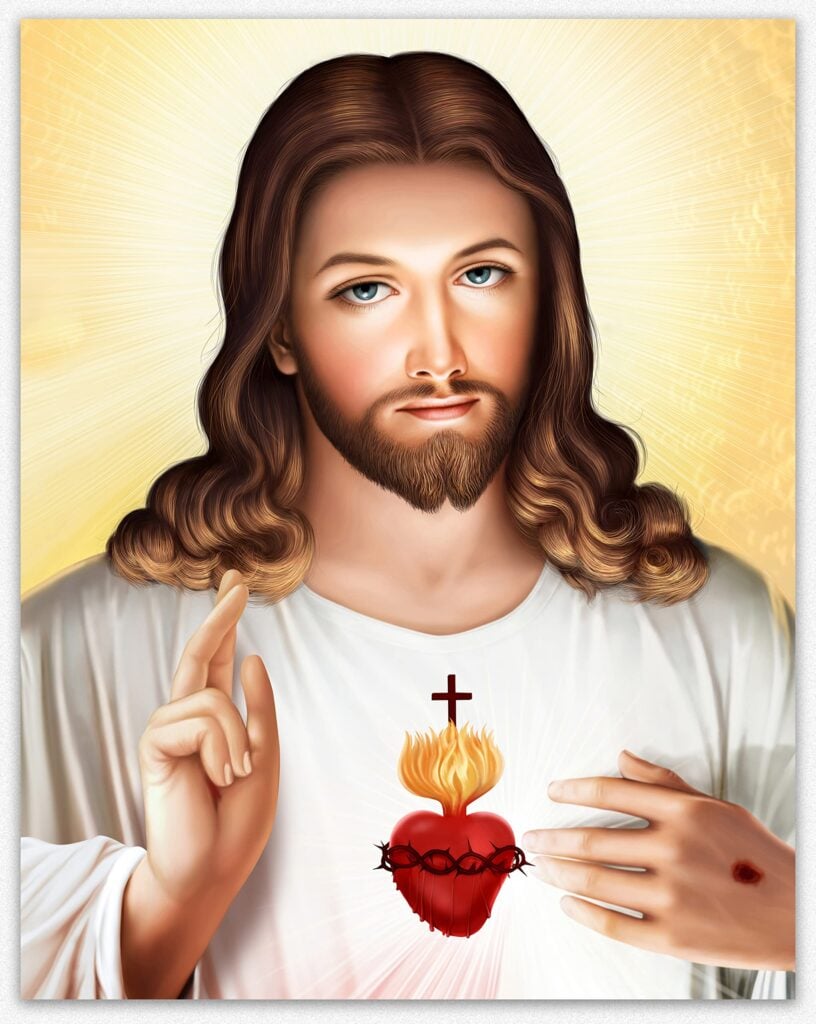
Jesus
The life of Jesus of Nazareth told entirely through real artifacts, texts and art — from the Dead Sea Scrolls and the earliest catacomb frescoes to the masterpieces of Giotto, Leonardo, Caravaggio and Michelangelo. Every scene is a genuine object or painting, ordered through the Gospel story from the Nativity to the Resurrection.
A chronological documentary of 68 moments spanning 1250–21136 on Loreline.
last updated 2026-07-21
Eras
- Relics, Texts & Earliest Images — The physical trail Jesus left in history: the scrolls of his world, the stone that names Pilate, the oldest scraps of the Gospels, and the first images Christians ever made of him.
- Nativity & Childhood — The Annunciation, the birth at Bethlehem, the Magi and the flight into Egypt — the beginning of the story, as the great painters imagined it.
- Baptism & Ministry — The baptism in the Jordan, the calling of the apostles and the Sermon on the Mount — the start of Jesus's public life.
- Miracles & Teaching — Water into wine, the storm stilled, the blind healed and Lazarus raised — the wonders and parables at the heart of the Gospels.
- The Passion — The entry into Jerusalem, the Last Supper, the agony in the garden and the trial before Pilate — the last days of Holy Week.
- The Crucifixion — The road to Calvary, the cross, and the grief of the Deposition and the Pietà — the death of Christ as rendered by Grünewald, Michelangelo and Caravaggio.
- Resurrection & After — The empty tomb, the risen Christ before Mary Magdalene and Thomas, the Ascension and the promise of the Last Judgment.
- — The Dead Sea Scrolls. The scrolls found at Qumran preserve Hebrew scripture and the Jewish world into which Jesus was born, copied from the 3rd century BC. (Qumran community, c. 250 BC – 68 AD)
- — The Pilate Stone. A limestone block from Caesarea bears the name of Pontius Pilate — the only archaeological evidence of the man who condemned Jesus. (Roman, c. 26–36 AD)
- — Papyrus 52 (Rylands Library). The oldest surviving fragment of the New Testament, a scrap of John's Gospel copied around 125 AD. (Unknown scribe, c. 125 AD)
- — The Alexamenos graffito. A crude Roman graffito mocking a Christian worshipping a crucified, donkey-headed figure — the earliest known image of the Crucifixion. (Anonymous Roman, c. 200 AD)
- — Papyrus 66 (Bodmer). A near-complete early codex of John's Gospel, one of the oldest substantial New Testament manuscripts. (Unknown scribe, c. 200 AD)
- — The Dura-Europos house church. The oldest known Christian house church, in Syria, holds the earliest datable images of Jesus healing and walking on water. (Anonymous, c. 240 AD)
- — The Good Shepherd fresco. In the Catacombs of Rome, Christ appears not crucified but as a young shepherd carrying a lamb — the earliest Christian art. (Anonymous, c. 250 AD)
- — The Codex Sinaiticus. One of the two oldest complete Bibles, this 4th-century Greek manuscript is among the greatest treasures of the British Library. (Unknown scribes, c. 350 AD)
- — The Sarcophagus of Junius Bassus. A richly carved Roman marble sarcophagus of 359 AD showing scenes from the life of Christ. (Roman workshop, 359 AD)
- — The Christ Pantocrator of Sinai. The oldest surviving icon of Christ, at Saint Catherine's Monastery, painted in encaustic wax in the 6th century. (Byzantine, c. 550 AD)
- — The mosaics of Ravenna. The 6th-century mosaics of Sant'Apollinare and San Vitale in Ravenna show Christ in imperial Byzantine splendour. (Byzantine, c. 550 AD)
- — The Book of Kells. An Irish illuminated Gospel book of about 800 AD, one of the most lavishly decorated manuscripts ever made. (Insular monks, c. 800 AD)
- — Relics of the True Cross. Fragments venerated as the cross of the Crucifixion have been enshrined in reliquaries across Christendom for over a millennium. (Various, medieval)
- — The Shroud of Turin. A linen cloth bearing the faint image of a crucified man, venerated as Jesus's burial shroud, first documented in 14th-century France. (Unknown, first recorded c. 1354)
- — The Adoration of the Magi. The wise men bring gold, frankincense and myrrh, in Gentile da Fabriano's gilded Gothic altarpiece. (Gentile da Fabriano, 1423)
- — The Annunciation. The angel Gabriel tells Mary she will bear the Son of God — here in Fra Angelico's serene fresco at San Marco, Florence. (Fra Angelico, c. 1440)
- — Leonardo's Annunciation. The young Leonardo da Vinci painted the Annunciation in a Tuscan garden, now in the Uffizi. (Leonardo da Vinci, c. 1472)
- — Botticelli's Adoration. Botticelli set the Magi among portraits of the Medici in this Florentine Adoration. (Sandro Botticelli, c. 1476)
- — The Nativity. The birth of Jesus in Bethlehem, in Geertgen tot Sint Jans's luminous night scene lit only by the Christ child. (Geertgen tot Sint Jans, c. 1490)
- — Christ among the Doctors. The twelve-year-old Jesus astonishes the teachers in the Temple, in Dürer's crowded panel. (Albrecht Dürer, 1506)
- — The Visitation. Mary visits her cousin Elizabeth, mother of John the Baptist, in Pontormo's radiant Mannerist panel. (Jacopo Pontormo, c. 1529)
- — The Massacre of the Innocents. Herod orders the killing of Bethlehem's infants, in Bruegel's chilling snowbound scene. (Pieter Bruegel the Elder, c. 1567)
- — The Flight into Egypt. Warned in a dream, the Holy Family flees Herod, in Caravaggio's tender Rest on the Flight into Egypt. (Caravaggio, c. 1597)
- — The Adoration of the Shepherds. Shepherds summoned by angels come to worship the newborn Christ, in Georges de La Tour's candlelit masterpiece. (Georges de La Tour, c. 1644)
- — The Temptation in the Wilderness. Christ resists the devil after forty days in the desert, in Duccio's early Sienese panel. (Duccio, c. 1310)
- — The Baptism of Christ. John baptizes Jesus in the Jordan as the Spirit descends, in Piero della Francesca's still, luminous panel. (Piero della Francesca, c. 1450)
- — Verrocchio's Baptism. on which the young Leonardo is said to have painted an angel. (Verrocchio & Leonardo, c. 1475)
- — The Calling of the Apostles. Christ calls fishermen to follow him, in Ghirlandaio's fresco in the Sistine Chapel. (Domenico Ghirlandaio, 1481)
- — The Calling of Saint Matthew. A shaft of light summons the tax collector Matthew, in Caravaggio's revolutionary canvas in Rome. (Caravaggio, c. 1600)
- — Christ the Good Shepherd. The parable of the shepherd who seeks the lost sheep, a central image of Christ's teaching, here by Murillo. (Murillo, c. 1660)
- — The Sermon on the Mount. Christ preaches the Beatitudes to the multitude, in Bloch's 19th-century Danish painting. (Carl Heinrich Bloch, 1877)
- — Christ Walking on the Water. Jesus walks across the water toward the disciples' boat, in Tintoretto's dramatic canvas. (after Schnorr von Carolsfeld, 19th c.)
- — The Feeding of the Five Thousand. Christ multiplies the loaves and fishes to feed the multitude, in a Bloch painting. (Various, )
- — The Raising of Lazarus. Christ calls the dead Lazarus from the tomb, in Sebastiano del Piombo's monumental altarpiece. (Sebastiano del Piombo, c. 1519)
- — The Transfiguration. Christ is transfigured in glory before three disciples, in Raphael's final, unfinished masterpiece. (Raphael, 1520)
- — The Wedding at Cana. Christ turns water into wine, in Veronese's vast, crowded Venetian banquet now in the Louvre. (Paolo Veronese, 1563)
- — Healing the Blind. Christ restores sight to the blind man, in El Greco's luminous early canvas. (El Greco, c. 1570)
- — Christ in the Storm. Christ calms the sea as terrified disciples cling to the boat, in Rembrandt's only seascape. (Rembrandt, 1633)
- — The Kiss of Judas. Judas betrays Christ with a kiss, in Giotto's face-to-face confrontation at Padua. (Giotto, c. 1305)
- — The Entry into Jerusalem. Christ rides into Jerusalem to shouts of Hosanna, in Giotto's fresco in the Arena Chapel, Padua. (Giotto, c. 1305)
- — The Agony in the Garden. Christ prays in Gethsemane as his disciples sleep, in Mantegna's stony, visionary panel. (Andrea Mantegna, c. 1460)
- — The Flagellation of Christ. Christ is scourged, in Piero della Francesca's coolly geometric and mysterious panel. (Piero della Francesca, c. 1460)
- — The Last Supper. Christ shares the Passover meal and foretells his betrayal, in Leonardo da Vinci's mural in Milan. (Leonardo da Vinci, 1495–1498)
- — Christ Washing the Disciples' Feet. At the Last Supper Christ kneels to wash his disciples' feet, in Tintoretto's canvas. (Tintoretto, c. 1548)
- — The Cleansing of the Temple. Christ drives the money-changers from the Temple, in El Greco's swirling composition. (El Greco, c. 1600)
- — The Taking of Christ. Soldiers seize Christ in the dark garden, in Caravaggio's electric, torch-lit canvas. (Caravaggio, c. 1602)
- — The Crowning with Thorns. Soldiers press a crown of thorns onto Christ's head, in a Caravaggio-influenced canvas. (Caravaggio, c. 1607)
- — Ecce Homo. Pilate presents the crowned and beaten Christ to the crowd — 'Behold the man' — here by Antonio Ciseri. (Antonio Ciseri, 1871)
- — Christ before Pilate. The Roman governor questions Christ, in Munkácsy's vast 19th-century canvas. (Mihály Munkácsy, 1881)
- — The Lamentation. The dead Christ is mourned, in Giotto's fresco where even the angels weep, at Padua. (Giotto, c. 1305)
- — The Descent from the Cross. Christ's body is lowered from the cross, in Rogier van der Weyden's grief-stricken masterpiece in the Prado. (Rogier van der Weyden, c. 1435)
- — The Crucifixion. Christ is crucified between two thieves, in Andrea Mantegna's stark predella panel. (Andrea Mantegna, c. 1459)
- — The Dead Christ. Mantegna's radically foreshortened dead Christ lies before the viewer, one of art's boldest images. (Andrea Mantegna, c. 1480)
- — The Pietà. The Virgin cradles her dead son, in Michelangelo's marble Pietà in Saint Peter's Basilica. (Michelangelo, 1499)
- — Christ Carrying the Cross. Christ bears the cross to Golgotha through a jeering crowd, in Bosch's nightmarish faces. (Hieronymus Bosch, c. 1515)
- — The Isenheim Crucifixion. Grünewald's harrowing, disease-ravaged Christ, painted for a hospital chapel, is one of the most powerful of all Crucifixions. (Matthias Grünewald, c. 1515)
- — Veronica's Veil. On the road to Calvary, Veronica wipes Christ's face and his image is left on the cloth, in El Greco's canvas. (El Greco, c. 1580)
- — The Entombment. Christ is laid in the tomb, in Caravaggio's monumental altarpiece now in the Vatican. (Caravaggio, c. 1603)
- — Velázquez's Christ Crucified. Velázquez painted a serene, solitary Christ against darkness, one of Spain's most revered images. (Diego Velázquez, c. 1632)
- — The Deësis of Hagia Sophia. The great Byzantine mosaic of Christ Pantocrator in Hagia Sophia, Istanbul, gazes out in majesty. (Byzantine, c. 1261)
- — The Resurrection. Christ rises from the tomb above sleeping soldiers, in Piero della Francesca's austere fresco at Sansepolcro. (Piero della Francesca, c. 1465)
- — Salvator Mundi. Christ as Saviour of the World blesses and holds a crystal orb, in the composition attributed to Leonardo. (attrib. Leonardo da Vinci, c. 1500)
- — Noli me tangere. The risen Christ appears to Mary Magdalene in the garden — 'Do not hold on to me' — in Titian's tender canvas. (Titian, c. 1514)
- — The Last Judgment. Christ returns in glory to judge the living and the dead, in Michelangelo's overwhelming Sistine fresco. (Michelangelo, 1541)
- — Pentecost. Tongues of fire descend on the disciples fifty days after Easter, in El Greco's soaring canvas. (El Greco, c. 1600)
- — The Supper at Emmaus. Two disciples recognise the risen Christ as he breaks bread, in Caravaggio's startling London canvas. (Caravaggio, 1601)
- — The Incredulity of Thomas. Doubting Thomas probes Christ's wound, in Caravaggio's unflinching close-up. (Caravaggio, c. 1602)
- — The Ascension. Christ ascends into heaven before his disciples, in Rembrandt's luminous canvas. (Rembrandt, 1636)
Full text archive: /loreline-text/jesus.md