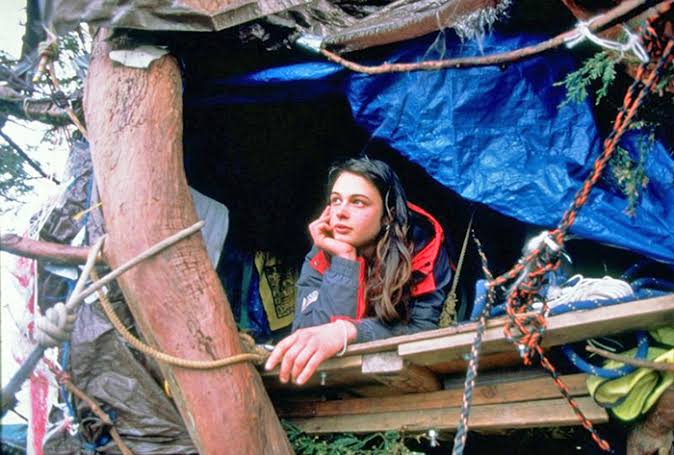
Julia Butterfly Hill
The activist who climbed a 1,500-year-old coast redwood named "Luna" in December 1997 and refused to come down for 738 days — through winter storms, an El Niño, helicopters and harassment — to stop the Pacific Lumber Company from cutting it down. When she finally descended in December 1999, Luna and a buffer of forest were saved for good. The story of one of the most remarkable acts of environmental protest ever undertaken.
A chronological documentary of 33 moments spanning 1915–2025 on Loreline.
last updated 2026-07-16
Eras
- Roots & the Awakening — Born in 1974 and raised partly on the road by a travelling preacher father, Julia Hill was a young Arkansas woman with no activist background — until a near-fatal 1996 car crash and a long recovery made her reconsider her life and led her, in 1997, to the ancient redwoods of California.
- The Redwoods & Headwaters — Humboldt County’s coast redwoods are among the oldest and tallest living things on Earth. By the late 1990s the Pacific Lumber Company — taken over by the Maxxam Corporation — was clear-cutting ancient groves, and activists were fighting to save the Headwaters Forest. Julia joined the fight.
- Climbing Luna (Dec 1997) — On 10 December 1997, Julia climbed about 180 feet up a roughly 1,500-year-old redwood the activists had named "Luna", onto a tiny tarp-covered platform. She intended to stay a week or two. She would not set foot on the ground again for over two years.
- 738 Days Aloft — Through an El Niño winter of brutal storms, a company helicopter downdraft, floodlights, a siege, loneliness and a media circus, Julia lived on the platform — cooking on a single burner, doing interviews by mobile phone, becoming the global face of the redwoods.
- The Deal & Coming Down (1999) — On 18 December 1999, after 738 days, Julia descended. Pacific Lumber agreed to preserve Luna and a 200-foot buffer of surrounding trees in exchange for $50,000 raised by supporters. She had won.
- A Life of Activism — Luna was nearly killed by a chainsaw attack in 2000 but survived. Julia wrote "The Legacy of Luna", co-founded campaigns and foundations, and spent the following decades as a speaker and activist for the environment and social justice.
- — A century of redwood logging. For over a century the giant coast redwoods of Humboldt had been felled; by the 1990s only a small fraction of the original old-growth forest remained.
- — A century of redwood logging. Archival footage of mid-century redwood logging — the industry that had already felled most of the ancient groves.
- — Pacific Lumber & Maxxam. Once a relatively sustainable family firm, the Pacific Lumber Company was bought by Charles Hurwitz’s Maxxam Corporation in 1985 and dramatically accelerated clear-cutting of ancient redwoods to service debt.
- — Maxxam & Charles Hurwitz. The corporate raider whose leveraged buyout of Pacific Lumber drove the accelerated clear-cutting of ancient redwoods.
- — Clear-cutting beside the giants. A NARA photograph: within a mile of magnificent old-growth redwoods, some of the worst clear-cutting in California — the destruction the activists fought.
- — Judi Bari & Redwood Summer. Earth First! organiser Judi Bari, nearly killed by a car bomb in 1990, led the redwood-defence movement Julia joined.
- — The tallest trees on Earth. Coast redwoods are the tallest living things on the planet — and the giants Julia fought to protect were among the oldest.
- — The Headwaters protests. Throughout the 1990s, Earth First! and other activists staged rallies, blockades and tree-sits to defend the Headwaters redwoods — the movement Julia joined.
- — Life on the platform. Two small platforms, a single propane burner, a sleeping bag and a solar-charged mobile phone. From here Julia would live, eat, sleep and campaign — never touching the ground.
- — The El Niño storms (winter 1997–98). Julia survives one of the worst El Niño winters on record — 40-mph winds, freezing rain and storms that nearly tore her from the tree. She lashes herself to Luna and refuses to come down.
- — Inside the Headwaters Forest Reserve. A walk through the Headwaters Forest Reserve, the old-growth redwoods at the centre of the fight.
- — Coming down — 18 December 1999. After 738 days, Julia’s feet touch the ground for the first time in over two years. She has saved the tree she lived in, and become one of the most famous environmental activists in the world.
- — Luna survives a chainsaw attack (2000). In late 2000 a vandal cuts more than halfway through Luna’s trunk with a chainsaw. Arborists and steel bracing save the tree; it still stands today.
- — The movement carries on. Tree-sitters mark an anniversary — Julia’s 738 days became a template for forest defence across the West.
- — The tree-sit movement lives on. Julia’s 738-day sit inspired a generation of tree-sitters defending forests across California and beyond.
- — Sentinels — the tree-sitters. A portrait of the tree-sitting activists who, like Julia, put their bodies between the chainsaws and the forest.
- — Born Julia Lorraine Hill (1974). Julia Lorraine Hill is born in Mount Vernon, Missouri, the daughter of a travelling evangelist; much of her childhood is spent on the road. Her nickname "Butterfly" comes from a butterfly that landed on her as a child. The subject dates from 1974; this photograph was taken in 2006.
- — The deal to save Luna. An agreement is reached: Pacific Lumber will permanently preserve Luna and a roughly 200-foot buffer of surrounding forest; supporters raise $50,000, which the activists frame as restitution donated to a university forestry program. The subject dates from 1999; this photograph was taken in 2006.
- — The ancient giants. Coast redwoods like the "Lost Monarch" are among the largest and oldest living things on Earth — the kind of tree Luna was. The subject dates from 1995; this photograph was taken in 2008.
- — The car crash & the awakening (1996). A drunk driver rear-ends Julia’s car; the steering wheel lodges in her skull and recovery takes nearly a year. The brush with death makes her re-examine her life and its purpose. The subject dates from 1996; this photograph was taken in 2009.
- — "The Legacy of Luna" (2000). Julia tells the full story in her best-selling book "The Legacy of Luna", and follows it with "One Makes the Difference" — turning her experience into a message for others. The subject dates from 2000; this photograph was taken in 2009.
- — The Headwaters Forest. in Humboldt County held some of the last unprotected old-growth redwoods. Its fate was the centre of one of the era’s biggest environmental battles. The subject dates from 1996; this photograph was taken in 2010.
- — Decades of activism & speaking. Julia co-founds campaigns and foundations and spends the following decades as a sought-after speaker and activist for the environment, sustainability and social justice.
- — Avenue of the Giants. The old-growth groves of Humboldt — the cathedral forest Julia walked into and resolved to defend. The subject dates from 1997; this photograph was taken in 2012.
- — Humboldt Redwoods. The Humboldt redwoods — the landscape and the stakes of the fight for the ancient forest. The subject dates from 1997; this photograph was taken in 2013.
- — Climbing Luna — 10 December 1997. Julia volunteers for a tree-sit and climbs roughly 180 feet up "Luna", an ancient redwood the activists had named, onto a 6-by-8-foot platform under a tarp. She plans to stay a couple of weeks. The subject dates from 1997; this photograph was taken in 2014.
- — First sight of the redwoods (1997). On a journey west, Julia walks into an ancient redwood grove for the first time and is overwhelmed — describing it as walking into a cathedral. She decides to give herself to protecting them. The subject dates from 1997; this photograph was taken in 2014.
- — Visiting Julia in her treehouse. Years later, a visit with Julia Butterfly Hill at home — still living close to the trees.
- — The Headwaters Reserve protected. After years of struggle, the Headwaters Forest Reserve was established in 1999 — the campaign Julia’s sit became the symbol of. The subject dates from 1999; this photograph was taken in 2015.
- — The forest from above. The Headwaters Forest — the wider ecosystem a single saved tree, Luna, came to stand for. The subject dates from 1998; this photograph was taken in 2016.
- — Julia’s reflections — "Where have all the humans gone?". Julia reflects, in her own words, on connection, the planet and what her time in Luna taught her.
- — The face of the redwoods. As months stretched on, Julia became a global symbol — interviewed worldwide, visited by celebrities and journalists, turning a single tree into the centre of the fight for the ancient forests.
- — Still in the trees. Decades on, Julia Butterfly Hill remains an advocate — for forests, for treehouses and living lightly, and for the idea that one person’s stubborn love can change the world.
Full text archive: /loreline-text/julia-butterfly-hill.md