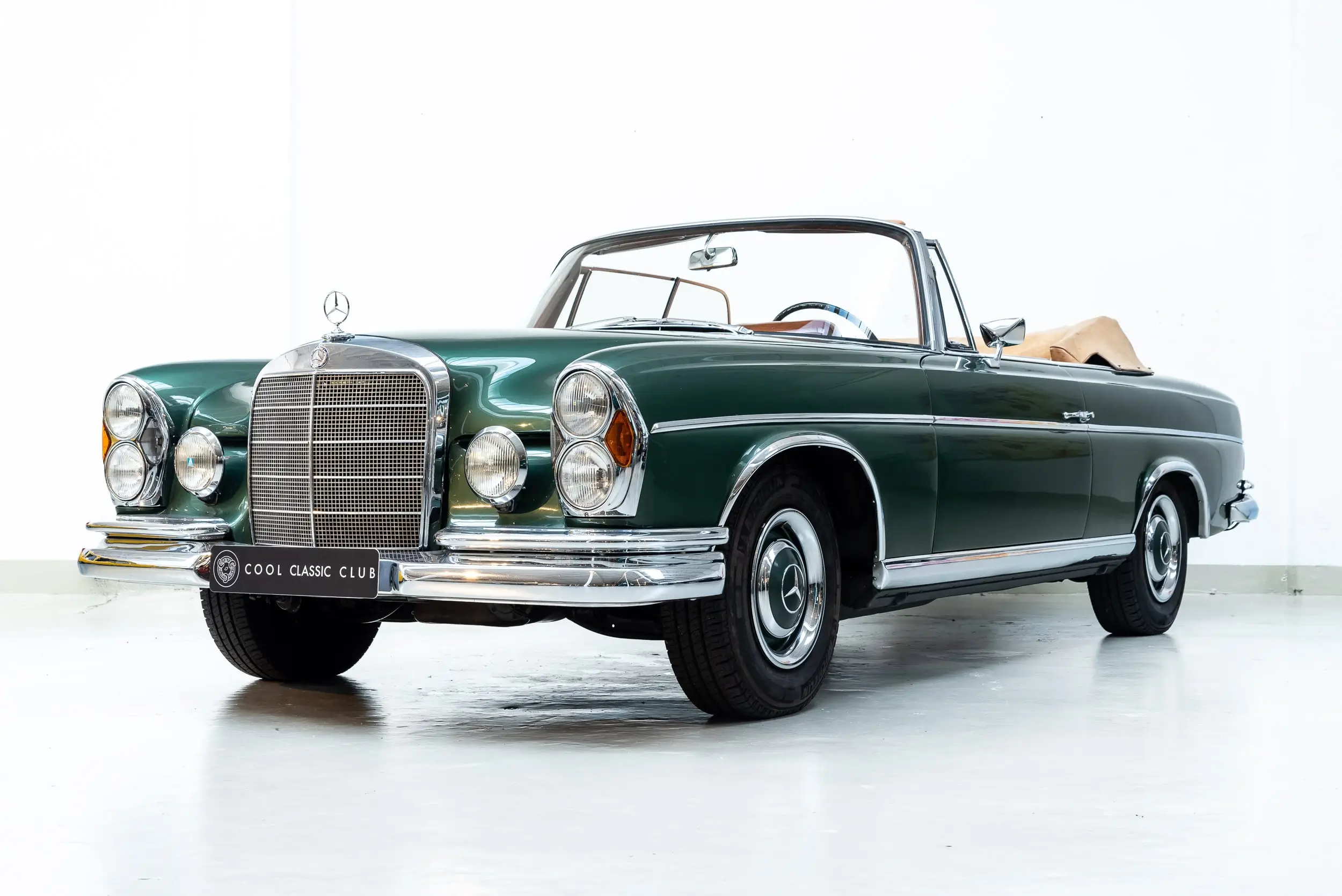
Mercedes-Benz
The complete story of Mercedes-Benz, from the 1886 Benz Patent-Motorwagen, the first automobile, through the pre-war Silver Arrows, the post-war icons like the 300SL Gullwing and the S-Class, the birth of AMG, decades of Grand Prix and Formula One dominance, to the electric era. The oldest car company in the world, and one of the most influential.
A chronological documentary of 1,240 moments spanning 1886–2026 on Loreline.
Curated by Olivier · last updated 2026-09-20
Eras
- Patent-Motorwagen, The first car. Karl Benz's three-wheeler patented in January 1886, Bertha Benz driving it 106 kilometres to Pforzheim without telling him and inventing the road trip and the brake lining on the way, Daimler and Maybach's engine, and the machines that came in the first two decades.
- Blitzen Benz and SSK, Brass-era speed. The 200-horsepower Blitzen Benz taking the land-speed record in 1909, the Targa Florio cars, the supercharged S, SS and SSK models of the twenties, and the Kompressor whine that announced them.
- Silver Arrows, The Grand Prix cars of the thirties. The W25, W125 and W154, the paint reportedly scraped off to make the weight limit, Rudolf Caracciola and Bernd Rosemeyer, the duels with Auto Union, and the state money and politics behind all of it.
- Fangio, Juan Manuel Fangio. Five world championships, the W196 with its enclosed streamliner bodywork, the 1957 Nürburgring drive that is still argued to be the greatest ever, and the years when Mercedes won by simply arriving.
- Le Mans and DTM, Closed-wheel racing. The 1952 Le Mans win and the 1955 disaster that ended the programme, the Sauber-Mercedes C9, the CLK GTR and its flip at the Ford chicane, the AMG GT3, and the C-Class touring cars of the DTM.
- Formula One, Back in Grand Prix racing as a works team. The engine deals with McLaren and Brawn, the Brackley and Brixworth operations, the hybrid era and eight straight constructors' titles, Hamilton and Rosberg racing each other, and the seasons since.
- 300SL Gullwing, The car with the doors. A racing spaceframe that forced the hinges onto the roof, direct fuel injection on a road car in 1954, the roadster that followed, and the object that is now among the most valuable cars in existence.
- SL and Coupes, The grand tourers. The Pagoda, the R107 that ran for eighteen years, the later SLs, the SLK and SLS and SLR, the CLK and CLS, the two-doors bought for the way they look.
- S-Class, The car where the technology arrives first. The W116 and the first production anti-lock brakes, the W126, airbags, the W140's over-engineering, the Maybach-badged versions, and the saloon that every rival benchmarks against.
- E-Class, The middle of the range and the backbone of the company. The Ponton and the Fintail, the W123 that ran a million kilometres, the W124, the four-headlamp W210, and the estates, taxis and diesels that did the actual work.
- C-Class and Compacts, The smaller cars. The 190E and its Cosworth engine, the C-Class through five generations, the A-Class and its elk-test rollover, the CLA, and Smart, Mercedes learning to build something cheap.
- G-Class and SUVs, Off-road and the SUVs that followed. The G-Wagen built for the military since 1979 and barely restyled since, the ML that opened the American plant, the GLA, GLC and GLE, and the point at which the range became mostly high-riding.
- Unimog, The universal machine. A farm tractor that turned into the vehicle you send where roads do not exist, portal axles, extreme articulation, fire and forestry and expedition versions, and the cult that grew around it.
- Trucks and Buses, The commercial side, which is most of the company by volume. The Actros and the long-distance haulage business, the Citaro and the city bus, the Sprinter's ancestors, and the vehicles that carry everything else.
- Vans, The working boxes. The Sprinter, Vito and Viano, the panel vans and the campers built on them, plus the ambulances and the coachbuilt conversions.
- Maybach, The luxury name, twice. Wilhelm Maybach's original cars and the enormous prewar Zeppelin, the 57 and 62 revival of the 2000s that never sold, and the Mercedes-Maybach badge that finally made it work.
- Engines, What is under the bonnet. The overhead cam and the supercharger, direct injection, the diesel that Mercedes put in a passenger car first, the V8s and the V12, AMG's one-man-one-engine assembly, and the hybrids.
- AMG, Affalterbach. Two engineers leaving Daimler in 1967 to tune the cars themselves, the Red Pig at Spa, the Hammer, the buyout, and the badge that turned into the performance division with its own engines and its own factory.
- Factory Floor, How they are actually built. Untertürkheim and Sindelfingen, the press shop and the body-in-white line, the robots and the people working alongside them, paint, final assembly, and the plants outside Germany.
- Crash Testing and Safety, The engineering nobody sees until they need it. Béla Barényi's crumple zone patented in 1951, the rigid passenger cell, the sled and the barrier, the dummies, ABS and the airbag, ESP after the elk test, and the accident research team.
- Concept Cars, Ideas built once. The show cars and design studies, the aerodynamic record-breakers, the C111 in orange, the Vision series, the interiors that never reached production, and the design studio where the shapes start.
- Electric Cars, The change of powertrain. The EQ range and the dedicated platform, the batteries and where they come from, the charging network, the Vision EQXX driving a thousand kilometres on one charge, and the plants being retooled for it.
- Advertising, How the cars were sold. The print campaigns and the television spots, the star in the badge, the showroom, the motor-show stands, and Janis Joplin asking the Lord for one, which they later used to sell them.
- Museum, The company looking at itself. The Stuttgart museum's double-helix ramp, the collection and the restoration workshops, the classic centre, the anniversaries, and the documentaries and retrospectives about the marque.
- DaimlerChrysler, The merger of equals that was not. The 1998 deal with Chrysler, the culture clash, the losses, the 2007 sale to Cerberus, and what the episode cost the company in the decade it lasted.
- - The Benz Patent-Motorwagen (1886). Carl Benz patents the Benz Patent-Motorwagen in Mannheim, a three-wheeled, single-cylinder vehicle widely regarded as the first true automobile. The birth of the car.
- - Daimler's motorised carriage (1886). Working separately near Stuttgart, Gottlieb Daimler and Wilhelm Maybach fit a high-speed petrol engine to a carriage, the first four-wheeled automobile.
- - Bertha Benz's long-distance drive (1888). Bertha Benz drives the Motorwagen 106 km from Mannheim to Pforzheim and back, the first long-distance automobile journey, proving the car to a sceptical world.
- - The Mercedes 35 hp & the name (1901). The Mercedes 35 hp, built by DMG and named after Mercédès Jellinek (daughter of dealer Emil Jellinek), is hailed as the first modern motor car. The "Mercedes" name is born.
- - The Blitzen Benz (1909). The Blitzen Benz set a land-speed record over 228 km/h, for years the fastest vehicle on earth.
- - The three-pointed star (1909). Daimler registers the three-pointed star, land, sea and air, as its trademark. It becomes one of the most recognised emblems in the world.
- - Daimler-Benz is formed (1926). Facing post-WWI economic crisis, Daimler and Benz merge to form Daimler-Benz AG, and the marque "Mercedes-Benz", combining the star and the laurel.
- - The Mercedes-Benz SSK (1928). The supercharged SSK, designed by Ferdinand Porsche, is one of the fastest and most fearsome sports cars of its age, a pre-war icon.
- - The SSKL & Caracciola (1931). Caracciola won the 1931 Mille Miglia in the lightened, supercharged SSKL, the first non-Italian to do so.
- - The W25 & the Silver Arrows legend (1934). The legend says the W25 was scraped to bare aluminium to meet a weight limit, creating the "Silver Arrows". It launched a decade of Grand Prix dominance.
- - Rudolf Caracciola - the rain master. Caracciola, Mercedes' greatest pre-war driver, took three European Championships in the Silver Arrows.
- - The rivalry with Auto Union. The state-backed duel between Mercedes' Silver Arrows and Auto Union's mid-engined cars defined 1930s racing.
- - Silver Arrows - pre-war Grand Prix footage. Archive footage of the supercharged 1930s Silver Arrows.
- - 1937 Tripoli Gran Prix Lang Scores Victory for Mercedes-Benz. 1937, but wins weren't easy to come by for the junior member of the Mercedes-Benz team. He was driving with Caracciola, who was the team leader at Mercedes and Manfred von Brauchitsch.
- - The W125 - 600 hp of fury (1937). The supercharged W125 produced around 600 hp, a power figure not matched in Grand Prix racing for decades. Rudolf Caracciola took the championship.
- - 1938 Mercedes-Benz Speed Record by European Drivers’ Champion Rudolf Caracciola. 28, 1938, Rudolf Caracciola (the 1935 and 1937 European Drivers’ Champion) broke Bernd Rosemeyer's speed record in a a heavily modified Mercedes-Benz W125 Grand Prix racer with a 725 horsepower, twin-supercharged 5.6-liter V-12 engine, and the ability to race a mile in just 13.4 seconds.
- - 1938 Swiss Gran Prix won by Rudolph Caracciola Mercedes-Benz. 1] (30 January 1901 -- 28 September 1959), more commonly Rudolf Caracciola (pronounced [ʁuːdɔlf kaʁaːtʃiːɔlɑ]), was a racing driver from Remagen, Germany.
- - 1938 Land Speed Trial Caracciola for Mercedes-Benz. 't ready to give up just yet. In January of 1938 another record week was set up. First off was Rudolf Caracciola in his Mercedes.
- - The Silver Arrows drivers. Caracciola, von Brauchitsch, Lang and Seaman were the stars of the all-conquering Mercedes team.
- - 1939 German Gran Prix Caracciola for Mercedes-Benz. 1939, the German GP was run on July 23 at the Nurburgring. Rudolph Caracciola won but it was Hermann Lang's year. This was one of the last races for the Championship before the outbreak of the War.
- - The 300SL "Gullwing" (1954). The 300SL, with its upward-opening "gullwing" doors and fuel injection, becomes one of the most beautiful and desirable cars ever built, born from a racing sports car.
- - Juan Manuel Fangio - five-time champion. Fangio, the greatest driver of his era, won two of his five titles for Mercedes in the W196.
- - Fangio & the W196 - race footage. Juan Manuel Fangio and the W196 in period Grand Prix footage.
- - The 300SLR & the 1955 Le Mans disaster. The 300SLR dominated sports-car racing, but at Le Mans 1955 one crashed into the crowd, killing 83, the worst disaster in motorsport history. Mercedes withdrew from racing for decades.
- - The 1955 Le Mans disaster. A documentary account of motorsport's worst tragedy and Mercedes' withdrawal.
- - Stirling Moss & the Mille Miglia (1955). Stirling Moss won the 1955 Mille Miglia in the 300 SLR with navigator Denis Jenkinson, a legendary drive. The subject is from 1955; this photograph was taken in 1958.
- - The 300 SL Roadster (W198). The open-top version of the Gullwing kept the 300 SL legend alive into the early 60s. The subject is from 1957; this photograph was taken in 1961.
- - 75 Year Jubilee Of Daimler-Benz (1961). ). Stuttgart, Germany. VS both MS and CU of vintage Daimler-Benz cars. GV Hall with the Mercedes star above platform. CU speaker (paperwork suggests this may be the Minister of Economics, Professor Ludwig Erhard). Mute FG FILM ID:2982.08 FOR LICENSING ENQUIRIES VISIT.
- - Mercedes-Benz buses (O302). Mercedes was a dominant force in coaches and city buses worldwide.
- - New Mercedes On Show (1969). ). Federal Republic of Germany (Western Germany). Various static shots from all angles of the parts of new Mercedes-Benz C 111 prototype sports car. Gull wing doors and engine are seen. Group of men around the car, observing it.
- - The W116 - the first "S-Class" (1972). The W116 was the first Mercedes officially called "S-Class", and the first car with ABS as an option.
- - The W165 - built to win Tripoli. 1974.
- - The W196 & Fangio (1954). Mercedes returns to Grand Prix racing with the W196; Juan Manuel Fangio wins back-to-back world championships. The streamlined version remains iconic. The subject is from 1954; this photograph was taken in 1976.
- - Mercedes Benz W123 "Star Drive 1976" Promotional Documentary Video and Rare Footage
- - Mercedes-Benz vintage commercial. A vintage Mercedes-Benz advertisement.
- - Mercedes-Benz 1x90 ‘Like no other car’ 1988. 1988.
- - Ad - 190E "He's Driving There?" (1988). A period American TV commercial for the compact 190E.
- - The Sauber-Mercedes C9 wins Le Mans (1989). The silver Sauber-Mercedes C9 won the 1989 Le Mans 24 Hours, reviving the Silver Arrows name in sportscars.
- - Mercedes Werbung 1990 Willkommen zu Hause
- - Mercedes TV Commercial 1990 "Engineered Like No Other Car in the World". ". Period footage from 1990.
- - W201 Mercedes Benz TV Commercial 1990. /charles.chomka @charles.chomka to see more retro MB videos. MB accessories/digital prints:.
- - Mercedes-Benz S-Klasse Werbung 1991. 5 Mio Testkilometer.
- - 1992 Macau Touring Car Race - Mercedes 190E Evo - BMW M3 Evo - Screensport
- - Mercedes-Benz Werbung 1992. 1992.
- - Ad - Janis Joplin "Mercedes Benz". A Mercedes TV spot built around Janis Joplin's famous a-cappella "Oh Lord, won't you buy me a Mercedes-Benz".
- - Mercedes E-Klasse Werbung 1995. 1995.
- - Ad - the A-Class arrives (1997). A period TV commercial launching the original A-Class.
- - Ad - SLK "Birthday Present". A late-90s commercial for the folding-hardtop SLK.
- - 1997 FIA GT Championship - Mercedes-Benz CLK GTR
- - Mercedes CLK, FIA GT Meister 1998
…and 1,190 more moments.
Full text archive: /loreline-text/mercedes-benz.md