USS Monitor
1862
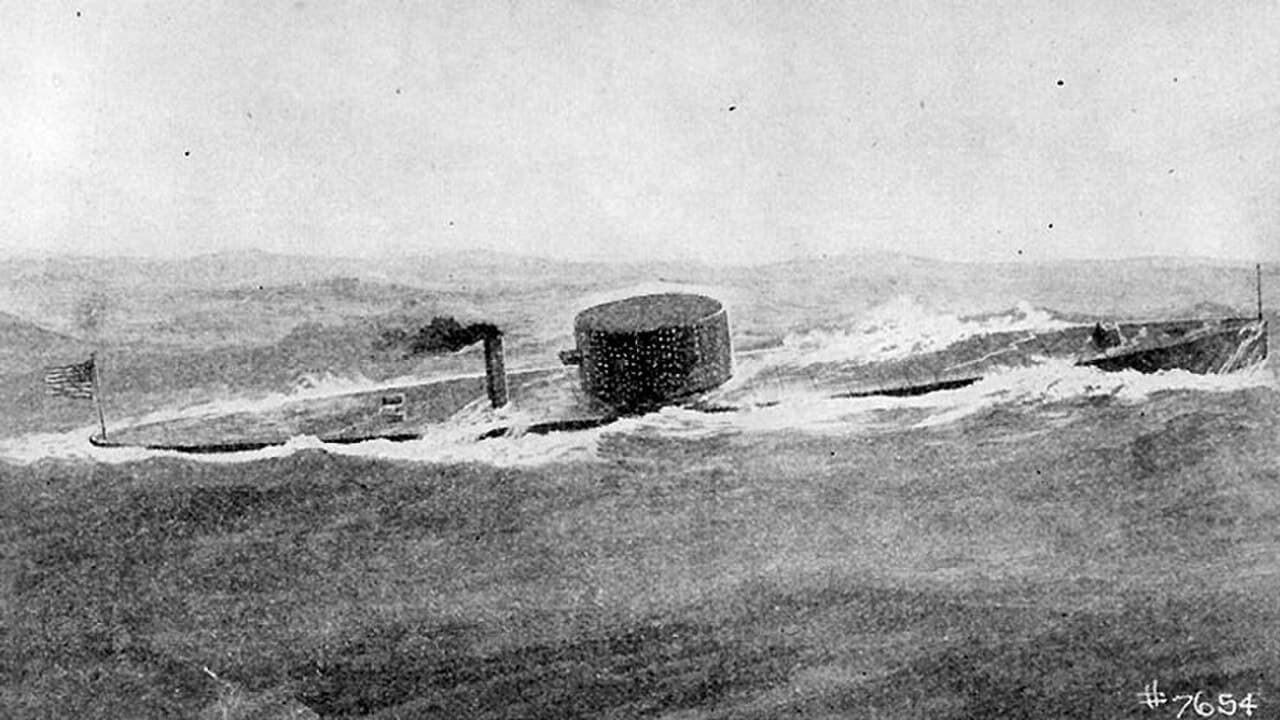
Cape Hatteras, the ironclad that ended sail Location: off Cape Hatteras, North Carolina · Coordinates: 35.00°N 75.40°W · Casualties: 16 · Survivors: 47 · Depth: 70 m · Cause: storm · foundered — Foundered under tow on the night of 31 December 1862 in a Cape Hatteras gale while en route from Hampton Roads to Beaufort. The low-freeboard turret ship took on water through her ventilators and rolled over. Sank in seventy metres. · Fate: turret raised 2002 · Mariners' Museum · Type: ironclad · turret warship · Tonnage: 987 tons · Crew: 63 · Flag: United States · Union · Launched: 1862 Union Navy ironclad, revolutionary low-freeboard turret ship (a cheesebox on a raft, as her detractors called her). Fought CSS Virginia to a draw at Hampton Roads in March 1862 and ended the age of wooden-hulled naval warfare in a single afternoon. Foundered in a storm off Cape Hatteras on New Year's Eve 1862: 16 dead, 47 rescued by USS Rhode Island. Discovered in 1973 and her turret raised in 2002, now on display at the Mariners' Museum in Virginia. The Vessel USS Monitor was the first ironclad warship commissioned by the United States Navy, designed by the Swedish-American engineer John Ericsson and built by the Continental Iron Works at Greenpoint, Brooklyn, between October 1861 and February 1862. She was 53 metres long, 987 tons displacement, with a low-freeboard armoured hull protecting an 18-inch iron-plated cylindrical revolving gun turret mounting two 11-inch Dahlgren smoothbore guns. Her design was the most radical warship concept of the nineteenth century. Ericsson's hull sat so low in the water that her main deck was only 45 centimetres above the waterline; her superstructure consisted of the turret and a small armoured pilothouse forward. She had no masts, no sails, no sides above the waterline to speak of. Her critics called her "a cheesebox on a raft". Her construction was funded under a Congressional emergency appropriation with the specific mission of countering the Confederate ironclad CSS Virginia (formerly USS Merrimack), which was known to be under conversion at Portsmouth, Virginia. She was commissioned under Lieutenant John Lorimer Worden on 25 February 1862, crewed by 58 Union Navy volunteers, and despatched south to Hampton Roads under tow by the steam tug Seth Low on 6 March 1862. She had not been sea trialled. Her crew had not trained in her turret mechanism. She was, as Worden described her in his letter to his wife, "the oddest ship in creation, and likely to go down in any weather at all". The Disaster Her end came in the winter. On 29 December 1862 she was ordered south from Hampton Roads to Beaufort, North Carolina, to support a Union amphibious operation against Wilmington. She was taken in tow by the sidewheel steamer USS Rhode Island and departed Fort Monroe that morning. The weather forecast was clear; the meteorology of 1862 did not yet identify rapidly-developing southeastern storms. By the afternoon of 30 December the weather had developed into a severe Cape Hatteras storm. Monitor was pitching heavily in 5-metre head seas; her ventilator caps were being periodically overtopped, and her pump belt failed in the early evening. Worden's successor as her commanding officer, Commander John P. Bankhead, ordered the signal rockets fired from her turret to request assistance from the Rhode Island. Rhode Island launched her boats. The Monitor foundered at approximately 01:30 on 31 December 1862, twenty nautical miles southeast of Cape Hatteras, North Carolina. Her low-freeboard hull had been unable to maintain the seakeeping margin required by Hatteras's weather; she filled through the ventilators, the engine-room hatch, and eventually the turret itself, and settled in 70 metres of water. Sixteen of her 63-man crew went down with her; the Rhode Island's boats pulled forty-seven out of the storm.
Source: naufragia.app
Part of Shipwrecks · Watch in the documentary