USS Indianapolis
1945
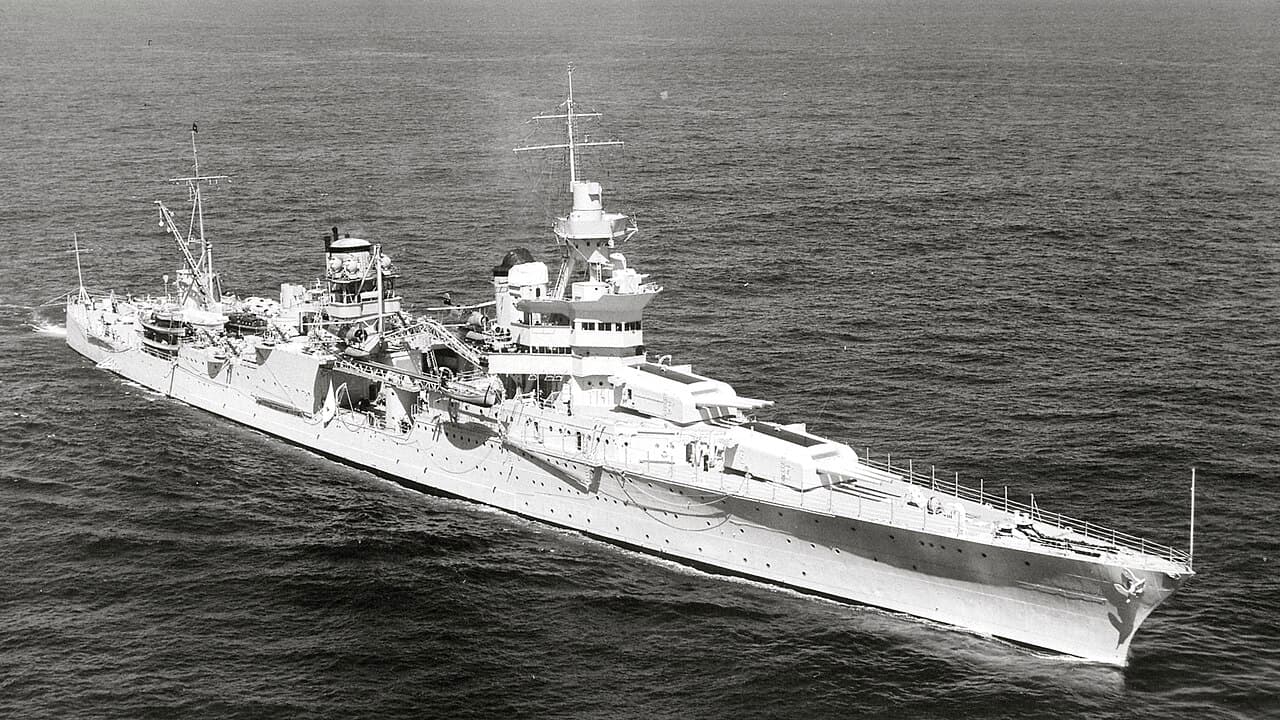
Delivered the bomb, then the sharks Location: Philippine Sea, between Guam and Leyte · Coordinates: 12.03°N 134.80°E · Casualties: ~880 · Survivors: 316 · Depth: 5,500 m · Cause: submarine torpedo — Torpedoed by Japanese submarine I-58 (Mochitsura Hashimoto, commanding) at 00:15 on 30 July 1945, four days after delivering components of the Hiroshima bomb to Tinian. Two torpedoes struck; she sank in twelve minutes. Of approximately 890 men who entered the water, only 316 were rescued four days later; the remainder died of injuries, exposure, drowning, and shark attack. · Fate: abyssal · located 2017 · Type: heavy cruiser · Portland class · Tonnage: 9,950 tons · Crew: 1196 · Flag: United States · Launched: 1931 Heavy cruiser. Delivered components of the Hiroshima bomb to Tinian, then torpedoed four days later by Japanese submarine I-58 in the Philippine Sea on 30 July 1945. Of 890 men who went into the water, only 316 were alive four days later when the silence was finally noticed; the sharks had taken an estimated 150 to 300 of the rest. Captain Charles McVay became the only U.S. commander court-martialed for losing his ship in combat, and Congress exonerated him posthumously in 2000. The Vessel USS Indianapolis (CA-35) was a Portland-class heavy cruiser of the United States Navy, commissioned at the Philadelphia Navy Yard on 15 November 1932. She was 185 metres long, 9,950 tons standard displacement, with nine 8-inch guns in three triple turrets and a designed speed of 32 knots on four shafts. Her class had been designed to the limits of the Washington Naval Treaty as the American answer to the Japanese Myōkō class, sharing a hull form with the preceding Northampton-class. She served as the flagship of Scouting Force 1 through the 1930s and as the Pacific Fleet's flagship under Admiral Raymond Spruance from August 1943. By July 1945 she had ten Pacific War battle stars, had taken a kamikaze hit at Okinawa on 31 March that put her into San Francisco for repairs, and had emerged from the Mare Island Naval Shipyard refit on 14 July 1945. Her master was Captain Charles Butler McVay III, a 46-year-old career officer, son of an admiral, holder of the Silver Star from Solomons action two years earlier. Her assignment on 16 July 1945 was a secret: to transport from Hunter's Point, California, to Tinian, Marianas, the U-235 enriched uranium core and the casing components of Little Boy, the atomic bomb to be dropped on Hiroshima three weeks later. The cargo was delivered on 26 July. Her delivery was the last significant operational act of her career. The Disaster The distress message that McVay's chief radio officer had ordered transmitted in the moments before the sinking had gone out, but was not received. The Navy's communications procedures for unescorted ships in transit were under-developed; the Indianapolis's arrival at Leyte was not logged as overdue, and her non-arrival was not noticed. She had simply vanished. The 880 men in the water entered an environment for which they had almost no preparation. Many had life jackets; most had no life rafts. The water temperature was 28 degrees Celsius and the weather fair, which meant that drowning was slower than it would have been in the North Atlantic but that exposure would take longer to act. The principal killers through the following days were dehydration from saltwater ingestion, drowning from exhaustion, and oceanic whitetip shark attacks. Over four days an estimated 150 to 300 men died from shark attack, the largest known incidence of shark-inflicted deaths in human history; most historians have settled on the figure of approximately 200, from an initial survivor population of 880 reduced to 316 by the time rescue arrived on the morning of 2 August. The rescue itself was by accident: a patrol plane on a routine Japanese-submarine search sighted the men at 11:00 on 2 August, 83 hours after the sinking. The pilot, Lieutenant Wilbur Gwinn, reported survivors and diverted the nearest rescue ship. Of the 1,195 aboard at Tinian's departure, 316 survived. 879 died. The shark figure of
Source: naufragia.app
Part of Shipwrecks · Watch in the documentary