SS Cedarville
1965
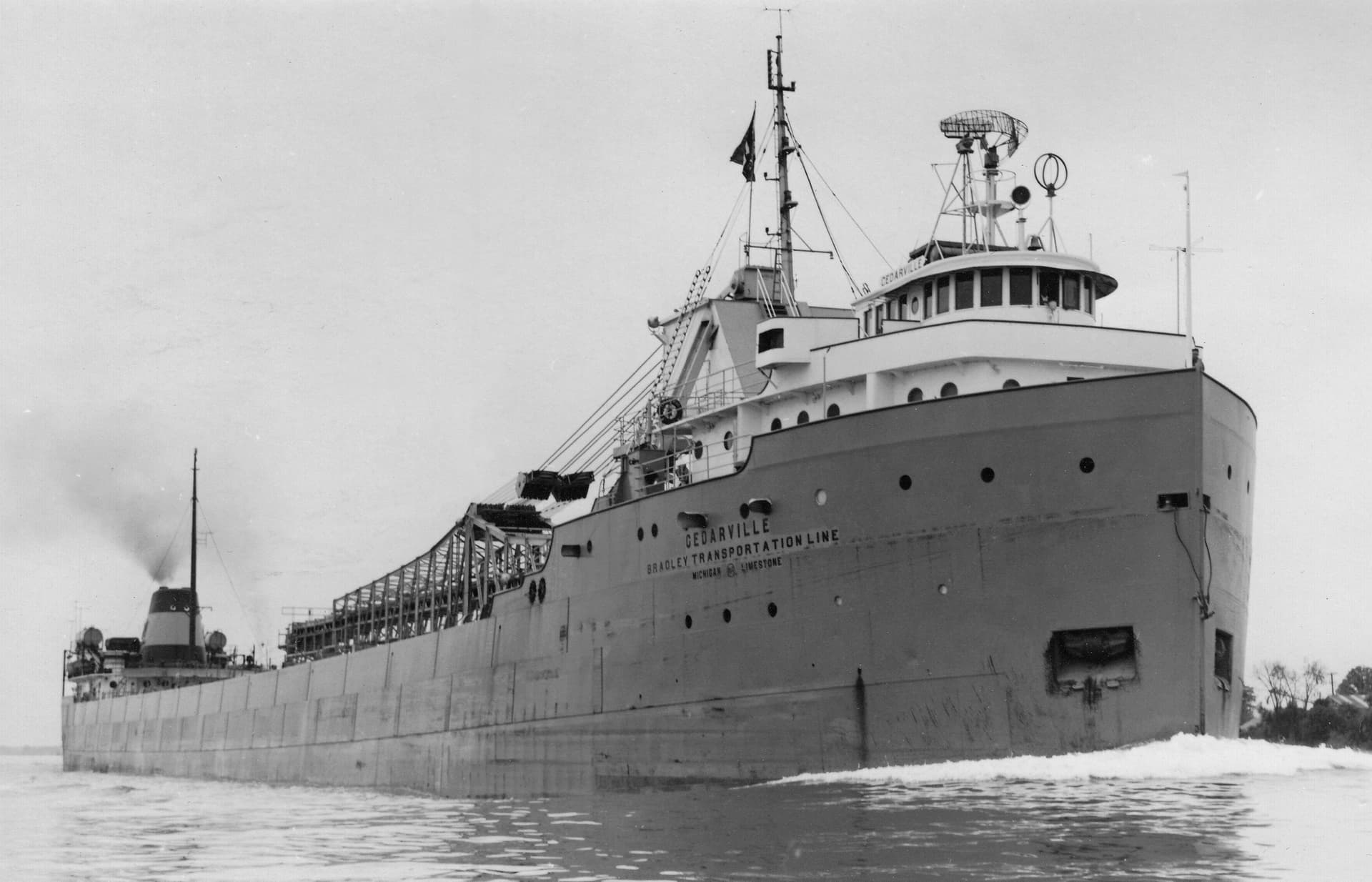
Mackinac, fog, the Norwegian bow Location: Straits of Mackinac, Lake Huron, Michigan · Coordinates: 45.82°N 84.72°W · Casualties: 10 · Survivors: 25 · Depth: 32 m · Cause: collision — Rammed in dense fog by the Norwegian motor vessel Topdalsfjord at 09:45 on 7 May 1965 in the Straits of Mackinac. A gash opened in her port side; her master attempted to beach her but she rolled 15 minutes later. Flooding accelerated by unclosed watertight doors. · Fate: upside down · war grave · diveable · Type: bulk freighter · Great Lakes · US Steel · Tonnage: 8,575 tons · Crew: 35 · Flag: United States · Launched: 1927 US Steel Great Lakes bulk freighter, carrying limestone from Calcite to Gary, Indiana. Rammed in dense fog by the Norwegian motor vessel Topdalsfjord in the Straits of Mackinac at 09:45 on 7 May 1965; her captain attempted to beach her on Mackinaw City before she rolled. 10 of 35 aboard died. She lies upside down at 32 metres, one of the most visited freshwater wreck dives in North America. The Vessel The SS Cedarville was an American steel-hulled Great Lakes bulk carrier, built at the American Ship Building Company yard at Lorain, Ohio in 1927. She was 180 metres long, 8,575 gross tons, and powered by a triple-expansion steam engine of approximately 1,800 horsepower. She had been built for the U.S. Steel Corporation's Great Lakes iron-ore and limestone trade: a specialised carrier designed for the narrow locks and confined waters of the Great Lakes system. She was originally built as the SS A. F. Harvey; she was renamed Cedarville in 1957 after purchase by U.S. Steel's Pittsburgh Steamship Division. Her operational employment through the late 1950s and early 1960s was the standard Great Lakes bulk-carrier circuit: iron ore from the Minnesota iron range to the Ohio and Pennsylvania steel mills, and limestone from the Michigan quarries to the Great Lakes steel-producing regions. By May 1965, Cedarville was 38 years old and substantially representative of the older Great Lakes bulk-carrier fleet. Her operational history had been extensive but unremarkable: routine commercial service, with minor incidents related to ice conditions and weather delays but no significant safety events. Her master on her final voyage was Captain Martin Joppich, 55, a career Great Lakes master with approximately 35 years of Great Lakes navigation experience. Her complement on 7 May 1965 was 35 officers and crew - a standard Great Lakes bulk-carrier complement. The Disaster At approximately 09:50 on 7 May 1965, Topdalsfjord emerged from the fog approximately 400 metres ahead of Cedarville. The specific relative bearing was approximately 20 degrees off Cedarville's port bow; the closing rate was approximately 25 kilometres per hour. Captain Joppich's response was immediate: engine reverse and hard port rudder. Cedarville began to swing to port under her rudder orders; however, her specific momentum (14,500 tonnes of cargo plus 8,575 tonnes of ship = approximately 23,000 tonnes displacement) could not be arrested in the available 400 metres. Captain Rasmussen of Topdalsfjord similarly ordered emergency rudder and engine orders; however, the two ships' closing rate was beyond either ship's avoidance capability. At approximately 09:52 on 7 May 1965, Topdalsfjord struck Cedarville on her port bow at approximately 8 knots relative impact speed. The specific impact penetrated Cedarville's hull approximately 3 metres deep; the breach was approximately 5 metres wide; the impact was at the waterline, directly into Cedarville's forward cargo hold. Cedarville's forward cargo hold began flooding immediately. The specific flooding rate was approximately 60 tonnes per minute; the ship's pumps could not address this rate. Captain Joppich's specific operational decision was to attempt to beach Cedarville on the nearby Michigan shoreline before she could sink in the deep waters of the Straits. Cedarville's speed was reduced to approximately 5 knots; her course wa
Source: naufragia.app
Part of Shipwrecks · Watch in the documentary