HMS Royal George
1782
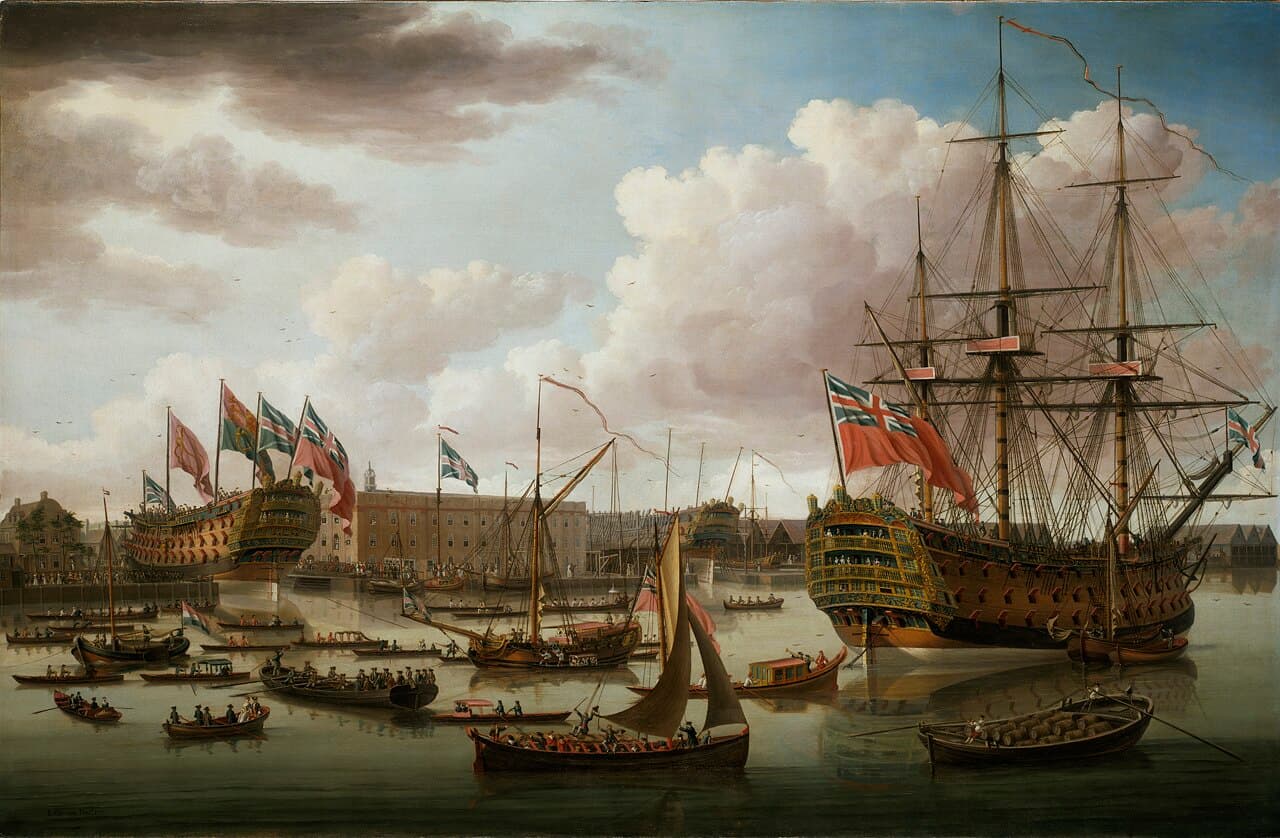
Spithead, heeled too far, at anchor Location: Spithead, Portsmouth, England · Coordinates: 50.78°N 1.10°W · Casualties: ~800-900 · Survivors: ~300 · Depth: 20 m · Cause: capsized — Heeled deliberately at anchor at Spithead on 29 August 1782 to repair a leaking water cock below the waterline. The heel was carried too far; water entered the lower gun ports and she rolled onto her beam ends. Sank in twenty metres in minutes, with almost everyone aboard trapped below. · Fate: cleared as hazard 1839-1843 · Type: warship · 100-gun first rate · Tonnage: 2,047 tons · Crew: 867 · Flag: Kingdom of Great Britain · Launched: 1756 Royal Navy first rate, 100 guns, Admiral Kempenfelt's flagship. Heeled intentionally at Spithead on 29 August 1782 to repair a leak below her waterline; the heel was carried too far, water entered the open gun ports, and she capsized at her anchor. Between 800 and 900 dead, including the admiral and several hundred wives, children, and merchants visiting the ship in harbour. Cowper's poem 'Loss of the Royal George' preserved the catastrophe in English literature. The Vessel HMS Royal George was a British first-rate ship of the line of the Royal Navy, built at Woolwich Dockyard between 1746 and 1756. She was 54 metres long, 2,047 tons displacement, and armed with 100 guns on three full gun decks (twenty-eight 42-pounders on the lower deck, twenty-eight 24-pounders on the middle deck, twenty-eight 12-pounders on the upper deck, and sixteen 6-pounders on the quarterdeck and forecastle). At her commissioning she was, along with HMS Victory launched nine years later, among the most heavily armed ships in the world. She had served as the flagship of Admiral Sir Edward Hawke at the Battle of Quiberon Bay on 20 November 1759, the decisive British naval victory of the Seven Years' War. Her subsequent service had been continuous through the Seven Years' War and the American War of Independence; by 1782 she was 26 years old, substantially worn, and in need of comprehensive dockyard refit. Her master in August 1782 was Rear-Admiral Richard Kempenfelt, aged 64, a distinguished career officer of Swedish-Scottish parentage who had developed the Royal Navy's signal-flag code system (the Kempenfelt signal book, adopted fleet-wide in 1779) and who was one of the most respected tactical officers of his generation. Her captain was Martin Waghorn; her complement at Portsmouth in August 1782 was approximately 867 naval personnel, plus an additional approximately 300 civilian visitors (primarily the families of the crew, traders, and Portsmouth dock workers) aboard wh The Disaster At approximately 09:20 on 29 August 1782, during the heeling operation, the structural condition of Royal George's 26-year-old lower hull timbers failed catastrophically. The specific failure mechanism, subsequently reconstructed by the Admiralty inquiry, was a combination of rotten hull frames along the ship's port quarter and the concentrated weight of the heeled ship exceeding the structural capacity of the deteriorated timbers. The port lower deck gunports, which had been opened to facilitate the heeling operation, were now below the waterline due to the heel angle. As the port hull frames failed, the hull lost its lateral stability; the ship's heel increased from 8 degrees to approximately 20 degrees within approximately 30 seconds; water began pouring into the open lower gunports at a rate that the ship's pumps could not possibly address. HMS Royal George capsized at her anchorage in approximately 90 seconds from the onset of the structural failure. She rolled onto her port beam; her masts touched the water; water poured into the ship through every opening in her port side. The concentration of the heeled armament on the port side, which had been the purpose of the heeling operation, now accelerated the capsize by providing approximately 600 tonnes of concentrated weight on the downward side. The loss of life was catastrophic and specifically concentrated among those below decks who had no warning of the capsize. Of the approximately 1,170 aboard (867 naval personnel pl
Source: naufragia.app
Part of Shipwrecks · Watch in the documentary