SS Valencia
1906
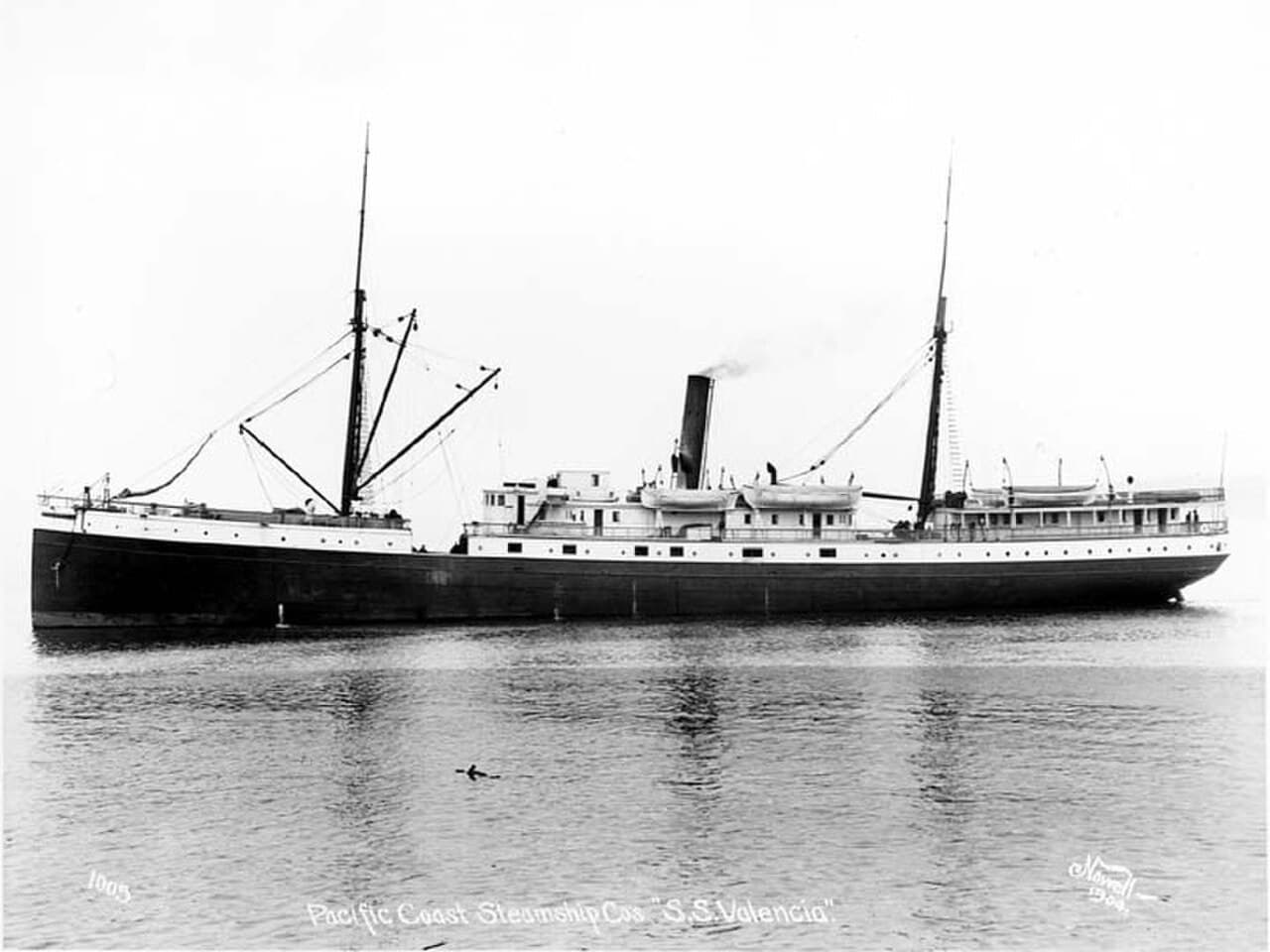
Graveyard of the Pacific, two days within sight of shore Location: Pachena Point, Vancouver Island, British Columbia · Coordinates: 48.78°N 125.10°W · Casualties: 136 · Survivors: 37 · Depth: destroyed on reef · Cause: grounding — Ran past the Cape Beale light in thick weather on the night of 22 January 1906 and struck the rocks of Pachena Point on Vancouver Island. Held fast on the reef for two days while the seas tore her apart within sight of shore. Rescue attempts by rowing boats and the steamer Queen were defeated by the surf. · Fate: destroyed · memorialised · Type: passenger liner · Pacific Coast Steamship · Tonnage: 1,598 tons · Crew: 57 · Flag: United States · Launched: 1882 American coastal liner, San Francisco to Seattle. In thick weather off Vancouver Island on 22 January 1906, she ran past the Cape Beale light and struck the rocks of Pachena Point, where the seas destroyed her over two days within sight of shore. 136 of roughly 180 aboard died. The catastrophe pushed the Canadian government to build the Pachena Lighthouse, construct what became the West Coast Trail, and charter a permanent lifesaving service along the 'Graveyard of the Pacific'. The Vessel The SS Valencia was an American Pacific Coast Steamship Company passenger steamer, commissioned at the William Cramp and Sons yard in Philadelphia in 1882. She was 77 metres long, 1,598 gross tons, with compound-expansion steam propulsion on a single screw. She had been built for the American Atlantic coastal trade but had been transferred to the Pacific Coast Steamship Company in 1898 for service on the San Francisco-to-Seattle and San Francisco-to-Puget Sound passenger trade. The Pacific Coast Steamship Company's Pacific Northwest passenger trade of the early twentieth century served the specific commercial requirement of American West Coast transportation before the completion of the northern Pacific railroad system. Approximately 10 passenger steamers operated regularly between California and the Pacific Northwest through the 1900s, carrying passengers, mail, and cargo on routes that typically required 3-5 days of steaming. Her master in January 1906 was Captain Oscar Marcus Johnson, 43, a career Pacific Coast Steamship Company officer. The Disaster The grounding of SS Valencia on Pachena Point produced one of the worst Canadian maritime disasters of the twentieth century. The grounding position was, specifically, approximately 90 metres off a near-vertical cliff face approximately 70 metres high. The Valencia was held against the cliff by the continuing storm; she could not be re-floated, and the storm conditions made any effective rescue approach impossible. The grounding was immediate and violent; Valencia was structurally damaged but not immediately destroyed. The passengers and crew aboard could see, through the rain and darkness, the cliff face approximately 90 metres away; they could see, in the dawn of 23 January 1906, the continuing 6-metre swell breaking against the cliffs and against the grounded ship. They could see that they were trapped. Captain Johnson attempted multiple rescue approaches over the following 36 hours of 23-24 January 1906. The lifeboats were launched and were immediately capsized by the heavy surf. Lines were fired to the cliff-top in attempts to establish a breeches-buoy rescue; the lines could not be successfully secured. Crew members attempted to swim to the cliff and climb the 70-metre rock face; most drowned in the attempt. The Valencia broke up on Pachena Point on the morning of 24 January 1906. Of her 180 aboard, 136 died: 108 passengers (all of the passengers), 28 crew. 44 survivors were eventually recovered from the cliff approach and from life rafts that had drifted south along th
Source: naufragia.app
Part of Shipwrecks · Watch in the documentary