RMS Tayleur
1854
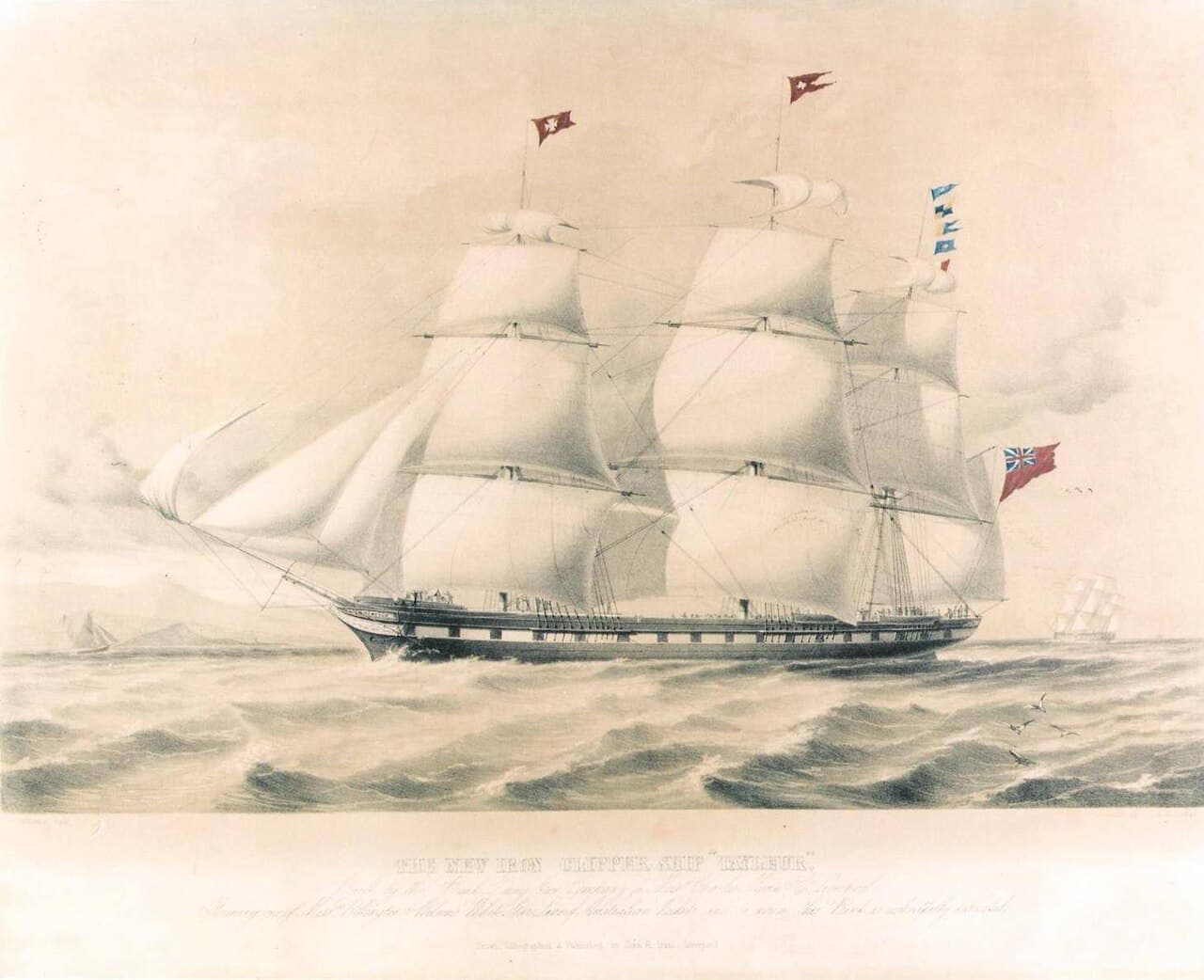
Iron clipper, compasses wrong, maiden voyage Location: Lambay Island, off Dublin, Ireland · Coordinates: 53.50°N 6.06°W · Casualties: ~380 · Survivors: ~280 · Depth: 18 m · Cause: grounding — Struck Lambay Island off the Dublin coast on 21 January 1854, two days into her maiden voyage from Liverpool to Melbourne. The iron hull had thrown her magnetic compasses off by several degrees; the crew were inexperienced and understrength for the gale. Holed on the cliffs and broke up within an hour. · Fate: located 1959 · Type: iron clipper · emigrant · Tonnage: 1,750 tons · Crew: 71 · Flag: United Kingdom · Launched: 1853 Iron-hulled emigrant clipper, Liverpool to Melbourne on her maiden voyage. Struck Lambay Island off the Dublin coast on 21 January 1854 in thick weather. Her compasses had been thrown off by the iron in her own hull; the crew were inexperienced and understrength for the conditions. 380 of 652 died, the first great iron-hulled disaster and in some tellings the Titanic of the gold-rush era. The Vessel The RMS Tayleur was a British iron-hulled clipper ship, commissioned at the Charles Tayleur and Company yard at Warrington on 4 October 1853. She was 68 metres long, 1,979 gross tons, and had been built for the White Star Line's Liverpool-to-Australia emigrant trade. Her construction incorporated what were, at the time, some of the most advanced shipbuilding innovations: a full iron hull (rather than the wooden hulls that still dominated the merchant marine), a centrally-mounted compass-binnacle system, and extensive iron-framed passenger accommodation for 660 emigrants below her main deck. The 1853 launching of the Tayleur had coincided with the peak of the Australian Gold Rush immigration cycle. The White Star Line, newly founded in 1845 and specialising in the Australia emigrant trade, had been accepting bookings for her maiden voyage since July 1853. Her passenger manifest for 1854 was full: 528 adult emigrants and 132 children, predominantly British and Irish working-class emigrants seeking the Australian goldfields. Her master on her maiden voyage was Captain John Noble, 44, a career mariner who had previously commanded the packet-ship Meridian on the transatlantic trade. Noble had not sailed an iron-hulled ship before; the Tayleur was his first command of the new iron-hulled class. The Disaster By the morning of 21 January 1854, Tayleur was approximately 140 kilometres southeast of Liverpool, having been at sea for 42 hours. Captain Noble's dead-reckoning position placed the ship in the open western Atlantic approaches; his actual position, due to the accumulated compass error, was substantially further east, approaching the west coast of Ireland. Weather had deteriorated into heavy rain, reducing visibility to less than one kilometre. At approximately 11:00 on 21 January 1854, the Tayleur struck a rocky outcrop at Lambay Island, 16 kilometres northeast of Dublin. The impact was substantial: her bow was crushed against the rock; her hull was holed below the waterline. The ship began to flood immediately and listed to starboard as her watertight subdivisions failed. The evacuation of the 731 aboard was catastrophically inadequate. The ship had been equipped with only four small lifeboats (total capacity approximately 80 people) for her 731 complement; three of the four lifeboats capsized during launching attempts in the heavy swell against Lambay Island's rocky shore. The one lifeboat that launched successfully carried 28 survivors to the island's beach. RMS Tayleur broke up against Lambay Island at approximately 13:00 on 21 January 1854 and sank in approximately 22 metres of water. Of the 731 aboard, approximately 380 died: 290 adult emigrants, 80 children, and 10 ship's crew. 351 survivors made their way to Lambay Island by swimming, by the one lifeboat, or by clin
Source: naufragia.app
Part of Shipwrecks · Watch in the documentary