MS Jan Heweliusz
1993
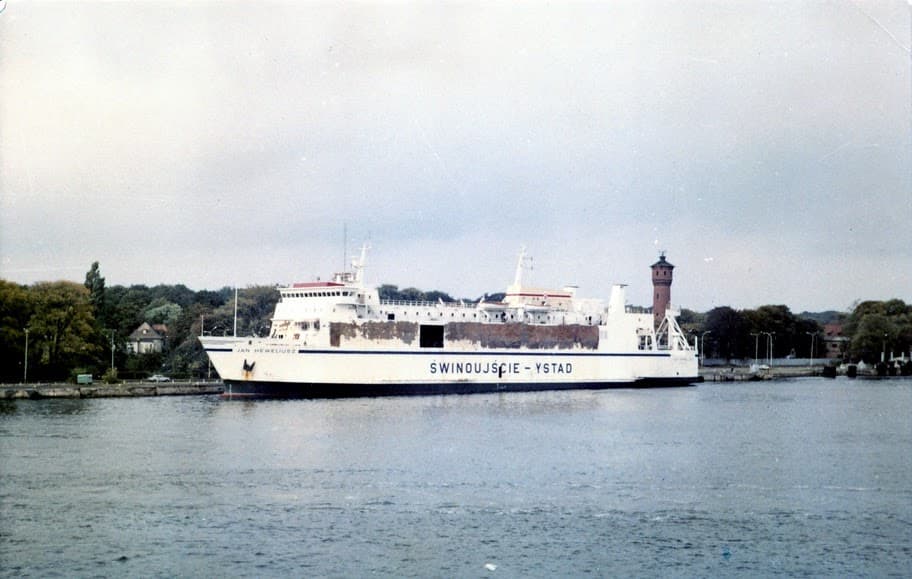
Baltic, unsecured trucks, top-heavy Location: Baltic Sea, off Rügen, Germany · Coordinates: 54.38°N 14.02°E · Casualties: 55 · Survivors: 9 · Depth: 20 m · Cause: capsized · cargo shift — Capsized in a Baltic storm at 05:12 on 14 January 1993 between Świnoujście, Poland and Ystad, Sweden. Her vehicle deck cargo, including unsecured trucks, shifted to port; she was already marginally stable because of a design-level top-heaviness. The list built up through the night before the final capsize. · Fate: partially salvaged · war grave · Type: roll-on/roll-off ferry · Polish Ocean Lines · Tonnage: 6,020 tons · Crew: 35 · Flag: Poland · Launched: 1977 Polish ro-ro ferry, Świnoujście to Ystad, the night of 14 January 1993. Unsecured trucks on her vehicle deck shifted to port in a Baltic storm; she was already marginally stable, built top-heavy. 55 of 64 aboard died. The Polish inquiry blamed inadequate cargo lashing procedures and ferry-class stability standards; EU ro-ro rules were tightened across the Baltic in its wake. The Vessel The MS Jan Heweliusz was a Polish car and train ferry of the Polish Baltic Shipping Company (Polska Żegluga Bałtycka, PZB), built at the Rauma-Repola yard at Rauma, Finland between 1976 and 1977 and commissioned on 11 July 1977. She was 126 metres long, 6,019 gross tons, and powered by twin diesel engines producing approximately 7,200 horsepower. Her design was a combined car-and-train ferry: she could transport approximately 250 cars or approximately 15 rail cars plus approximately 1,000 passengers on her internal decks. She was named after the seventeenth-century Polish astronomer Johannes Hevelius (Jan Heweliusz in Polish). Her operational role was the Baltic ferry service between the Polish port of Świnoujście (on the western Polish Baltic coast) and the Swedish port of Ystad (on the southern Swedish coast). The specific route was a standard Baltic ferry service approximately 12 hours in duration. By January 1993, the Jan Heweliusz had been operating on the Świnoujście-Ystad route for approximately 16 years. The specific maintenance condition of the ship had been the subject of several specific concerns; the specific operational pressure had been substantial following the 1989-1991 Polish political and economic transition, which had reduced the resources available for comprehensive ferry maintenance. Her master on her final voyage was Captain Andrzej Ułasiewicz, 52, a career Polish merchant marine officer. Her complement on 14 January 1993 was 64 persons: 35 passengers (p The Disaster At approximately 05:15 on 14 January 1993, Jan Heweliusz experienced substantial cargo shift. The specific combination of: (i) extreme wind and sea conditions; (ii) the ship's rolling motion; (iii) the heavy cargo weight; and (iv) the specific cargo-securing arrangements produced a major cargo shift toward the starboard side of the vehicle bay. The specific consequence was a progressive starboard list. Within approximately 15 minutes of the cargo shift, the ship's list had exceeded 25 degrees; within 30 minutes, the list had exceeded 40 degrees. Captain Ułasiewicz's response was standard: pumps were activated to counter-flood port ballast tanks; specific efforts were made to restrain the shifted cargo. However, the cargo shift was so substantial that counter-flooding could not restore adequate stability; the ship was progressively passing the point of recoverable stability. MS Jan Heweliusz capsized and sank at approximately 06:35 on 14 January 1993 in approximately 60 metres of water in the central southern Baltic Sea. The capsize was catastrophic; the ship rolled completely inverted within approximately 3 minutes of the final loss of stability. The specific evacuation was almost entirely unsuccessful. The extreme weather conditions made lifeboat launch impossible; the rapid capsize prevented effective evacuation; the specific water temperature (approximately 1-2 degrees Celsius) substantially reduced survival times in the water. Of the 64 aboard, 55 died: predominantly lorr
Source: naufragia.app
Part of Shipwrecks · Watch in the documentary