MV Prestige
2002
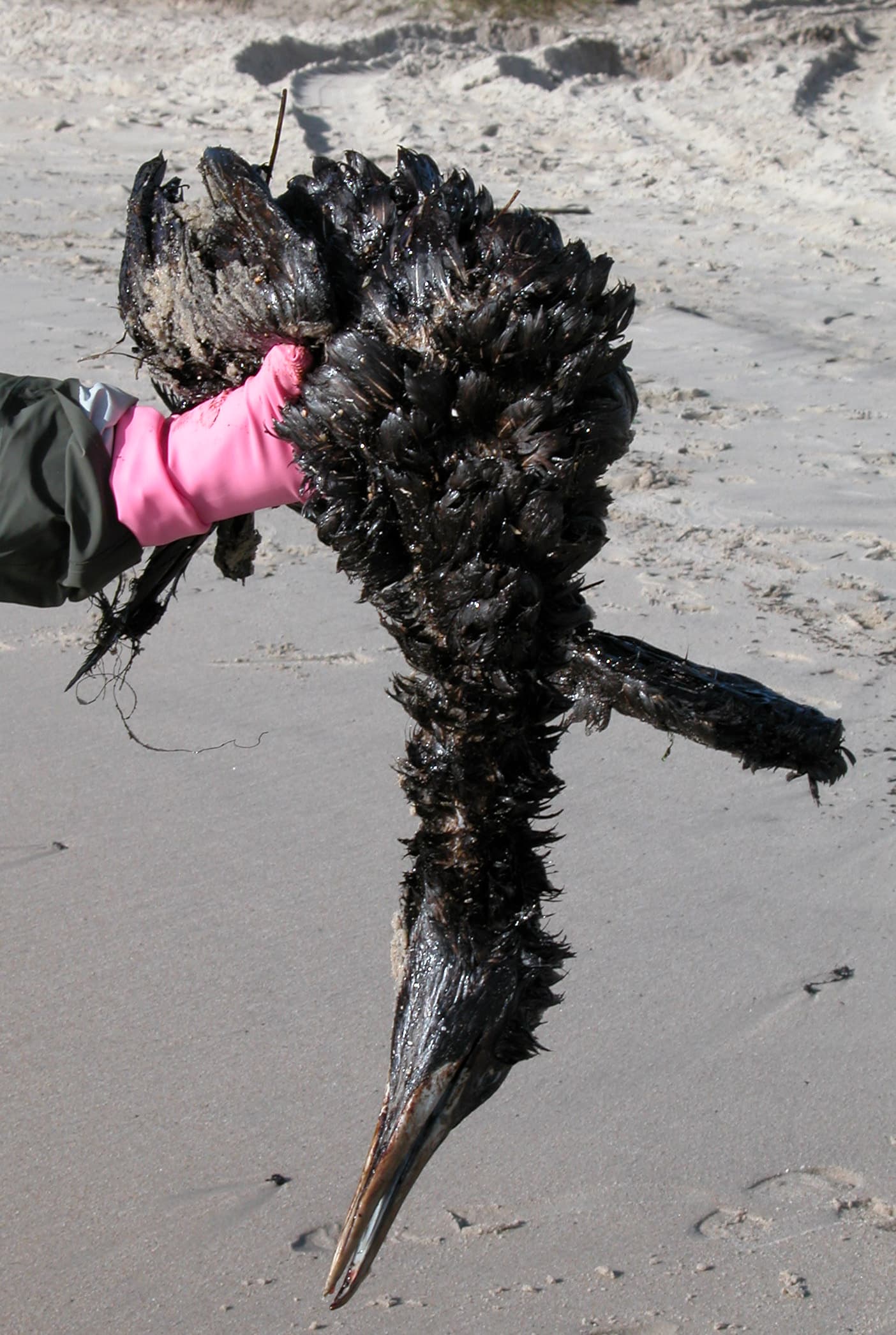
Galicia, turned away by three countries, the broken spine Location: Atlantic Ocean, off Galicia, Spain · Coordinates: 42.15°N 12.10°W · Casualties: 0 · Survivors: 27 · Depth: 3,500 m · Cause: structural failure · storm — Broke a fuel tank in a Biscay storm on 13 November 2002 while carrying 77,000 tonnes of heavy fuel oil. Spain, Portugal, and France each refused her a port of refuge; the French tug company pulled her further out to sea. She broke in half on 19 November and sank in 3,500 metres. · Fate: abyssal · partial salvage · Type: oil tanker · single-hulled · Tonnage: 42,820 GRT · Crew: 27 · Flag: Bahamas · Launched: 1976 Bahamas-flagged single-hulled oil tanker, carrying 77,000 tonnes of heavy fuel oil from Latvia to Singapore. Developed a fuel-tank rupture in a Biscay storm on 13 November 2002; Spain, Portugal, and France each refused her a port of refuge. Towed ever further out to sea, she broke in half six days later. 63,000 tonnes of bunker fuel reached 2,900 kilometres of Iberian and French coast. The European Union's ERIKA-III legislation phased out single-hulled tankers from EU waters. The Vessel The MV Prestige was a Bahamas-flagged oil tanker, built at the Hitachi Zosen Corporation yard at Osaka, Japan between 1975 and 1976 and commissioned on 18 April 1976. She was 243 metres long, 81,589 deadweight tons, and powered by a steam turbine producing approximately 16,000 horsepower. Her design was a single-hull oil tanker - a standard configuration for oil tankers of the mid-1970s that was progressively being phased out by international regulations through the early 2000s. Her ownership and operational history was substantially complex. She had been owned by multiple shipping companies through the 1980s and 1990s; by 2002, she was owned by the Liberian-registered Mare Shipping Inc., managed by the Greek Universe Maritime management company, and chartered to the Russian oil trading company Crown Resources. The specific ownership and management structure - characteristic of the flags-of-convenience oil-tanker market - had substantially complicated regulatory oversight. By November 2002, Prestige was 26 years old. The specific structural condition of the ship had been the subject of several specific concerns through the 1990s and 2000s; the specific classification society (the American Bureau of Shipping, ABS) had conducted multiple inspections that had identified various deficiencies. However, the ship had retained her classification and had been certified for continued service. Her master on her final voyage was Captain Apostolos Mangouras, 67, a Greek career merchant ma The Disaster Over the subsequent six days (14-19 November 2002), the Prestige was progressively directed away from both the Spanish and Portuguese coasts. Multiple European governments (Spain, Portugal, France) refused to accept the damaged ship into their territorial waters for shelter; the specific governmental decisions reflected the combined concerns about potential oil-spill damage and the desire to avoid political responsibility for the specific catastrophe. During this period, the ship's structural condition continued to deteriorate. The specific hull damage progressively worsened; the ship's cargo tanks began releasing oil; the ship's operational capability was substantially compromised. The specific Spanish and Portuguese naval assistance was limited; the ship was effectively adrift in the Bay of Biscay with no safe port of refuge. On the morning of 19 November 2002, approximately 260 kilometres off the Galician coast, Prestige's structural failure became catastrophic. The ship broke in half at approximately 08:00 on 19 November 2002. The specific failure divided the ship into two separate sections: the bow section (approximately 120 metres long) and the stern section (approximately 120 metres long). Both sections sank within the subsequent hours: the bow section sank at approximately 11:45 on 19 November 2002; the stern section sank at approximately 16:18 on 19 November 2002. The specific depth of the sinking was approximately 3,500 metres - substantial deep-ocean conditions. Th
Source: naufragia.app
Part of Shipwrecks · Watch in the documentary