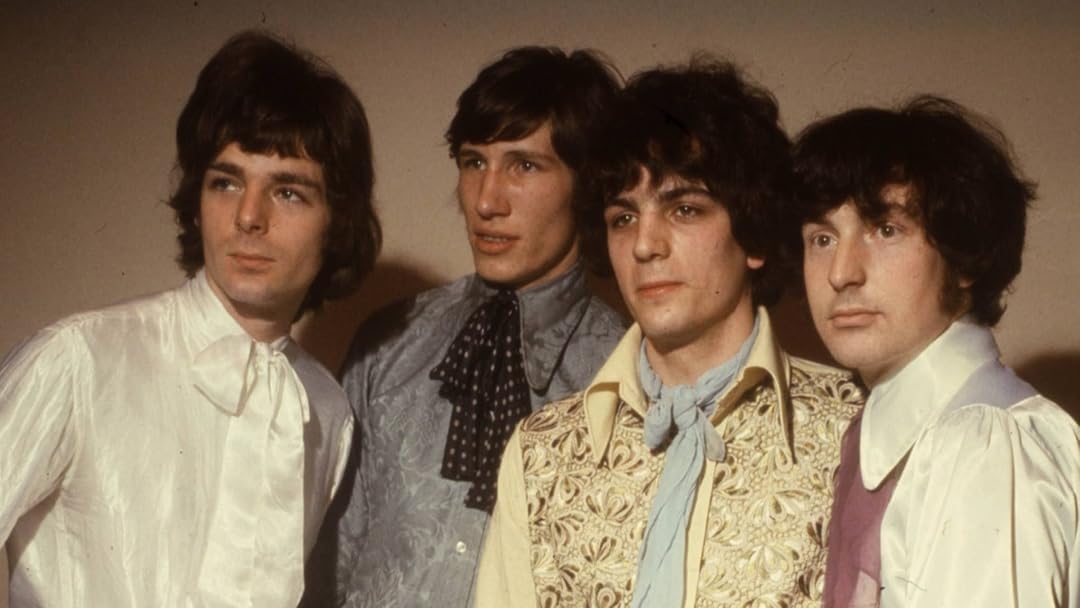
Pink Floyd
A band named off a single sleeve note, from a 1962 Blind Boy Fuller record where Paul Oliver listed Pink Anderson and Floyd Council among Piedmont players who had never met each other. They began as the house band of the London underground with Syd Barrett writing, and lost him in the least dramatic way imaginable: David Gilmour joined as a fifth member, and one morning in January 1968 the others simply did not collect Barrett for a gig. What followed was a decade of building rooms out of sound, quadraphonic rigs and a co-ordinator that moved noise around a hall, films projected behind the stage, an inflatable pig that got loose over Battersea, and a wall built across the front of an arena and knocked down again. Then the fights: Wright pushed out during the record he was playing on, Waters in the High Court in 1986 trying to dissolve the thing, a settlement rather than a verdict, and two decades of the members giving irreconcilable accounts of the same events. This archive is built from what can actually be watched, which since 2020 has included the band posting their own concert films for free, and it covers the losses from the documented record rather than the legend.
A chronological documentary of 1,034 moments spanning 1900–2026 on Loreline.
Curated by Olivier · last updated 2026-09-20
Eras
- Stagecraft, The apparatus, which is genuinely distinctive and badly under-collected. Quadraphonic sound and the Azimuth Co-ordinator, the joystick that moved sound around a hall, now in a museum case. Mr. Screen, the circular projection screen. Lasers, the mirrorball that opened like a flower, the crashing aeroplane, the inflatables, and the wall itself, built across the front of the stage during the show and demolished at the end of it.
- Live, Performance, the largest part of this archive and the reason it exists in the form it does. Since April 2020 the band has been posting complete concert films free on its own channel, so what is here runs from a 1967 Granada broadcast and Belgian and French television in 1968, through Pompeii in 1971 with no audience at all, Earls Court, the Wall shows of 1980 and 1981 of which only thirty one performances were ever staged, Venice in 1989, the Pulse tour, and Live 8 in 2005, the last time all four were on a stage together.
- Songs, Individual tracks as objects rather than as a soundtrack: promo films, official videos, single releases, chart appearances and the occasional oddity. Note what is deliberately absent. Static-image audio uploads were excluded even where official, because a still photograph over a recording is not documentary footage, and unofficial re-uploads of songs were excluded because they are the class of thing that disappears.
- Interviews, Sixty years of the members and their collaborators talking, and the only place where the contradictions can be handled honestly. Waters and Gilmour give irreconcilable accounts of Wright's removal, of the 1986 High Court filing, and of every reunion question since, so both accounts are carried and attributed and neither is arbitrated here. Also the people usually left out of the story: engineers, producers, the sleeve designers, and Barrett's sister Rosemary Breen, whose account of his later life differs sharply from the one the documentaries tell.
- Studio, Where the records were actually made. Abbey Road, Britannia Row, the Astoria houseboat, Chateau d'Herouville. Sessions, control rooms, isolated tracks, and the engineers and producers who are usually a footnote: Alan Parsons, Chris Thomas, Bob Ezrin, James Guthrie. The making-of material for Dark Side and The Wall is unusually well documented, including the tape loops, the cash registers and the string of coins Nick Mason made by hand in 1972.
- Films, The band on screen. Live at Pompeii, filmed in October 1971 in an empty Roman amphitheatre, which is the film's defining condition. The Wall in 1982 with Gerald Scarfe's animation. The concert films, Delicate Sound of Thunder and Pulse. The soundtrack work for More, La Vallee and Zabriskie Point. Plus the documentaries, including Have You Got It Yet?, begun by Storm Thorgerson and finished after his death.
- Barrett, Roger Keith Barrett as a subject in his own right, handled from the documented record only. There is no publicly available diagnosis, and every one in circulation traces back to a bandmate or a biographer rather than to a medical record, so this archive presents the competing accounts and attributes them: Waters has said schizophrenia, Wright blamed acid, Gilmour has said it would have happened anyway, and his sister Rosemary Breen has said he neither suffered from mental illness nor received treatment in the decades she knew him. He went home to Cambridge, painted, gardened, used his given name Roger, and died on 7 July 2006.
- Places, The physical locations, and the facet that rescues the thin decades because buildings can be photographed when the band could not. Battersea Power Station and its preserved control room, Abbey Road, the Roundhouse, Alexandra Palace, the Cambridge streets Barrett came from and returned to, Ely, Saunton Sands, the Roman amphitheatre at Pompeii, and Earls Court.
- Artwork, Hipgnosis, Storm Thorgerson and Aubrey Powell, and Gerald Scarfe's drawings for The Wall. Note how this segment is built. The 2024 sale of the band's catalogue included name and likeness, so the sleeves themselves are not reproduced here, including where a freely licensed photograph happens to show one on a gallery wall. What is here instead is the material that is genuinely photographable: the locations the images were made at, the physical objects and props, and the designers themselves talking about the work.
- Apart, The members working outside the band, where it bears on the band. Waters performing The Wall live and the Us and Them tours, Gilmour's solo records and his return to the Pompeii amphitheatre in 2016 with an audience this time, Nick Mason's Saucerful of Secrets playing the pre-Dark Side material that the band itself stopped playing, Wright's Broken China and Zee, and Barrett's two solo albums.
- - Cambridgeshire High School for Boys, Hills Road. The Hills Road school, photographed around 1900, where Barrett, Roger Waters and David Gilmour were all pupils. All three grew up in Cambridge and knew each other well before London, which is why Gilmour's arrival in 1967 was not the recruitment of a stranger.
- - Building the Astoria, 1911. Workmen building the superstructure of the houseboat Astoria on Tagg's Island in 1911. Seventy-five years later it became David Gilmour's recording studio.
- - The Empire Pool, Wembley, 1938. The hall on the opening day of the 1938 European Aquatics Championships, still a swimming pool. Pink Floyd played it as a concert hall thirty-six years later.
- - Peter Whitehead - Pink Floyd movie TV interview 1967. Peter Whitehead filmed Pink Floyd recording 'Interstellar Overdrive' at Sound Techniques in January 1967 for Tonite Let's All Make Love in London.
- - Pink Floyd - The Scarecrow (Outtakes). Outtakes from the 1967 promotional filming. 'The Scarecrow' is a Syd Barrett song from The Piper at the Gates of Dawn.
- - Syd Barrett - Interviewed By Meatball Fulton - London August 1967. Syd Barrett interviewed in London in August 1967, weeks after The Piper at the Gates of Dawn was released. Recorded interviews with Barrett are very scarce.
- - Pink Floyd - Recording Interstellar Overdrive and Nick's Boogie (London, 1967). Filmed at Sound Techniques in London in January 1967 for Peter Whitehead's Tonite Let's All Make Love in London. The band are recording rather than performing, which makes it unusual for the period.
- - Pink Floyd - Interstellar Overdrive (The Roundhouse) ['Science Fiction - Das Universum Des Ichs']. Filmed at the Roundhouse in Chalk Farm for German television. The Roundhouse hosted the International Times launch party on 15 October 1966, one of the band's defining early nights.
- - 1967-04-xx -= Pink Floyd - Abbey Road Studios. EMI Studios at Abbey Road, where Pink Floyd recorded from The Piper at the Gates of Dawn in 1967 through to Wish You Were Here in 1975.
- - Pink Floyd - Instrumental Improvisation (from BBC's The Sound of Change). Filmed for the BBC's The Sound of Change in 1967, at the height of the London underground scene.
- - Pink Floyd - Instrumental Improvisation (Tomorrow's World). Filmed for the BBC science programme Tomorrow's World in 1967. The band were used to demonstrate new sound and lighting technology, which is how the era's press understood them.
- - Syd Barrett rare interview in the early years of Pink Floyd. Syd Barrett speaking during his time in Pink Floyd. Very little interview material with him survives.
- - Pink Floyd - Jugband Blues (London Line Promo Video, 1967 London). A promotional film made for London Line in 1967. 'Jugband Blues' was Syd Barrett's last song for the band and, read plainly, a song about not being present.
- - 1967: Are PINK FLOYD too LOUD? | The Look Of The Week | Classic BBC Music | BBC Archive. Esteemed musicologist and critic Hans Keller introduces a new band - The Pink Floyd (so new they hadn't yet dropped the 'The') - who are very much not to his liking, due to their "continuous repetition" which leads to them being "a bit boring" - but what really seems to grate on Mr Keller is the band's sheer volume, wh...
- - Pink Floyd with Syd Barrett, 1967. The four-piece with Syd Barrett, photographed in 1967 and printed in Hit Parader the following July. Barrett wrote almost all of the first album and the two hit singles. Gilmour joined as a fifth member around December 1967; on 26 January 1968 the band simply did not collect Barrett for a Southampton gig, and the announcement came on 6 April.
- - Pink Floyd - Interstellar Overdrive (from Granada TV's Scene – Underground). Granada Television's Scene: Underground, filmed in London in 1967. It is among the earliest surviving film of the band playing.
- - Pink Floyd - The Scarecrow (Pathé Pictorial, UK, July 1967). Filmed for Pathé Pictorial, the British cinema newsreel, in July 1967, weeks before The Piper at the Gates of Dawn was released.
- - Are Pink Floyd too loud? 🔊. The BBC's The Look of the Week in 1967, with Syd Barrett and Roger Waters questioned about volume and seriousness by a classical musicologist. It is one of very few filmed interviews with Barrett.
- - Pink Floyd - Chapter 24. From The Piper at the Gates of Dawn, 1967. Syd Barrett took the lyric from the I Ching.
- - Roger Waters (for Pink Floyd) Interviewed by BBC Radio 1's Brian Matthews (1968-06-25). Roger Waters interviewed by Brian Matthew for BBC radio during the band's first year of chart success.
- - Syd Barrett, 1967. Syd Barrett in 1967, from a band photograph printed in Hit Parader the following July. He wrote almost all of The Piper at the Gates of Dawn along with "Arnold Layne" and "See Emily Play", and took the band's name from a sleeve note listing the Piedmont players Pink Anderson and Floyd Council. The two never met and never recorded together.
- - Pink Floyd - See Emily Play. Released June 1967, produced by Norman Smith. The band's commercial peak of the Barrett era, reaching the UK top ten. It was written for the Games for May concert at the Queen Elizabeth Hall in May 1967.
- - Pink Floyd Interview on American Bandstand 1967 | Syd Barrett and Dick Clark. Pink Floyd on American Bandstand during the collapsed American tour of late 1967. Barrett's unresponsiveness on American television that autumn is among the most-circulated footage of him.
- - Pink Floyd - Arnold Layne (Official Music Video). Released March 1967, produced by Joe Boyd. Syd Barrett's song about a clothes thief. Some radio outlets refused to play it.
- - Pink Floyd 1967 full interview [Syd Barrett & Roger Waters]. Syd Barrett and Roger Waters interviewed in 1967. Filmed and recorded interview material with Barrett is very scarce.
- - Pink Floyd - Paintbox (Official Music Video). A Richard Wright song, released as a B-side in 1967.
- - Pink Floyd - Apples and Oranges. Released November 1967. It failed to chart and was Syd Barrett's last single with the band.
- - A Roy Harper concert poster, 1968. A poster for Roy Harper at St Pancras Town Hall in November 1968. Harper sang lead on "Have a Cigar" in 1975 because he happened to be recording in the building; Waters has expressed later regret about handing the vocal away.
- - Pink Floyd - A Saucerful of Secrets ('P1 – P wie Petersilie'). Filmed for the German television programme P1 - P wie Petersilie in 1968.
- - Pink Floyd - Corporal Clegg ('P1 – P wie Petersilie'). Filmed for the German television programme P1 - P wie Petersilie in 1968.
- - Pink Floyd - A Saucerful Of Secrets (Forum Musiques). Filmed for the French programme Forum Musiques in 1968, the first year without Syd Barrett.
- - Pink Floyd - Set The Controls For The Heart Of The Sun (Forum Musiques). Filmed for the French programme Forum Musiques in 1968, the first year without Syd Barrett.
- - Pink Floyd - Point Me At The Sky (Promo Video). Released December 1968. It failed to chart, and the band did not release another single in Britain for eleven years.
- - Pink Floyd - Interstellar Overdrive ('Pop 68'). Filmed for French television in 1968.
- - Pink Floyd - Set The Controls For The Heart Of The Sun ('All My Loving'). Filmed for Tony Palmer's BBC documentary All My Loving in 1968.
- - Pink Floyd - Let There Be More Light (‘Surprise Partie’). Filmed for French television in 1968. 'Let There Be More Light' opened A Saucerful of Secrets, the only Pink Floyd album with both Barrett and Gilmour on it.
- - Pink Floyd - Let There Be More Light (‘Tous En Scène’). Filmed for French television in 1968. 'Let There Be More Light' opened A Saucerful of Secrets, the only Pink Floyd album with both Barrett and Gilmour on it.
- - Pink Floyd - Let There Be More Light (‘A l’Affiche Du Monde’). Filmed for French television in 1968. 'Let There Be More Light' opened A Saucerful of Secrets, the only Pink Floyd album with both Barrett and Gilmour on it.
- - Pink Floyd - Remember A Day ('Samedi et Compagnie'). Filmed for French television in 1968. 'Let There Be More Light' opened A Saucerful of Secrets, the only Pink Floyd album with both Barrett and Gilmour on it.
- - Pink Floyd - Intro then Let There Be More Light ('Samedi et Compagnie'). Filmed for French television in 1968. 'Let There Be More Light' opened A Saucerful of Secrets, the only Pink Floyd album with both Barrett and Gilmour on it.
- - Pink Floyd - Astronomy Domine ('Tienerklanken - Kastival'). Filmed for the Belgian youth programme Tienerklanken in 1968. Continental broadcasters filmed the band far more than British ones did.
- - Pink Floyd - It Would Be So Nice ('Release - Rome Goes Pop'). Filmed in Rome for the programme Release in 1968. 'It Would Be So Nice' was a Richard Wright song and a commercial failure.
- - Pink Floyd - Paintbox ('Discorama'). Filmed for the French programme Discorama. 'Paintbox' was a Richard Wright song, released as a B-side in 1967.
- - Pink Floyd - See Emily Play (Tienerklanken 1968). Filmed for the Belgian youth programme Tienerklanken in 1968. Continental broadcasters filmed the band far more than British ones did.
- - Pink Floyd - Corporal Clegg (Tienerklanken 1968). Filmed for the Belgian youth programme Tienerklanken in 1968. Continental broadcasters filmed the band far more than British ones did.
- - Pink Floyd - The Scarecrow (Tienerklanken 1968). Filmed for the Belgian youth programme Tienerklanken in 1968. Continental broadcasters filmed the band far more than British ones did.
- - Pink Floyd - Astronomy Domine (Tienerklanken 1968). Filmed for the Belgian youth programme Tienerklanken in 1968. Continental broadcasters filmed the band far more than British ones did.
- - Pink Floyd - Let There Be More Light. Opened A Saucerful of Secrets in 1968, the only Pink Floyd album with both Syd Barrett and David Gilmour on it.
- - Pink Floyd - Set The Controls For The Heart Of The Sun. Roger Waters' song from A Saucerful of Secrets, 1968, with a lyric partly assembled from translated Tang dynasty poetry.
- - "Careful with That Axe, Eugene" on Columbia. The label of the 1968 Columbia single carrying "Careful with That Axe, Eugene", credited to Waters, Wright, Gilmour and Mason and produced by Norman Smith. It began life as a B-side and became one of the band's most durable live pieces, built around a long quiet passage and a scream.
…and 984 more moments.
Full text archive: /loreline-text/pink-floyd.md