The Golden Bull of 1356
JAN 01 1356 · 12:00
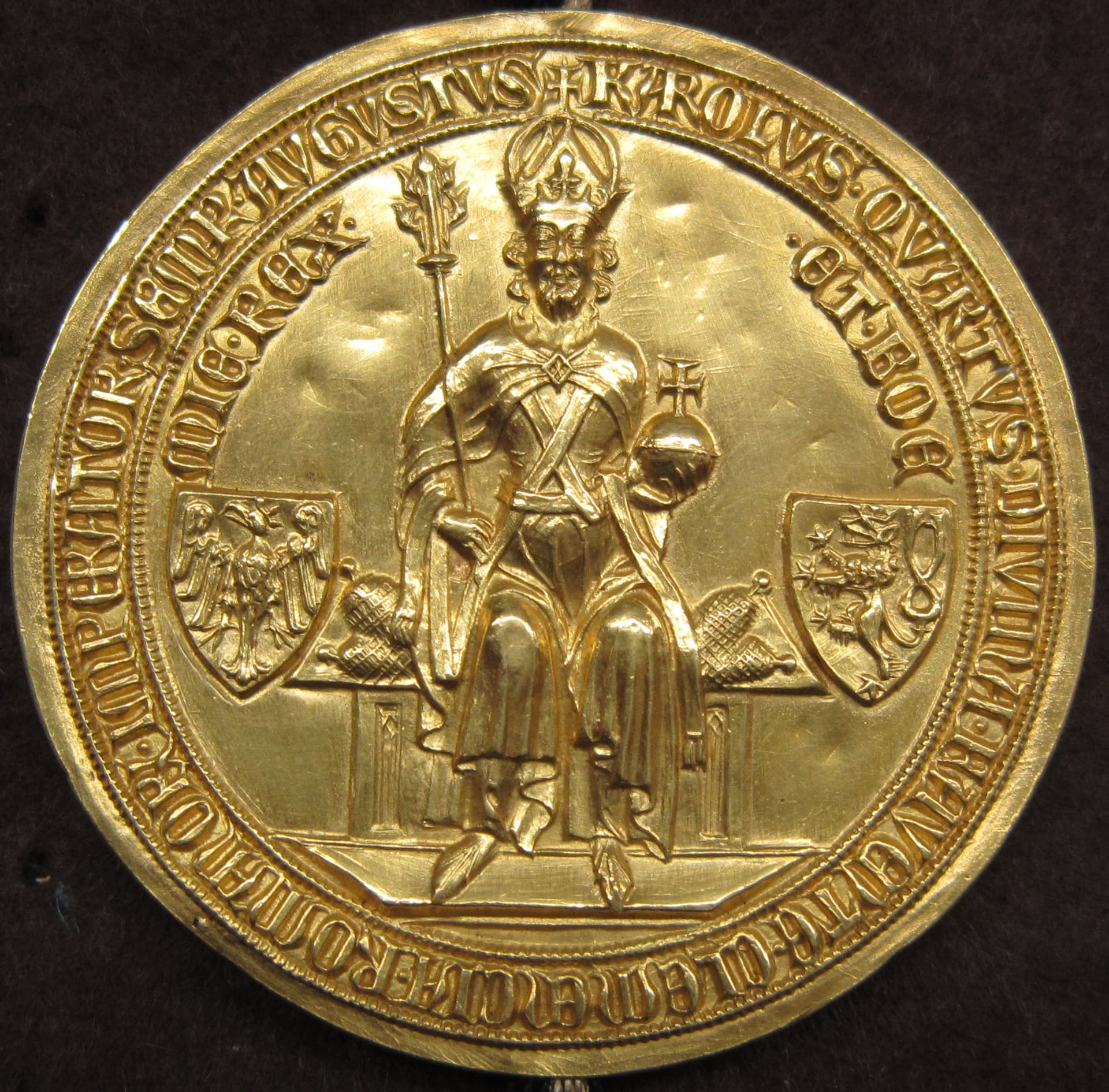
Detail of the original Golden Bull of 1356, the constitutional charter of the Holy Roman Empire for the next 450 years. Place: Promulgated in two parts: at the Diet of Nuremberg (10 January 1356) and the Diet of Metz (25 December 1356) Figures: Charles IV · the seven prince-electors (the archbishops of Mainz, Cologne, and Trier; the count palatine of the Rhine; the duke of Saxony; the margrave of Brandenburg; the king of Bohemia, who is Charles himself) For two and a half centuries the German throne has been contested by ambiguous procedures and double elections. There is no settled list of electors, no settled majority rule, no settled procedure for what happens when a candidate wins narrowly. Charles, who came to his own throne through such a disputed election, intends to close the question forever. The Diet of Nuremberg in January 1356 passes the first twenty-three chapters; the Diet of Metz the following Christmas adds the last eight. The whole is sealed with the imperial golden bulla from which the document takes its name. The seven electors are fixed: three ecclesiastical (Mainz, Cologne, Trier) and four lay (Bohemia, the Rhenish Palatinate, Saxony-Wittenberg, Brandenburg). The election shall be by majority. The electors' territories are made indivisible by inheritance, immune from imperial jurisdiction, possessed of regalian rights to mint coin and try capital cases. The King of Bohemia is named the senior lay elector, with the office of imperial cupbearer and precedence at every diet.
Source: prague-oracle.vercel.app
Part of Prague's story · Watch in the documentary