Dire Straits — Money For Nothing
JUL 01 1985 · 12:00
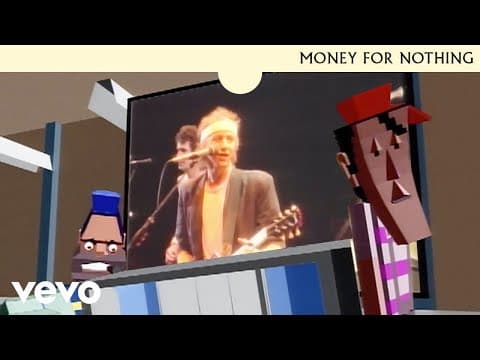
Dire Straits — Money For Nothing (1985) Director: Steve Barron Era: Golden Age of MTV (1985) - Peak of the music video as a mass-cultural art form; CGI experimentation collides with arena rock spectacle at the moment MTV defines mainstream pop culture. An essential Tier 1 artifact for any archive of 1980s visual culture. The video is simultaneously a primary source for the history of CGI, a case study in self-referential media critique, a commercial and awards landmark, and a crystallisation of the MTV era's aesthetic contradictions. Its dark, warm palette and fast-cut editing rhythm are directly measurable correlates of the song's sardonic energy, making it an ideal specimen for quantitative-qualitative cross-analysis. The animators' subsequent founding of Mainframe Entertainment gives this single production a direct causal link to the entire tradition of fully computer-animated television. Context: Released in June 1985, 'Money for Nothing' arrived at the precise moment MTV had transformed from a cable curiosity into the dominant force in popular music. The song's working-class narrator watches rock stars on television and voices envious bewilderment — a self-critique that the video literalises by embedding fictional MTV broadcasts within its own frame. By deploying then-state-of-the-art CGI to satirise the very spectacle of MTV, the video performs the contradiction it critiques: it became one of the most-played clips on the network it mocked. The song reached number one for three weeks on the US Billboard Hot 100 and was the first video ever aired on MTV Europe, cementing it as a transatlantic cultural landmark. Grammy wins for Best Rock Performance by a Duo or Group with Vocal (1986) reinforced its commercial and critical dominance. Director notes: Barron was approached by Warner Bros. executive Jeff Ayeroff and travelled to Budapest to convince Dire Straits, then on tour, to participate in the production. The band's live concert footage filmed in Budapest was digitally painted over using the Quantel Paintbox system, creating the signature neon-rotoscoped aesthetic. For the CGI segments, animation directors Ian Pearson and Gavin Blair used a Bosch FGS-4000 system at CAL Videographics in London; Pearson spent approximately three and a half weeks living in the studio to complete the work by deadline. The video embeds two fictional 'videos-within-the-video' as diegetic content, and also incorporates real footage of the Hungarian pop band Első Emelet re-labelled as 'Baby, Baby' by 'First Floor'. The production was connected to Rushes Postproduction in London. Pearson and Blair subsequently founded Mainframe Entertainment (now Mainframe Studios) and later referenced the video in an episode of their animated series ReBoot. The video received 11 nominations at the 1986 MTV Video Music Awards, winning Video of the Year and Best Group Video, and was the inaugural broadcast on MTV Europe on 1 August 1987.
Source: radarchive.org
Part of RAD Archive · Watch in the documentary