Journey — Any Way You Want It
JUL 01 1980 · 12:00
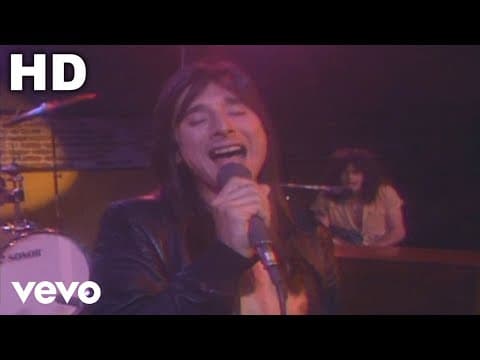
Journey — Any Way You Want It (1980) Director: Kim Paul Friedman Era: Early Music Video Era (1980) - Pre-MTV promotional clip representing the nascent studio-performance format before the music video became a codified art form; released six months before MTV's August 1981 launch. High. As a confirmed pre-MTV promotional clip (March 1980) with full director attribution, this video is a primary source document of the transitional moment between the British-origin promo film tradition and the MTV-era music video. Its quantitative metrics are consistent with the period's production norms and offer a measurable baseline for comparative archival research. The identity-reveal narrative device and jukebox framing are culturally legible genre markers of early AOR visual culture. Tier 1.5 reflects its significant historical value tempered by its deliberately modest production scope. Context: Released in February 1980, 'Any Way You Want It' arrived at a pivotal transitional moment: the promotional music video was displacing live TV appearances as a band's primary visual marketing tool, yet MTV would not exist for another 18 months. This clip belongs to the pre-MTV promotional film tradition — a functional artifact designed for broadcast on shows like Don Kirshner's Rock Concert or American Bandstand rather than a purpose-built channel. Journey were ascending from cult progressive-rock origins toward full arena-rock mainstream dominance; this single, lifted from the album Departure, captures that inflection point. The jukebox framing device consciously situates the song within the consumer jukebox economy of late-1970s rock radio and bar culture, reinforcing the AOR format's blue-collar audience appeal. Director notes: The video premiered in March 1980, predating MTV by over a year, and functions as a promotional clip in the tradition of British 'promo films.' It employs a framing device in which an anonymous man selects the song on a jukebox; this figure is revealed at the video's conclusion to be lead singer Steve Perry, who turns to face the camera. The central body of the video is a straightforward studio performance shoot. The jukebox-to-tape-reel dissolve sequence is the primary cinematographic flourish, connecting the consumer act of selecting a song to the band's act of playing it — a self-referential loop that comments on the song-as-commodity. The quantitative metrics (brightness 46.1/255, contrast 40.8, saturation 125.9, motion 6.74) confirm a static, warmly lit, performance-anchored production with minimal movement, consistent with the low-budget promotional clip norms of the period.
Source: radarchive.org
Part of RAD Archive · Watch in the documentary