Supertramp — Better Days
JUL 01 1985 · 12:00
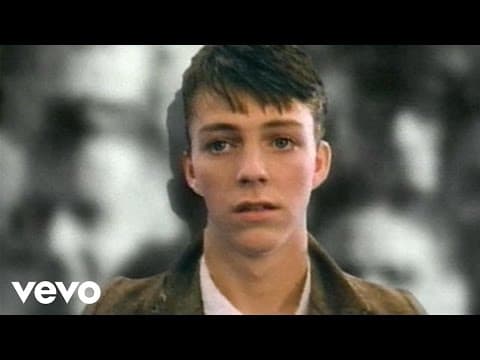
Supertramp — Better Days (1985) Director: Steve Barron Era: Mid-80s MTV Concept Era (1985) - Peak period of high-concept narrative music video production, coinciding with the post-Roger Hodgson Supertramp reformation and the Cold War cultural anxieties embedded in the 'Brother Where You Bound' album cycle. High curatorial value as a documented Steve Barron-directed artifact from his peak MTV period, featuring a fully realized time-travel narrative, period costume production design, archival political footage, and a signature black-and-white to color transition. Valuable for study of both Supertramp's creative evolution and the mid-80s expansion of music video as a storytelling medium. The embedded 1984 US presidential campaign material gives the video additional significance as a primary source document of Cold War popular culture. Context: Released in 1985 as part of Supertramp's 'Brother Where You Bound' album cycle — the band's first post-Roger Hodgson LP — 'Better Days' and its video reflect the intense Cold War anxieties and nuclear-age disillusionment permeating mid-decade popular culture. The song's extended fade-out features voice-overs from the four key players of the 1984 US presidential campaign, embedding it explicitly in contemporaneous political discourse. Steve Barron's time-travel narrative format — a young Depression-era man confronting the failures of 20th-century progress — mirrors a broader cultural preoccupation with historical memory and utopian disappointment prevalent in Reagan-era pop, progressive rock, and the early MTV visual vocabulary. The video situates Supertramp's cerebral prog-pop sensibility within the emerging spectacle-driven promotional film culture of mid-80s MTV. Director notes: Confirmed directed by Steve Barron per IMDb (tt7290478) and IMVDb. The video is dated 1985 on IMDb and 1986 on IMVDb, consistent with the 'Brother Where You Bound' album release cycle (A&M Records, 1985). The narrative follows a young man from the early 20th-century Depression era who is transported by two eccentric figures on a time-travel journey through the 20th century, confronting technological progress alongside war, political corruption, and social failure. A notable production hallmark is the black-and-white to color transition marking the protagonist's entry into the time tunnel — a technique reviewers have specifically cited. The video incorporates political archival footage and voice-overs from the 1984 US presidential campaign (Ferraro, Mondale, Bush, Reagan), echoing the song's Cold War-era lyrical themes. The clip is considered part of Steve Barron's peak mid-80s output, contemporaneous with his iconic A-ha and Dire Straits videos, though produced at a more modest budget.
Source: radarchive.org
Part of RAD Archive · Watch in the documentary