Deep Forest — Deep Forest Sweet Lullaby official video
JUL 01 1993 · 12:00
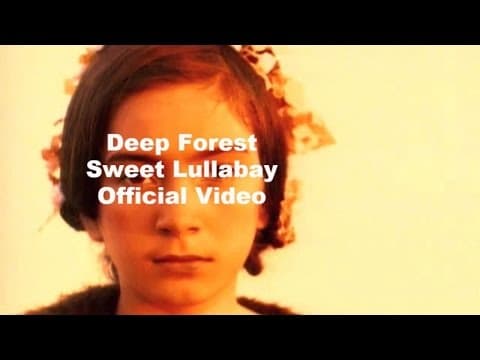
Deep Forest — Deep Forest Sweet Lullaby official video (1993) Director: Tarsem Singh Era: Early 1990s World Music-Electronic Fusion Era (1992–1994) - The apex of ethno-ambient crossover, when UNESCO field recordings and European electronic production converged to produce chart-crossing world music hybrids, epitomized by Deep Forest's debut album cycle. Exceptionally high. This is among the most culturally layered and visually distinguished music videos of the early 1990s, sitting at the intersection of world music ethics debates, cinematic music video direction, and MTV-era pop globalism. Its status as a Tarsem Singh work — made between 'Losing My Religion' and his feature debut — gives it auteur significance. Its documentary and ethical dimensions (the Afunakwa/Zemp sampling controversy) make it essential for both media studies and ethnomusicology curricula. Nominated for four 1994 MTV VMAs. Context: Released as a single in 1992 and re-released with remixes in 1993–1994, 'Sweet Lullaby' emerged at the precise cultural moment when ethno-electronic music — pioneered by Enigma and then Deep Forest — was crossing over from niche new-age/world-music audiences into mainstream pop and alternative radio. The song reached number 10 on the UK Singles Chart, number 7 in Australia, number 3 in Norway, and entered the US Billboard Hot 100 after MTV placed the video in heavy rotation in its 'Buzz Bin.' The track is built around an unauthorized sample of 'Rorogwela,' a traditional Baegu lullaby from Malaita, Solomon Islands, sung by a woman named Afunakwa and recorded by ethnomusicologist Hugo Zemp in 1970 for a UNESCO Musical Sources LP. This unauthorized use subsequently became a widely-cited case study in debates around cultural appropriation, sampling ethics, and the exploitation of indigenous musical heritage by Western artists. The video's globe-trotting visual language simultaneously celebrated and aestheticized cultural difference, situating it within broader early-1990s postcolonial pop globalism. Director notes: The 'Sweet Lullaby' video is officially designated Version 2 on IMDb (tt6659470), distinguishing it from an earlier Version 1 directed by David Lodge (tt6787070) which focused on sub-Saharan African imagery. Tarsem's version was shot across eight countries during a four-and-a-half-week shoot in late 1993, with locations including Varanasi (India), Moscow (Russia), Barcelona (Spain), the Great Wall of China, New York City (USA), Turkey, Kenya, and other sites. The video follows a young girl riding a tricycle through iconic global locations. The estimated production budget was $150,000 (per IMDb). Tarsem worked on the video without pay and contributed his own funds. Per a 1994 Billboard interview cited in Wikipedia, Tarsem described his approach as arriving at a location in the afternoon, spending three hours taking Polaroids, and deciding where to shoot at dinner — an improvisational, eye-led methodology. The video was nominated at the 1994 MTV Video Music Awards in categories including Breakthrough Video, Best Direction, Best Editing, and Best Cinematography, and received one nomination at the 1994 Music Video Production Awards in Los Angeles. Tarsem himself later described it as 'my baby' — a video he felt had been overlooked compared to his 'Losing My Religion' success. VideoStatic noted that 'each frame is carefully composed and slightly surreal' with 'no performance, no cameos.' The video was re-uploaded in HD by Eric Mouquet and has continued to accumulate views across platforms.
Source: radarchive.org
Part of RAD Archive · Watch in the documentary