Television
The box, not the programmes. Five men demonstrated working apparatus between 1925 and 1927 and this archive crowns none of them, preferring to show what each actually did: a ventriloquist dummy at thirty-two lines in a Soho attic, a model windmill transmitted to a Washington rooftop with the Navy watching, a single straight line in a San Francisco laboratory, and a Japanese katakana character at forty lines on a cathode ray tube. After that it follows the object: the veneered console that was furniture before it was electronics, the tube that made the cabinet deep, the spinning disc that lost, the factories that moved from America to Japan to Korea to China, the shops where crowds watched through the window, the repairmen with their valve caddies, and the lead-heavy glass that makes a dead set difficult to throw away. A mechanical colour system was the legal American standard for fourteen months, and almost nobody remembers it.
A chronological documentary of 1,085 moments spanning 1884–2026 on Loreline.
Curated by Olivier · last updated 2026-09-20
Eras
- Mechanical TV, The mechanical era as hardware. Nipkow discs, mirror drums, the Televisor, radiovision kits, neon lamps and magnifying lenses. This is the smallest facet in the archive and that is a measured fact rather than a gap: about sixty genuinely mechanical files exist on Wikimedia Commons in total. It survives on film chiefly through the people who still build working thirty-line receivers today.
- Laboratories, Where the hardware was invented and tested. Baird at Frith Street and the Royal Institution, Farnsworth at 202 Green Street in San Francisco, Zworykin at Camden, Takayanagi at Hamamatsu, Rosing, Bell Labs, the University of Illinois plasma work, prototype rigs and the inventors with their apparatus. Thin here by measurement rather than neglect: television patent drawings are scarce on Wikimedia Commons, whose patent category is mostly aeroplanes and machinery.
- Tubes, Cathode ray tubes as objects and as components: bare tubes, cutaways, electron guns, shadow masks and aperture grilles, phosphor screens, leaded funnels, projection tubes, the flat tube in a pocket television, and the last enormous direct-view screens. Also the receiving valves that sat in a chassis, which is a narrower category than it sounds, since the wider vacuum tube world is mostly radar, X-rays and hi-fi.
- Panels, Flat display hardware. Plasma cells and panel cutaways, liquid crystal layers, backlights from fluorescent tubes to light emitting diodes, organic substrates, rear projection engines and micromirror arrays, curved and rollable screens. Plasma began in 1964 as a computer terminal part with inherent memory, forty years before it reached a living room and lost.
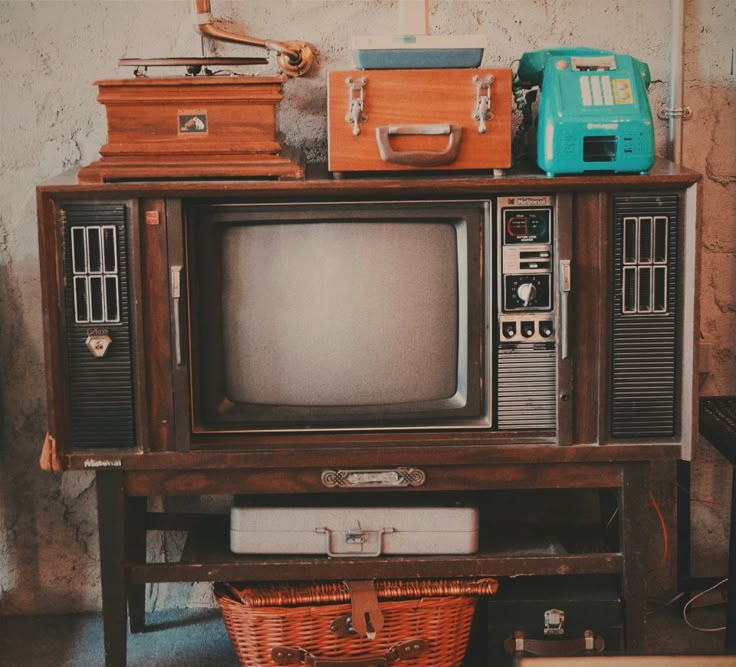
- Cabinets, The set as furniture and as sculpture. Veneered consoles with doors that closed, Bakelite table sets, moulded plastic shells, Soviet cabinets, the slim panel hung on a wall. For most of the century the cabinet was the part of a television anyone actually looked at, and it changed faster than the electronics behind it. Model designations here are often unverified, so these are captioned by what is visible.
- Showrooms, Where sets were sold and watched in public. Shop windows with crowds outside, department store television departments, rental showrooms, appliance dealers, Soviet electronics counters, walls of identical screens in a warehouse store, and trade fairs. Sets were bought, rented and watched collectively long before most households owned one.
- Factories, Production lines and plant interiors: glass forming, frit sealing, phosphor screening, gun mounting, evacuation, ageing racks, chassis assembly, coil winding, wave soldering, and the panel cleanrooms that replaced all of it. The story runs from America and Europe to Japan, then Korea, then China, and it is told here in Russian, German, Japanese, Korean and Chinese sources as well as English, because an English search alone ends it in Japan in 1985.
- Living Rooms, The set in domestic use, as an object in a room. Families around a console, the neighbour's house and the pub, rooftop aerials, remote controls, folding trays, and the same scene in Soviet, Japanese, British, American, Chinese and Indian homes. A television is a piece of furniture before it is anything else, and the room shows how it was used.
- Repair, The service trade as objects and people: repairmen with valve caddies, tube testers, workshop benches, oscilloscopes, service manuals and schematics, a chassis pulled out onto the living room floor, and the modern restoration bench. For decades a television was a repairable appliance with an entire trade behind it, and that trade has an unusually strong presence on film today.
- Scrapyards, The afterlife. Dumped sets at the kerb, stockpiles of cathode ray glass, recycling floors, electronic waste grounds, museum stores and conservation benches, collector shelves of professional monitors, and smashed tubes. A twelve inch tube holds about half a kilogram of lead and a thirty-two inch one up to three, with the funnel glass a fifth to a quarter lead oxide, which is why a dead set is a disposal problem rather than rubbish.
- - Disco di nipkow per televisore meccanico. Disco di Nipkow in alluminio a spirale di fori (ovvero i fori sono disposti a spirale in prossimità del bordo più esterno). Ha quattro razze con una superficie verniciata di nero. Funzione Disco utilizzato per analizzare e riprodurre le immagini in un televisore meccanico Fracarro.
- - Windmill Tower, Wickham Terrace, Brisbane. Reports differ on whether the Telephane was successfully implemented. The first television broadcast in Australia took place on 30 September 1929 at the Menzies Hotel in Melbourne, using the electro-mechanical Radiovision system. Other transmissions took place in the city over the next few weeks.
- - Cathode Rays Figure 1. Figure 1 from J. J. Thomson's paper Cathode Rays, published in 1897. Thomson's work established that cathode rays were streams of particles, which is the physics every later picture tube depended on.
- - Cathode Rays Figure 4. Figure 4 from Thomson's 1897 paper Cathode Rays. The apparatus measures how far a beam bends under a magnetic field, the same effect a deflection yoke later exploited to paint a picture. It is a published figure rather than a photograph.
- - JJ Thomson exp2. A diagram of Thomson's 1897 cathode ray experiment, showing the ray in blue being bent by an electric field in yellow. Deflecting a beam under electrical control is the single effect every picture tube depends on, so this experiment is the direct ancestor of the television screen.
- - Televisón de los 1900. A model of a television of the 1900s, built to show the arrangement that followed Nipkow's invention of the scanning disc. Nipkow patented the disc in 1884, decades before anyone transmitted a moving picture with one.
- - Phantoscope charles francis jenkins. The Phantoscope and a phantoscope picture roll, Jenkins's early motion picture apparatus. Jenkins came to television from film projection, which is why his approach was built around mechanically moving images rather than electronics.
- - Radio equipment - Indiana State Museum - DSC00410. Early radio and television equipment, Indiana State Museum, 650 West Washington Street, Indianapolis, Indiana, USA. Left to right: 1915 De Forest Audion vacuum tube was the first device which could amplify electrical signals, creating the field of electronics. 1923 Crosley "Pup" radio; this single tube receiver was manufactured in Cincinatti.
- - MC Macau hotel room 鷺環海天度假酒店 Grand Coloane Resort 1918 Estrada de Hac Sa 路環 黑沙馬路 May 2017 Lnv2. A flat panel television in a hotel room at the Grand Coloane Resort on Hac Sa Road, Coloane, Macau, photographed in May 2017. Hotel rooms were among the first places most people encountered a wall mounted panel, because hotels replaced their sets faster than households did. The 1918 in the address is a street number and not a date.
- - Vladimir Zworykin and historic TV tubes. Zworykin standing in front of a display of some of the historic television tubes he invented. Working at Westinghouse and RCA laboratories from 1923 through the 1940s, Zworykin invented the first successful electronic-scan television systems, including the widely used iconoscope camera tube.
- - Charles Francis Jenkins and G. E. Arneman. Charles Francis Jenkins with G. E. Arneman arriving at Langley Field, where Jenkins lectured the Army Tactical School in January 1923. Jenkins courted military interest early, and US Navy representatives were present at his public demonstration of radio transmitted images in June 1925.
- - Dr. David Todd & C.F. Jenkins, 8-21-24 LOC npcc.11973. Dr David Todd and Charles Francis Jenkins, seated in front, photographed in August 1924 for the National Photo Company. Jenkins was working towards the public demonstration he gave in June 1925, when he transmitted the silhouette of a model windmill by radio.
- - 1925 Events Collage V 1.0. Clockwise: Tri-State tornado outbreak Sheikh Said rebellion Mein Kampf Great Syrian Revolt Incident at Petrich St. Nedelya Church assault 1925 Dali earthquake First working television system / John Logie Baird.
- - Baird TV 1926a. Television receiving apparatus used by John Logie Baird in the demonstration he gave to members of the Royal Institution. That demonstration, on 26 January 1926, was Baird's first public showing, distinct from the private achievement of 2 October 1925 when he first got a recognisable image of Stooky Bill at 32 lines. Most accounts merge the two events.
- - John Logie Baird and Stooky Bill. British inventor John Logie Baird and his first publicly demonstrated television system, with which he transmitted moving pictures March 25, 1925 at the London department store Selfridges. This was one of the first demonstrations of television technology. The selenium photoelectric tubes he used had such low sensitivity that human faces could not be televised due to their low contrast.
- - John Logie Baird and television receiver. Scottish television pioneer John Logie Baird (left) and his television receiver. This was one of the world's first television systems, with which Baird demonstrated transmission of moving images in 1925. The transmitter consisted of a spinning disk with 30 lenses in it which focused light from a spot on the image onto a selenium photoelectric cell.
- - C.F. Jenkins & J.W. Robinson, 6-15-25. Charles Francis Jenkins with J. W. Robinson, photographed on 13 June 1925, the day Jenkins publicly demonstrated the transmission of moving images by radio. He sent the silhouette of a model Dutch windmill turned by an electric fan from the Naval Radio Station at Bellevue to his rooftop on Connecticut Avenue, with US Navy representatives present.
- - Motion pictures by radio coming soon. Motion pictures by radio is very near, predicts C. Francis Jenkins,. Francis Jenkins, who has designed this small radio- vision receiving set for use in the homes. It is only a few inches square and is attached to the regular radio receiving set. A miniature motion picture screen is placed on the wall of your home, as shown in this photo.
- - Charles Francis Jenkins, inventor, 1925. The inventor Charles Francis Jenkins, photographed in 1925 on a glass plate negative. Jenkins demonstrated radio transmitted moving images publicly on 13 June 1925, seven months before Baird's public demonstration, a fact British accounts routinely leave out.
- - The JLB Digital Archive - In 1925 Robert Shaw was 'Televised' by John Logie Baird. On Robert Shaw being televised by Baird in 1925. The specific claim Baird holds up best is tonal gradation, meaning grey values rather than black-and-white silhouettes, which is the thing Jenkins shadow images did not have.
- - Baird TV 1926b. A second view of the receiving apparatus Baird used before members of the Royal Institution in January 1926. The receiver is an assembly of exposed mechanism rather than a cabinet, because at this stage nothing about the equipment was intended for a domestic room.
- - Baird TV 1926c. Baird's Royal Institution receiving apparatus of 1926 photographed from another angle, showing the scanning mechanism and its drive. The picture was assembled by a perforated disc spinning in front of a lamp whose brightness varied with the signal.
- - Baird TV 1926d. Further receiving apparatus from Baird's 1926 demonstration to the Royal Institution. The audience were scientists rather than the public, and the equipment was set up to be examined at close range rather than merely watched.
- - Baird TV 1926e. The last of the series showing the apparatus Baird used at the Royal Institution in January 1926. Baird's mechanical system produced a 32 line image, fewer than the 40 lines Takayanagi displayed on a cathode ray tube in Tokyo in December of the same year.
- - Francis Jankins [i.e. Charles Francis Jenkins] qui transmet par radio des cartes géographiques renseignant. Sujet : Jenkins, Charles Francis (1867-1934) -- Portraits Portraits -- 1914-1945 Référence bibliographique : Rol, 118186 Appartient à l’ensemble documentaire : Pho20Rol Image de presse Couverture :.. avril 1927 Langue : français.
- - Mechanical television receiver 1927 - Indiana State Museum. A prototype mechanical television receiver built by Morris VanWay for RCA in 1927. The video signal from a receiver was applied to the neon bulb at top, and it was viewed through holes in the spinning disk (Nipkow disk) at rear, which created the scan lines, resulting in a dim orange monocolor image about one inch square. Before modern electronic scan television systems were developed around World War 2, the first television systems used this mechanical scan technology.
- - Baird Television Receiver, 1928. A Baird receiver for home use, photographed in 1928 with Captain O. G. Hutchinson, one of Baird's associates, pointing at the viewing aperture. The picture appeared in that small opening rather than on a screen as later understood.
- - Early Television System Diagram. Diagram of an early mechanical-scan television system. This technology was used in the first experimental television broadcasting stations in the 1920s and 1930s, before it was replaced by modern electronic-scan television systems in the 1940s.
- - Gernsback Television 1928. Hugo Gernsback watching television in his Manhattan apartment in August 1928. The picture is 1.5 inches square. This low definition image has 48 scan lines at 7.5 frames per second.
- - Radio Listeners Guide Fall 1928 Cover. The cover of the Radio Listeners' Guide and Call Book for November 1928, whose artwork imagines what television would become. It is an artist's projection from a moment when actual receivers showed a postage stamp sized image built from 30 scanning lines.
- - Radio News Apr 1928 pg1098. Television Comes to the Home Radio News, April 1928. Volume 9 Number 10. Published by Experimenter Publishing, New York, NY Editor-in-Chief and Publisher: Hugo Gernsback Image:Radio News Apr 1928 pg1098.png Image:Radio News Apr 1928 pg1099.png Image:Radio News Apr 1928 pg1100.png The page numbers were on an annual basis, not per issue.
- - Radio News Nov 1928 Cover. Hugo Gernsback in his Manhattan apartment is watching a television broadcast from his WRNY station in August 1928. The 1.5 inch square picture is low definition; 48 scan lines at 7.5 frames per second. Hugo is holding the manual synchronization control.
- - Radio News Nov 1928 pg422. How to Make Your Own Television Receiver. Experimenter Publishing's WRNY began transmitting experimental television in August 1928 to viewers in New York City. Most viewers built their own set.
- - Radio News Nov 1928 pg423. A page from Radio News of November 1928 setting out how to build a television receiver at home. The magazine assumed a reader competent with a soldering iron, because in 1928 there was almost nothing to buy ready made.
- - Radio News Sep 1928 Cover. The ideal television of the future. The realistic television of 1928 can be seen on the November cover Image:Radio News Nov 1928 Cover.jpg. These early experimental televisions could not maintain synchronization with the camera.
- - Science and Invention Nov 1928 pg618. Instructions for building a television receiver, published in Science and Invention for November 1928. The magazine expected readers to construct the apparatus themselves, because in 1928 there was practically nothing available to buy ready made.
- - Science and Invention Television 1928. A woman watching an early homemade experimental mechanical television receiver in 1928, from Hugo Gernsback's magazine Science and Invention. During the 1920s some radio stations began broadcasting experimental television programs, which could be viewed by mechanical "televisor" receivers like this one. The video signal from the receiver (left) is applied to a neon lamp in the viewer (right).
- - Ernst Alexanderson with television receiver, 1928 NYT photo. Ernst Alexanderson operating a receiver in 1928, with the picture appearing in the small aperture at the top of the cabinet. The original caption points out the aperture, because a reader in 1928 would not have known where to look.
- - Television Schematic 1928. A schematic published in 1928 under the heading How to Make Your Own Television Receiver. Experimenter Publishing's station WRNY began experimental transmissions to New York viewers in August 1928, and readers were expected to build the receiving apparatus themselves from plans like this one.
- - Charles Francis Jenkins. 13 June 1925, seven months before Baird's public demonstration. He transmitted a model Dutch windmill turned by an electric fan, with US Navy representatives present. British accounts of television's invention routinely omit him.
- - First television broadcast NBC. Publicity photo National Broadcasting Company (NBC) issued for their 30th anniversary in 1956. The photo depicts their work in television beginning in 1928. The Felix the Cat doll shown in the photo was used by the company for over a decade beginning with mechanical television in 1928 and continued to be used to help develop electronic television.
- - Group. Charles Francis Jenkins (2nd from left) showing his Mirror Drum Television Receiver. Charles Francis Jenkins, second from left, showing his mirror drum television receiver to a group. A mirror drum used angled mirrors around a rotating cylinder instead of a perforated disc, giving a brighter picture for the same scanning rate.
- - Identified! (Group. Charles Francis Jenkins (2nd from left) showing his Mirror Drum Television Receiver) (LOC). Charles Francis Jenkins, second from left, demonstrating his mirror drum television receiver to a group, photographed by Harris and Ewing. The mirror drum used angled mirrors on a spinning cylinder in place of a perforated disc.
- - John Logie Baird, negative, 1928 (Lafayette; NPG x49619). John Logie Baird photographed by Lafayette on a whole plate film negative in March 1928. 1928 was the year Baird transmitted a picture across the Atlantic from London to Hartsdale, though the exact date of that transmission is not established.
- - Phonovision record 1928. A Phonovision record of 1928, Baird's attempt to store a 30 line television picture on a gramophone disc. Because the mechanical signal was slow enough to fit within audio bandwidth, it could be cut to a record, making these among the earliest recordings of a television image.
- - Radio News Sep 1928 pg222. The Scanning Disc, Television's Canvas Radio News, September 1928. Volume 10 Number 3. Published by Experimenter Publishing, New York, NY Editor-in-Chief and Publisher: Hugo Gernsback Table of Contents Image:Radio News Sep 1928 pg194.png The page numbers were on an annual basis, not per issue.
- - Vladimir Zworykin and a cathode ray tube, 1929 NYT. Vladimir Zworykin with the cathode ray tube he developed for receiving television pictures, photographed for the press in 1929. The original caption claims the tube greatly simplifies reception, which was the commercial argument that eventually carried electronic television over the mechanical systems.
- - Zworykin kinescope 1929. Vladimir Zworykin with the kinescope, the receiving tube he developed at Westinghouse and later RCA. Zworykin's tubes gave RCA the electronic system that displaced mechanical scanning, though the patent priority fight with Farnsworth ran for years. The photograph is dated 1934 in the archive record.
- - Baird television, 1929. A Baird receiver of 1929, from the period when the BBC was transmitting 30 line pictures using Baird's mechanical system. The image was built up by a spinning disc pierced with a spiral of holes rather than by a tube.
- - Earle Rogers Co., Wheeling's quality furniture store, 12th and Main Sts., Wheeling, W. Va. The Earle Rogers Company furniture store at 12th and Main Streets in Wheeling, West Virginia. Television was sold through furniture dealers before it was sold through electronics shops, because the set was bought as a piece of furniture.
…and 1,035 more moments.
Full text archive: /loreline-text/television.md