Cornelia Sollfrank (co-founder) — Old Boys Network — cyberfeminist collective
1997
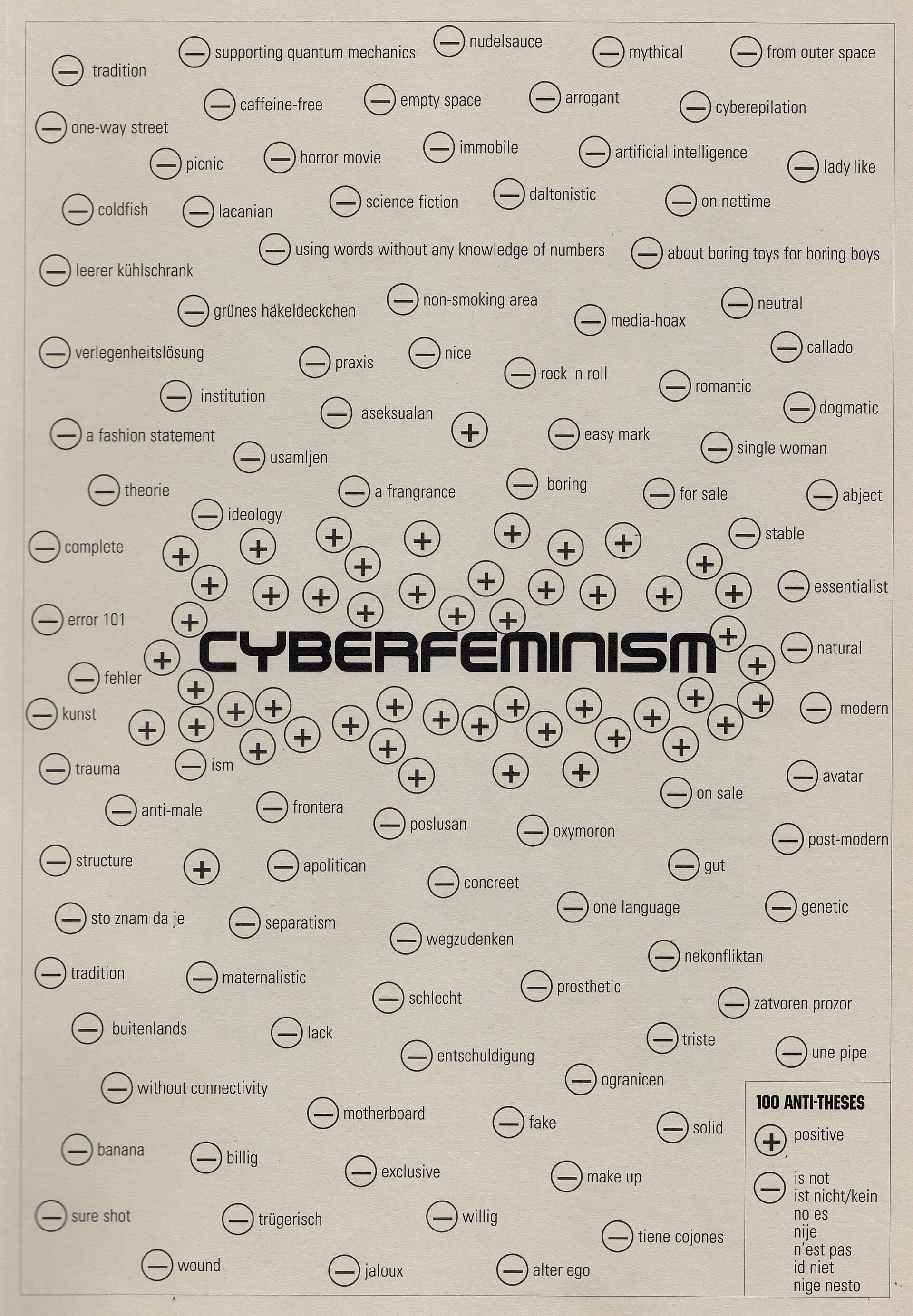
Artists: Cornelia Sollfrank (co-founder), Susanne Ackers, Julianne Pierce, Ellen Nonnenmacher, Valentina Djordjević · Year: 1997 · Medium: Cyberfeminist collective — conferences, publications, exhibitions, online platform · Substrate: Mailing-list infrastructure, physical conferences (First Cyberfeminist International Kassel 1997), publishing operations · Place: Berlin / Hamburg / Vienna / Helsinki · Institution: Old Boys Network (self-organized international collective) Cornelia Sollfrank, Yvonne Volkart, Helene von Oldenburg, and Verena Kuni co-founded Old Boys Network (OBN) in Kassel in September 1997 during the documenta X exhibition, in response to what Sollfrank and her collaborators had diagnosed as the masculine incorporation of net.art's then-emerging canon. The collective took its name from a deadpan inversion: in the 1990s the "old boys' network" was the default mechanism by which men passed opportunity among themselves, and OBN proposed that a deliberately cyberfeminist counter-network could use the same methods — mutual advocacy, collaborative visibility, shared infrastructure — for women working in network art and theory. OBN operated as both a mailing list and an organization. It ran the First Cyberfeminist International in Kassel in 1997, a three-day symposium whose 37 participants included Shu Lea Cheang, Rosa Menkman's predecessors, Faith Wilding (then working inside Critical Art Ensemble), and dozens of women who would become the next decade's most visible European and North American net-artists. The group published the OBN Reader in 1999. Subsequent Cyberfeminist International meetings in Rotterdam (1999) and Hamburg (2001) sustained the organization into the early 2000s. What OBN argued, operationally and explicitly, was that the 1990s celebration of net.art as a frontier of free radical practice was obscuring a measurable gender disparity in who was being published, invited, and historicized. Sollfrank's own practice from the same period — the 1997 Female Extension project, in which she submitted hundreds of plausible fictional female artists' work to the "Extension" competition of Hamburger Kunsthalle's net.art exhibition, causing an overwhelming majority of submissions to appear female — made the disparity visible as a statistical fact. The intervention worked: the museum reported a sudden spike in female-identified submissions and had to revise its framing of the competition. OBN's archive was one of the earliest net.art collectives' to be systematically preserved. It lives at the obn.org domain, which the group still owns. Lore Sollfrank was a visual artist before she was a cyberfeminist and had been running her own net.art projects for a couple of years when the Kassel meeting happened. The four co-founders met in person during documenta X and chose the OBN name in a bar over several evenings of arguing about whether the reference would read as ironic enough. Sollfrank has said in subsequent interviews that the 1997 Kassel First Cyberfeminist International was organized on essentially zero budget — space donated by Hybrid Workspace, a loose coalition of Kassel spaces; travel paid out of pocket; the 37-participant gathering ran on institutional goodwill and free internet access. She continues to work as a researcher and is now at the Leuphana University of Lüneburg where she runs a research centre specifically on the culture of free art. Sources • Sollfrank, Cornelia (ed.) — The Beautiful Warriors: Technofeminist Praxis in the Twenty-First Century (Minor Compositions, 2020). • OBN Reader (Old Boys Network, 1999). • obn.org — Old Boys Network archive.
Source: daoracle.com
Part of Digital Art · Watch in the documentary
More from Digital Art
- Critical Art Ensemble (founded 1987) — Critical Art Ensemble — Electronic Civil
- Cornelia Sollfrank — Female Extension
- Mark Amerika — Grammatron
- M.River (Tim Whidden) — MTAA — Simple Net Art Diagram
- Form Art — Alexei Shulgin's HTML-form artworks
- Heath Bunting — _readme.html (Own, Be Owned, or Remain Invisible)