Silver Suits and a Chorus of Rumour
MAY 15 2007 · 12:25
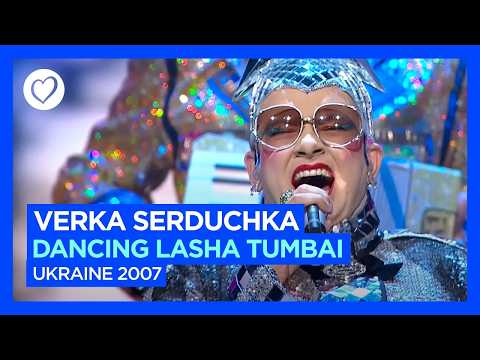
Verka Serduchka · "Dancing Lasha Tumbai" · Ukraine · 2007 Placement: 2nd · Language: German / English / Ukrainian / Russian · Composers: Andriy Danylko · Venue: Hartwall Arena · Host: Helsinki, Finland · Type: scandal · Broadcast: HD On May 12, 2007, at the Hartwall Arena in Helsinki, the Ukrainian comedian Andriy Danylko appeared on the Eurovision stage in full Verka Serduchka drag: a silver-foil costume, a bright pink lipstick, a large star-shaped headpiece and an attitude that fell somewhere between Soviet-era train conductor and drag-club MC. 'Dancing Lasha Tumbai' was a relentlessly upbeat dance track, its lyrics a multilingual jumble of German ('sieben sieben ai lyu lyu'), English ('I want to see') and deliberately nonsensical phrases, including the titular 'lasha tumbai' — glossed by Danylko as 'whipped cream' in a possibly invented language, but widely heard by Russian-speaking audiences as sounding suspiciously like 'Russia goodbye'. The performance was pure high-camp energy: Serduchka and her silver-clad dancers stomping in unison across a stage drenched in disco lighting, with more visible joy than anything else in that year's final. Televoters across Europe, particularly outside Russia, responded enthusiastically. Ukraine finished second, beaten only by Serbia's Marija Šerifović, and the result was read — rightly or wrongly — as a significant pan-European endorsement of a drag artist performing a song heard by many as mocking Moscow. Context 2007 was a year of sharpening tensions between Ukraine and Russia. The afterglow of the 2004 Orange Revolution was fading; Vladimir Putin's Munich speech in February of that year had marked an open turn in Russian foreign policy; gas disputes between Moscow and Kyiv had already made international news. Eurovision itself was in its maximalist late-2000s phase — huge stages, heavy televote dependence, Eastern European countries increasingly dominant. Drag performance was not new to the contest, with Dana International's 1998 win still a recent memory, but Verka Serduchka was a distinctively post-Soviet creation: a drag character rooted in kitsch and working-class nostalgia rather than high-glamour. The multilingual lyric, the deliberate absurdity and the silver costuming all read, in 2007, as a specifically Eastern European form of camp. Legacy 'Dancing Lasha Tumbai' became one of the most enduring Eurovision songs of the 2000s, regularly topping retrospective polls despite not winning. It was reinterpreted politically after Russia's 2014 annexation of Crimea and especially after the 2022 full-scale invasion, when Danylko publicly embraced the 'Russia goodbye' reading and performed an explicitly changed version of the lyric. For Ukraine, the performance became a durable cultural symbol of irreverence toward Moscow. For the contest, it demonstrated that a non-winning performance could have a larger cultural afterlife than many winners, and it further normalised drag as a mainstream Eurovision presence. It also cemented the template of the deliberately absurd, multilingual, televote-friendly camp anthem. Mythology It is now frequently asserted that 'Lasha Tumbai' was always intended to mean 'Russia goodbye'. Danylko consistently denied this in 2007, only later embracing the reading. The song is also sometimes remembered as a Eurovision winner; it finished second to Serbia's Marija Šerifović and 'Molitva'.
Source: eurovisionoracle.com
Part of Eurovision · Watch in the documentary
More from Eurovision
- Eurovision Begins Its Long Argument About How to Count the Votes
- Israel Nearly Disqualified Over Iran-Referencing Lyrics
- Glam-Rock Revival Survives Eurovision's Plasticine Era
- Terry Wogan's 30-Year Crusade Against Eurovision Bloc Voting
- Ukraine's Mirror Cubes Set the Silver Body-Suit Standard
- Ani Lorak's Silver Becomes a Post-Crimea Casualty