A Countertenor in Basel
MAY 15 2025 · 12:00
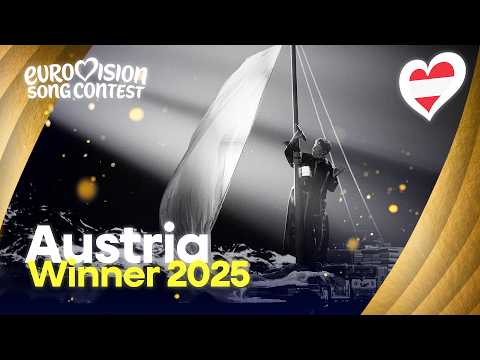
JJ · "Wasted Love" · Austria · 2025 Placement: 1st · Score: 436 · Language: English · Composers: Johannes Pietsch, Teodora Špirić, Thomas Thurner · Venue: St. Jakobshalle · Host: Basel, Switzerland · Type: winner · Broadcast: streaming On the night of 17 May 2025 at the St. Jakobshalle in Basel, a twenty-four-year-old Austrian-Filipino countertenor who moonlit at the Vienna State Opera stepped into a black-and-white visual field — the stage lit like a chiaroscuro painting — and won the 69th Eurovision Song Contest with a song that started as an operatic lament and ended as a techno-adjacent breakdown. JJ, real name Johannes Pietsch, had emerged from Austria's revamped national selection the previous autumn with 'Wasted Love' — a three-minute piece that essentially splits in half. The first half is voice-and-piano; the second half turns into a BPM-driven, rave-lit climax. The staging used a rocking-boat visual image — JJ tilted on a platform — and almost no color at all. The jury handed him 258 points, the largest jury tally of the night, and eight countries — Belgium, Finland, Germany, Ireland, Latvia, the Netherlands, Norway, and Sweden — awarded him the maximum twelve. The televote was tighter; Israel's Yuval Raphael led the public vote with a late surge. But the combined total — 436 — settled the contest in Austria's favor. It was Austria's third Eurovision win, after Udo Jürgens in 1966 and Conchita Wurst in 2014. The continuity, in the moment, felt almost scripted: another countertenor-adjacent voice, another Austrian delegation unafraid of staging as art object, another win that would hand the contest back to Vienna the following year. Context Basel had taken on the 2025 contest as Switzerland's first host slot since 1989, following Nemo's 'The Code' victory in 2024. The delegation lineup was unusually competitive: Israel, Estonia, France, Sweden, and Austria all looked within reach of victory in pre-contest analysis. 'Wasted Love' had been building quietly from the Austrian national selection through to spring betting markets, but its win was not pre-ordained — the televote split across multiple delegations and the jury consensus around JJ's vocal performance ultimately tipped the balance. JJ's dual track as an operatic singer and a pop artist was itself unusual: he had reportedly performed at the Vienna State Opera's children's chorus as a teenager and continued training as a countertenor while releasing independent pop material. Legacy Austria's third win placed ORF in the position of hosting Eurovision 2026, widely expected to be staged in Vienna. 'Wasted Love' became one of the fastest-streaming Eurovision tracks of the decade in its first weeks, and the song's hybrid-operatic-electronic structure has already become a reference point in fan community discussions about where the contest is heading aesthetically. JJ has continued performing both opera and pop work, and the Austrian delegation is being studied closely by other public broadcasters looking to rebuild their own pipelines. Mythology People already misremember 'Wasted Love' as a traditional operatic piece throughout — it is more accurately a two-part structure with an electronic second half. JJ is also sometimes misidentified as a soprano; he is a countertenor, which is a distinct vocal classification. And Austria's win is often framed as its second after Conchita — it is the third, with Udo Jürgens 1966 ('Merci, Chérie') being the first.
Source: eurovisionoracle.com
Part of Eurovision · Watch in the documentary