The Warrior Princess Template
MAY 15 2004 · 12:10
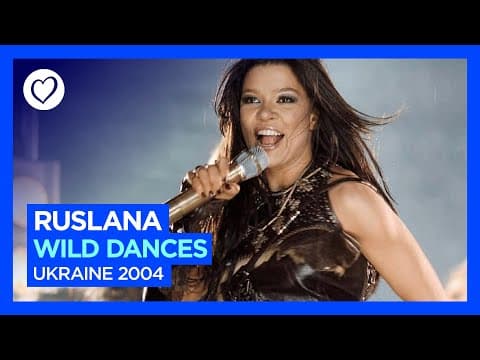
Ruslana · "Wild Dances" · Ukraine · 2004 Placement: 1st · Language: English / Ukrainian · Composers: Ruslana Lyzhychko, Oleksandr Ksenofontov · Venue: Abdi İpekçi Arena · Host: Istanbul, Turkey · Type: national debut · Broadcast: satellite On May 15, 2004, at the Abdi İpekçi Arena in Istanbul, Ruslana Lyzhychko stormed onto the Eurovision stage in a leather and fur costume that read as equal parts Carpathian folk dress and Xena: Warrior Princess, cracked a long whip above her head, and launched into 'Wild Dances'. The song fused Hutsul mountain-folk motifs — trembita-style horn calls, modal hooks, Ukrainian-language interjections — with a driving, almost tribal English-language chorus and a choreography that had her leading a troupe of similarly costumed dancers in unison stomps and synchronised jumps. It was only Ukraine's second-ever Eurovision appearance, the country having debuted the previous year. The staging was physical to a degree the contest had rarely seen: drums on stage, fire effects, Ruslana herself singing live while moving at full performance intensity. The vocal was raw rather than pretty, and deliberately so — closer to a battle cry than a pop hook. Televoters across Europe responded with what became a decisive victory, and Ukraine, a country many Western European viewers had barely registered as a Eurovision participant, won the contest in its second year of eligibility. Context Eurovision 2004 was the first contest to introduce the semi-final system — a response to the unmanageable growth in participating countries following Eastern European expansion. Ukraine was in the final months of Leonid Kuchma's presidency; the Orange Revolution would break out later that year, in November 2004, putting Ukraine at the centre of European political attention. Ruslana's win preceded those events but is often read retrospectively in their light, as a cultural prelude. Istanbul hosting — Turkey's win the previous year with Sertab Erener's 'Everyway That I Can' — also reinforced the contest's geographical eastward pull. Televoting was fully dominant, and the era of the high-concept, physically demanding staged performance was beginning. Wild Dances arrived as something that felt both unmistakably Eastern European in its folk textures and unmistakably designed for a global televote. Legacy 'Wild Dances' set the template for what became one of Eurovision's most durable winning archetypes: a female lead, a fusion of national folk motifs with a contemporary pop-rock arrangement, a physically demanding live performance and a clear visual identity that translated to any language. Variations of it would recur for years afterwards — Helena Paparizou's 'My Number One' in 2005, Dima Bilan's 'Believe' in 2008, Jamala's '1944' in 2016, each owing something to Ruslana's model. Ruslana herself became a significant Ukrainian cultural and later political figure, active in the Orange Revolution protests and in subsequent public life. Ukraine's 2005 hosting in Kyiv turned Eurovision into a showcase for the country during a moment of intense international attention. Mythology It is sometimes claimed that 'Wild Dances' used authentic Hutsul folk samples directly; in fact the Hutsul elements were largely composed and arranged in the studio, inspired by rather than sampled from the tradition. Ruslana is also sometimes remembered as a political figure who won Eurovision; she was an established pop singer first, and only became prominently political after the contest.
Source: eurovisionoracle.com
Part of Eurovision · Watch in the documentary
More from Eurovision
- Ne ver', ne boysia: The Favorites Who Arrived Already Global
- Fame Academy Grad Fronts Post-Jemini UK
- Believe Me: Russia's Mid-2000s Eurovision Ascent
- Liechtenstein Has Tried to Compete Three Times and Been Rejected Every Time
- Lebanon's Eurovision Debut Ends Before It Starts
- Malta's Second Chiara Entry Almost Wins