Everyway That I Can: Turkey's Ethno-Pop Crown in Riga
MAY 15 2003 · 12:05
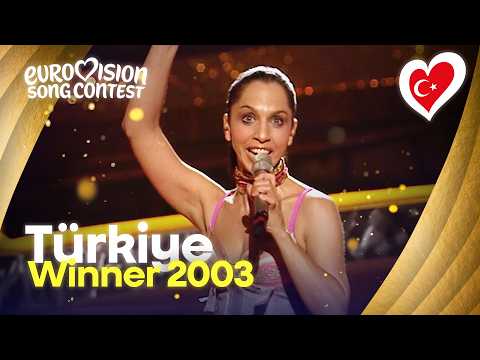
Sertab Erener · "Everyway That I Can" · Turkey · 2003 Placement: 1st · Score: 167 · Language: English · Composers: Demir Demirkan, Sertab Erener · Venue: Skonto Hall · Host: Riga, Latvia · Type: winner · Broadcast: satellite On May 24, 2003, at the Skonto Hall in Riga, Turkish singer Sertab Erener — a classically-trained vocalist whose career had run for over a decade through Turkish-pop and light-opera territory — performed 'Everyway That I Can,' a propulsive English-language ethno-pop song co-written with Demir Demirkan. The staging leaned fully into an orientalist-aesthetic fantasy: four female dancers in harem-inspired costume, Erener herself moving through a belly-dance-influenced choreography, the arrangement layering ney-flute and darbuka percussion over a clean pop chorus. The performance received the only standing ovation of the evening. At the close of voting, 'Everyway That I Can' had received 167 points, winning Eurovision for Turkey for the first and only time in the country's participation history. The song was also Turkey's first Eurovision entry performed entirely in English — a structural shift enabled by the 1999 abolition of the contest's national-language rule, and one that Turkey had debated publicly before committing to. Erener's victory arrived during a politically sensitive period in Turkey's EU-accession negotiations, and both Turkish and European commentators read the win as a moment of cultural rapprochement. Within a decade, however, Turkey had withdrawn from Eurovision entirely over scoring-rule disputes — a withdrawal that continues, making Erener's 2003 win an increasingly retrospectively-significant moment in the relationship between Turkish broadcasting and the European cultural infrastructure. Context Eurovision 2003 was held in Latvia following Marie N's 2002 win — the second consecutive Eurovision hosted in a former Soviet state. The contest had abolished its language rule in 1999, opening the door to English-language entries from countries whose languages had previously dominated their Eurovision submissions. Turkey had participated since 1975 without a single victory across more than twenty-five years of attempts; the 2003 entry was a calculated strategic shift into English-language ethno-pop explicitly designed to appeal to the contest's new televoting electorate, which included substantial Turkish diaspora populations across Western Europe. Sertab Erener was selected internally by Turkish-broadcaster TRT rather than through a national-final process. Demir Demirkan was a Turkish rock producer whose work had included heavier genre territory than his Eurovision contribution suggested. Legacy Turkey's 2003 win remains the country's only Eurovision victory as of 2026. Turkey hosted Eurovision 2004 in Istanbul — the contest's only visit to the country. Sertab Erener continued a substantial Turkish-pop career and has appeared at Eurovision anniversary events. The 'Everyway That I Can' ethno-pop template — Anglophone lyrics with instrumentation coded as national-cultural signifier — became one of the dominant Eurovision formulae for the mid-2000s, directly influencing Ruslana's 2004 winning 'Wild Dances,' Helena Paparizou's 2005 'My Number One,' and a range of subsequent entries. Turkey withdrew from Eurovision after 2012 citing voting-rule disputes, particularly objections to the re-introduction of jury voting and disagreements with the EBU over LGBTQ-content display. The country has not returned, and Erener's win increasingly reads as the peak of a national Eurovision participation that has since ended. Mythology Erener is sometimes described as a pure pop singer; she trained classically and had performed light opera before her pop career, which gives 'Everyway That I Can' more vocal-range range than some reviews suggest. The 2003 win is occasionally credited to Demirkan as sole composer; Erener was a co-writer. Turkey's withdrawal is sometimes described as permanent by treaty; it is a broadcaster-level withdrawal by TRT that could technically be reversed, though as of 2026 shows no signs of ending.
Source: eurovisionoracle.com
Part of Eurovision · Watch in the documentary