Barefoot on the Malmö Shore
MAY 15 2013 · 12:15
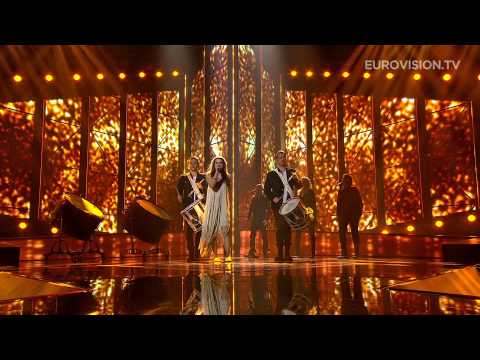
Emmelie de Forest · "Only Teardrops" · Denmark · 2013 Placement: 1st · Language: English · Composers: Lise Cabble, Julia Fabrin Jakobsen, Thomas Stengaard · Venue: Malmö Arena · Host: Malmö, Sweden · Type: winner · Broadcast: HD On the night of 18 May 2013, at the Malmö Arena in southern Sweden, a twenty-year-old Danish singer stepped onto a wind-swept stage barefoot, flanked by a flute and a war drum, and sang the contest into a different decade. Emmelie de Forest had drifted through the Danish national final like an apparition in a flower crown, but in Malmö the small, wide-eyed aesthetic hardened into something stranger — a folk anthem staged like a peace treaty. 'How many times can we win and lose? / How many times can we break the rules?' she sang, each line the product of a Swedish-Danish writing camp that had been engineering exactly this kind of pan-Scandinavian earworm for a decade. The drummer lifted his mallet. The camera pulled back on a stage designed, deliberately, to look like a landscape after war. Denmark had been the pre-contest favorite since March. When the votes completed — Sweden handing the title over the Øresund to its neighbor — de Forest climbed the stairs reportedly still barefoot, reportedly still composed, and delivered a reprise that the post-broadcast clips would stretch into the streaming years. Sweden's Loreen had ended one era in Baku. In Malmö, across the bridge, Denmark opened the next. Context Eurovision 2013 sat at a hinge. The contest had just survived Baku's human-rights controversies; Malmö was pitched as a deliberate correction — smaller arena, tighter budget, an event about songs rather than spectacle. The hosts framed it as 'We Are One,' a line Europe was still trying to believe as the euro crisis ground on and austerity politics hardened across the continent. YouTube had become the real second venue: Eurovision's channel was by now a permanent fixture, and 'Only Teardrops' was engineered, consciously or not, for that afterlife. The song's co-writer Thomas Stengaard was part of a Scandinavian pop-export machine that would, within a few years, supply much of the Anglophone charts. De Forest herself had been discovered at a folk festival. The juxtaposition — cottage-industry artist, industrial-grade song — defined where Eurovision was heading. Legacy 'Only Teardrops' became one of the decade's most-streamed Eurovision tracks and kept a long tail on European radio into 2014. Denmark hosted the 2014 contest in Copenhagen's B&W Hallerne, a converted shipyard — an ambitious build that reportedly ran well over budget and became a cautionary tale for future hosts. De Forest went on to co-write the UK's 2014 entry, one of the first winners to pivot quickly into Eurovision's backroom songwriting economy. Her barefoot-in-a-flower-crown image became a template imitated, to diminishing returns, for several contests afterward. The song itself lives on as a reliable anthem in compilation broadcasts and Eurovision retrospectives. Mythology People remember the barefoot and the flower crown; fewer remember that the song had been a betting favorite for months before Malmö and that its victory was among the least surprising in modern Eurovision history. The folk-waif image also obscures how professionally constructed the song was — a Scandinavian co-write assembled for exactly this outcome.
Source: eurovisionoracle.com
Part of Eurovision · Watch in the documentary
More from Eurovision
- Lithuanian Journalists Sting Azerbaijan's Vote-Buying Network
- The BBC sends a rock legend into the voting crater
- Germany's Euphoria-adjacent dance-pop hits the plagiarism probe
- Azerbaijan's Box Choreography Achieves Second
- Finland's Same-Sex Kiss Triggers Turkish Blackout
- Margaret Berger Turns the Stage Pure White