Golden Boots: Sweden's Post-ABBA Return
MAY 15 1984 · 12:00
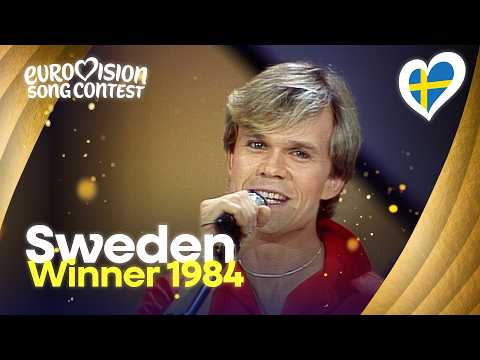
Herreys · "Diggi-Loo Diggi-Ley" · Sweden · 1984 Placement: 1st · Score: 145 · Language: Swedish · Composers: Torgny Söderberg, Britt Lindeborg · Venue: Grand Théâtre · Host: Luxembourg City, Luxembourg · Type: winner · Broadcast: color crt On May 5, 1984, at the Grand Théâtre in Luxembourg City — the duchy hosting for the first time since Anne-Marie David's 1973 victory — three brothers from a Swedish pop family, Per, Richard, and Louis Herrey, performed 'Diggi-Loo Diggi-Ley' in matching golden boots and coordinated pop-group choreography. The song was nonsense-syllable up-tempo schlager, with a chorus designed entirely around the title phrase's syllabic bounce. The matching outfits were chosen for television-visibility rather than continuity with Swedish pop tradition. The Herreys won with 145 points, giving Sweden its second Eurovision victory — ten years after ABBA's 1974 Brighton win. Sweden had spent the intervening decade honing its Melodifestivalen selection process into an industrial-scale pop pipeline, and the Herreys' victory confirmed that the country's Eurovision infrastructure could produce consistent winners. The golden-boots visual became the 1984 contest's single most-referenced image and has been cited in essentially every subsequent retrospective of 1980s Eurovision production aesthetics. Context Eurovision 1984 was hosted by Luxembourg following Corinne Hermès's 1983 Luxembourg win and represented a moment when the contest's aesthetic had stabilized into a recognizable mid-1980s pop idiom — synthesizer-backed schlager, group-act coordinated staging, English-or-Swedish lyrics with commercial-pop structures. Sweden had participated since 1958 without a win until ABBA 1974; the Herreys' 1984 victory marked the beginning of the country's sustained Eurovision dominance. The three brothers had performed as a family-pop group in Swedish markets before Melodifestivalen selection; their Eurovision entry was produced with the full commercial-industrial support Sweden had built around the contest. Luxembourg's 1983-84 double-hosting underscored the duchy's continuing Eurovision presence even as its winning-frequency was declining. Legacy The Herreys' 1984 win is one of Sweden's seven Eurovision victories and helped establish the country's post-ABBA template of commercial-pop-factory entries that would dominate subsequent decades — Charlotte Nilsson 1999, Loreen 2012 and 2023, Måns Zelmerlöw 2015. The golden-boots image remains one of the most-imitated Eurovision costume moments; subsequent Swedish entries have referenced the 1984 aesthetic. The Herrey brothers continued Swedish pop performance for years after the Eurovision peak. Melodifestivalen's post-1984 reputation as the most commercially-sophisticated Eurovision national selection traces directly to the 1984 result. Mythology The Herreys are sometimes described as an ABBA-adjacent act; they had no direct musical or business relationship to ABBA. The golden boots are occasionally claimed to have been a stylistic choice by the brothers; they were a production-team decision. The song's 'Diggi-Loo Diggi-Ley' phrase is sometimes described as having a specific meaning in Swedish; it is nonsense syllabic text chosen for rhythmic-vocal effect.
Source: eurovisionoracle.com
Part of Eurovision · Watch in the documentary
More from Eurovision
- Daniel Popović's 'Džuli' Gives Yugoslavia a Top-Five
- Chai: Ofra Haza's Eurovision Launch Into World Music
- Flamenco on the Eurovision Stage Earns Zero Points
- Eurovision's Fan Organization Is Founded in a Finnish Sauna
- La det swinge: Norway's First Win After Years of Humiliation
- Maria Christian's Weekend-Pop Lands Mid-Table