The Ribbentrop-Molotov Pact
AUG 23 1939 · 12:00
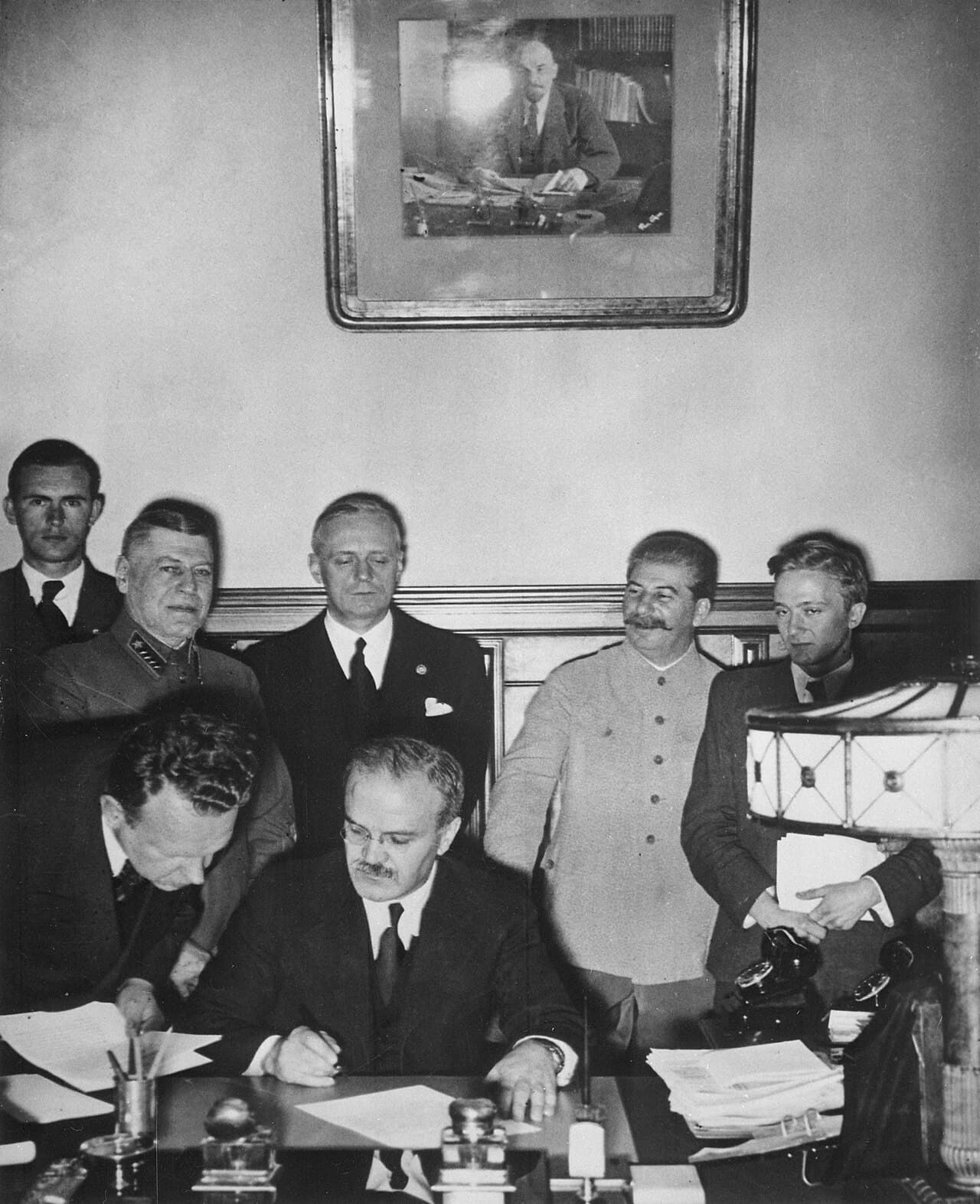
Vyacheslav Molotov signs the Soviet-German Non-Aggression Pact in Moscow as Joachim von Ribbentrop and Joseph Stalin look on, 23 August 1939. Place: The Kremlin, Moscow Figures: Joachim von Ribbentrop, German Foreign Minister · Vyacheslav Molotov, Soviet Foreign Minister · Joseph Stalin, observing the signature · Friedrich-Werner Graf von der Schulenburg, German Ambassador The Deepest Enemies Sign Negotiations move from trade talks in May to a political treaty by mid-August. Ribbentrop flies to Moscow on 23 August. The public Treaty of Non-Aggression, ten articles, commits each party not to attack the other and not to support any third party that attacks it. It is signed late that night in Molotov's office, with Stalin standing behind the table. The Secret Additional Protocol, four short articles, divides Eastern Europe into spheres of influence. The Baltic states north of Lithuania, eastern Poland, Bessarabia: Soviet. Lithuania and western Poland: German. A line runs roughly along the Vistula, the San, and the Narew. The protocol's existence is denied by Moscow for fifty years and confirmed only in 1989 when the Lithuanian SSR's commission accesses the German microfilm copy. Westphalian Raison d'État, Pure The deepest ideological enemies of the decade ally to dismember Poland. The Comintern reverses anti-fascist policy overnight; Western communist parties spend twenty-two months explaining that the imperialist war is none of their concern. The Soviet Union supplies Germany with grain, oil, manganese, and chrome until literally hours before the German invasion of June 1941. It is Westphalian raison d'état in its purest form: state interest unmoored from any ideological pretext. The alliances that produce 1914 (see [[august-1914-mobilization]]) had at least been ideologically plausible; the alliances of 1939 demonstrate that under sufficient pressure the Westphalian system will pair any two states whose immediate interests align. The pact lasts twenty-two months. Its territorial provisions outlast it. The Baltic states, partitioned in 1940, regain independence only in 1991. Video: Indy Neidell on the 23 August 1939 non-aggression pact and the secret protocol that partitioned Eastern Europe between Berlin and Moscow.
Source: westphalia-oracle.vercel.app