The Hague Peace Conference
2007
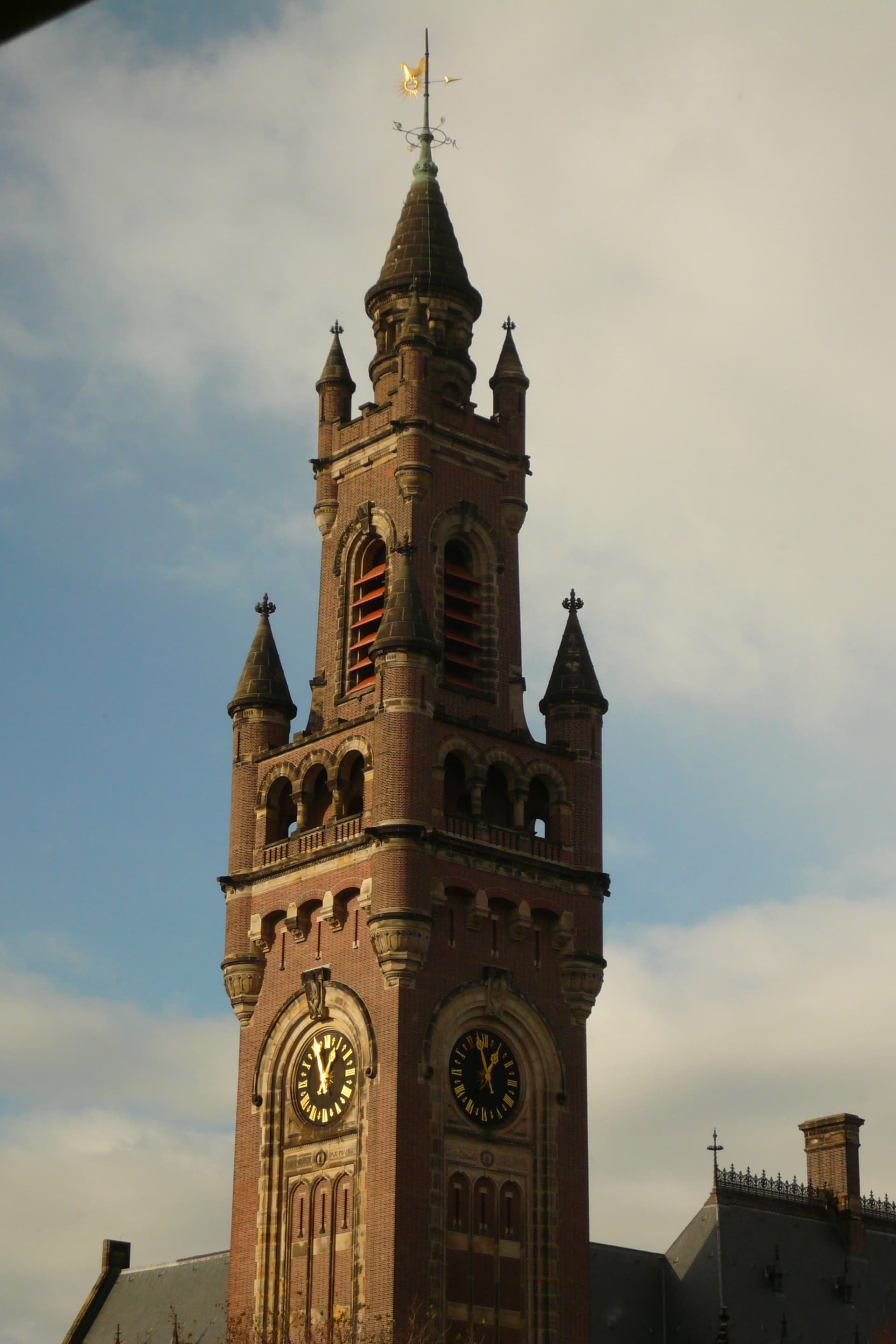
The Peace Palace at The Hague, built 1907 to 1913 to house the institutions born of the 1899 Hague Conference. Place: Huis ten Bosch palace, The Hague, Netherlands Figures: Tsar Nicholas II, convenor in name · Count Mikhail Muravyov, Russian Foreign Minister, the actual mover · Léon Bourgeois, French · Andrew Dickson White, United States · Frederic de Martens, Russian jurist, drafter of much of the legal text A Tsar Proposes Disarmament On 24 August 1898, Count Muravyov circulates a Russian note to all governments accredited to St Petersburg proposing an international conference on arms limitation. Russia's actual motive (it cannot afford to match the new rapid-fire field artillery the Austrians and Germans are introducing) is given a humanitarian wrapper. The proposal is met with some embarrassment in Berlin and Vienna and some enthusiasm in Britain and the United States. Twenty-six states accept. The conference opens at The Hague on 18 May 1899, Nicholas II's birthday, in the seventeenth-century summer palace of the House of Orange. Ten weeks of negotiation produce three conventions and three declarations. The First Convention establishes machinery for the peaceful settlement of international disputes and creates the Permanent Court of Arbitration. The Second codifies the laws and customs of war on land, drawing heavily on the work of the jurist de Martens. The Third extends the Geneva Convention to maritime warfare. Three declarations ban dum-dum bullets, projectiles diffusing asphyxiating gases, and (for five years, renewable) the discharge of explosives from balloons. Law That Cannot Bind The conference does not achieve arms limitation; the Germans block any binding cap. What it does achieve is the first systematic attempt to overlay the Westphalian system (see [[congress-of-vienna-1815]]) with codified multilateral law. The Permanent Court of Arbitration handles its first case in 1902 and a handful per year thereafter. The 1907 follow-up conference, with forty-four states attending, expands the conventions. A planned third conference for 1915 is cancelled by the war that begins the previous August. The poison-gas declaration is comprehensively violated at Ypres in April 1915. The dum-dum ban is violated throughout the war. The Belgian neutrality treaty (see [[belgian-independence-1831]]) had been similarly violated the previous August. The Hague conventions remain in legal force; they bind no one whose interest in violating them is sufficient. The League of Nations and the United Nations will inherit the same problem on a larger scale. The Westphalian system can codify itself; it cannot, by codification alone, compel its members to obey the codes they sign. The subject dates from 1899; this photograph was taken in 2007.
Source: westphalia-oracle.vercel.app