The League of Nations Founded
JAN 10 1920 · 12:00
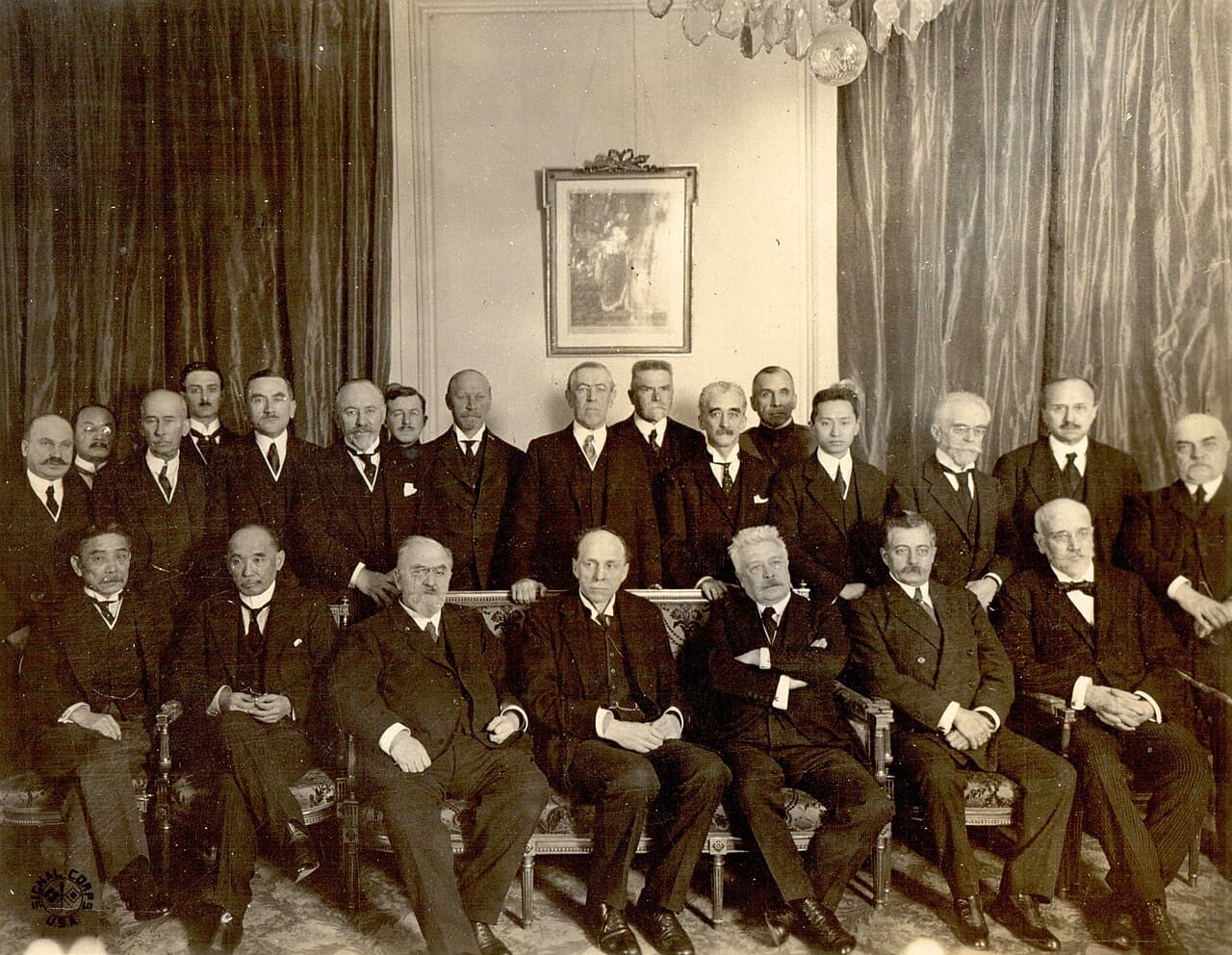
Members of the League of Nations Commission at the Paris Peace Conference, drafters of the Covenant that came into force on 10 January 1920. Place: Palais Wilson, Geneva, Switzerland Figures: Eric Drummond, first Secretary-General · Léon Bourgeois, French theorist of the League idea · Lord Robert Cecil, British architect · 42 founding member states · the United States, conspicuously absent A Standing Body for a Westphalian World The League comes into being on 10 January 1920 with the entry into force of the Treaty of Versailles (see [[treaty-of-versailles-1919]]). Forty-two founding members. Headquartered initially at the Palais Wilson, then from 1936 at the Palais des Nations on the lakeshore. Article 10 of the Covenant binds members to respect and preserve as against external aggression the territorial integrity and existing political independence of all members. Article 16 commits members to economic and military sanctions against any state that resorts to war in violation of its Covenant obligations. It is the first standing planetary body designed to constrain Westphalian sovereignty by collective security. The architecture is ambitious. The financing is thin: a budget around six million Swiss francs, a Secretariat of about 700 in its peak years. Born Without Its Architect The United States, having proposed the institution as Wilson's fourteenth point (see [[wilson-fourteen-points-1918]]), never joins. The Senate rejects ratification in November 1919 and again in March 1920, principally over Article 10's apparent commitment to collective force. Wilson collapses on a national speaking tour intended to break the deadlock and is incapacitated for the remainder of his term. Without American participation, the League cannot deliver either security or constraint. Germany joins in 1926 and withdraws in 1933. Japan withdraws in 1933. Italy withdraws in 1937. The Soviet Union joins in 1934 and is expelled in 1939 for invading Finland. By 1940 the Geneva offices are essentially shuttered. The institution survives juridically until 18 April 1946, when it dissolves and transfers its assets to the new United Nations (see [[un-charter-1945]]). Video: The Great War channel on the Covenant entering force 10 January 1920, the Senate's rejection of US membership, and the structural weaknesses built into Geneva from the start.
Source: westphalia-oracle.vercel.app