The Maastricht Treaty
2015
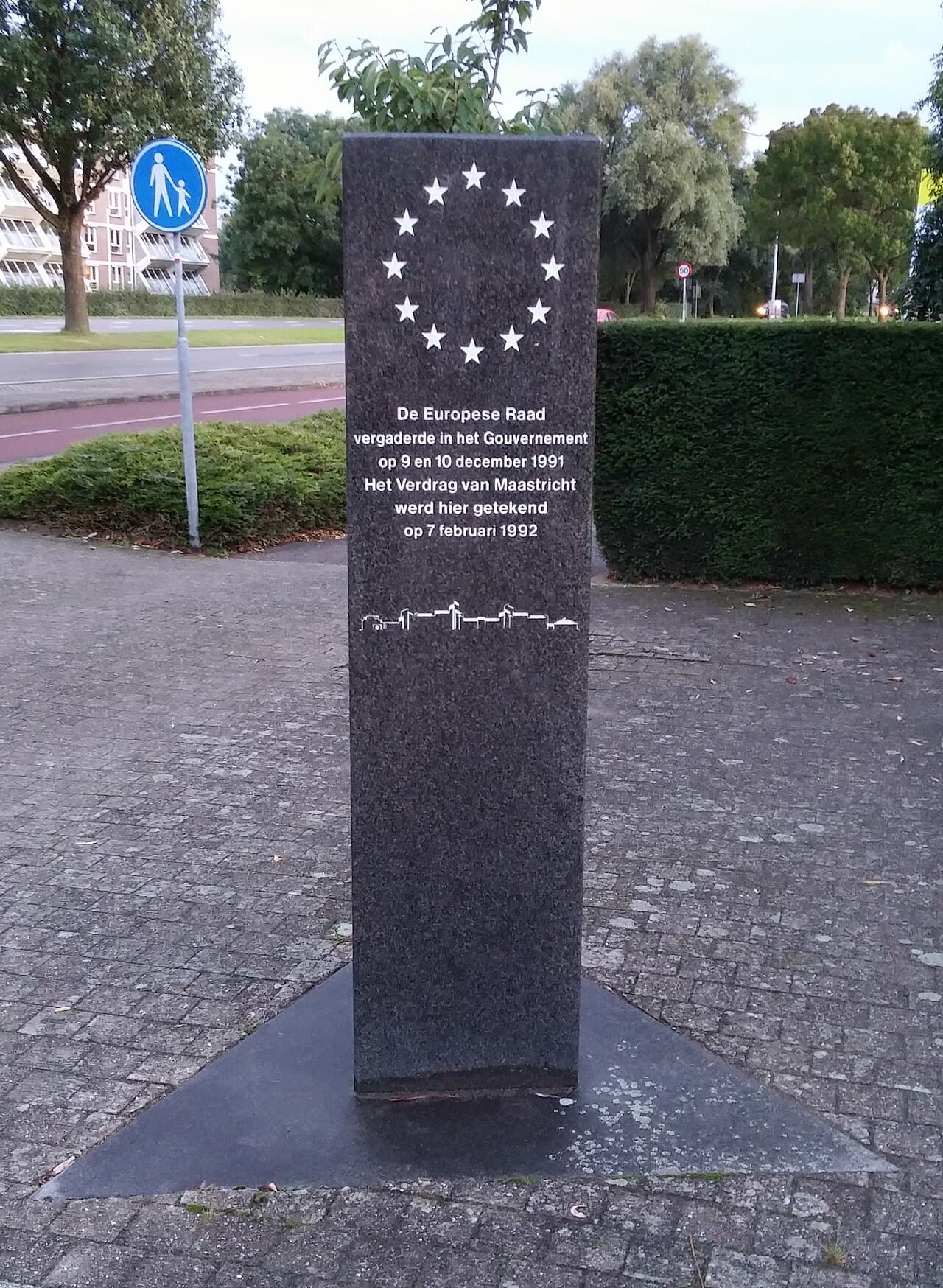
Memorial stone outside the Limburg provincial government building in Maastricht marking the signing of the Treaty on European Union, February 1992. Place: Maastricht, Limburg, Netherlands Figures: Jacques Delors, European Commission president · Helmut Kohl, German chancellor · François Mitterrand, French president · John Major, British prime minister (opt-out) · the foreign and finance ministers of the twelve member states Three Pillars The Treaty on European Union, signed at the Provinciehuis in Maastricht on 7 February 1992 by the foreign and finance ministers of the twelve European Community states, restructures the European project on three pillars. The first pillar is the European Communities themselves, now renamed the European Union, with new competences in education, public health, consumer protection, and (decisively) economic and monetary union. The second pillar is the Common Foreign and Security Policy. The third is Justice and Home Affairs, covering asylum, immigration, and judicial cooperation. Two of the three pillars are explicitly intergovernmental; the first is supranational, with binding effect through the Court of Justice in Luxembourg. The treaty also creates European citizenship, granting every citizen of a member state the right to live, work, and vote in local elections in any other member state. The Westphalian principle that a state defines who counts as a member of the political community (see [[peace-of-westphalia-1648]]) is, for the first time at scale, layered with a transnational citizenship that overrides it. The Currency and the Opt-Out The most consequential commitment is monetary. The treaty schedules the introduction of a single currency in three stages, with convergence criteria (3 percent deficit, 60 percent debt-to-GDP, inflation within 1.5 points of the three best performers, exchange-rate stability) that member states must meet to join. The euro will enter accounting use in 1999 and circulation in 2002. The deepest pooling of sovereignty above the Westphalian state in the system's history is being scheduled, in a treaty article, with deadlines. Britain negotiates an opt-out from the single currency, and Denmark a referendum-driven opt-out shortly after. The opt-outs preview, in 1992, the contradiction that will surface in Brexit. A state can pool monetary sovereignty or retain it; it cannot do both. The Maastricht text registers the choice as a footnote; twenty-four years later (see [[cracks]] era) the footnote becomes a constitutional crisis. Video: European Parliament retrospective on the signing of the Treaty on European Union at Maastricht, 7 February 1992, using archival footage of the ceremony at the Limburg provincial government building. The subject dates from 1992; this photograph was taken in 2015.
Source: westphalia-oracle.vercel.app