The Sack of Magdeburg
MAY 20 1631 · 12:00
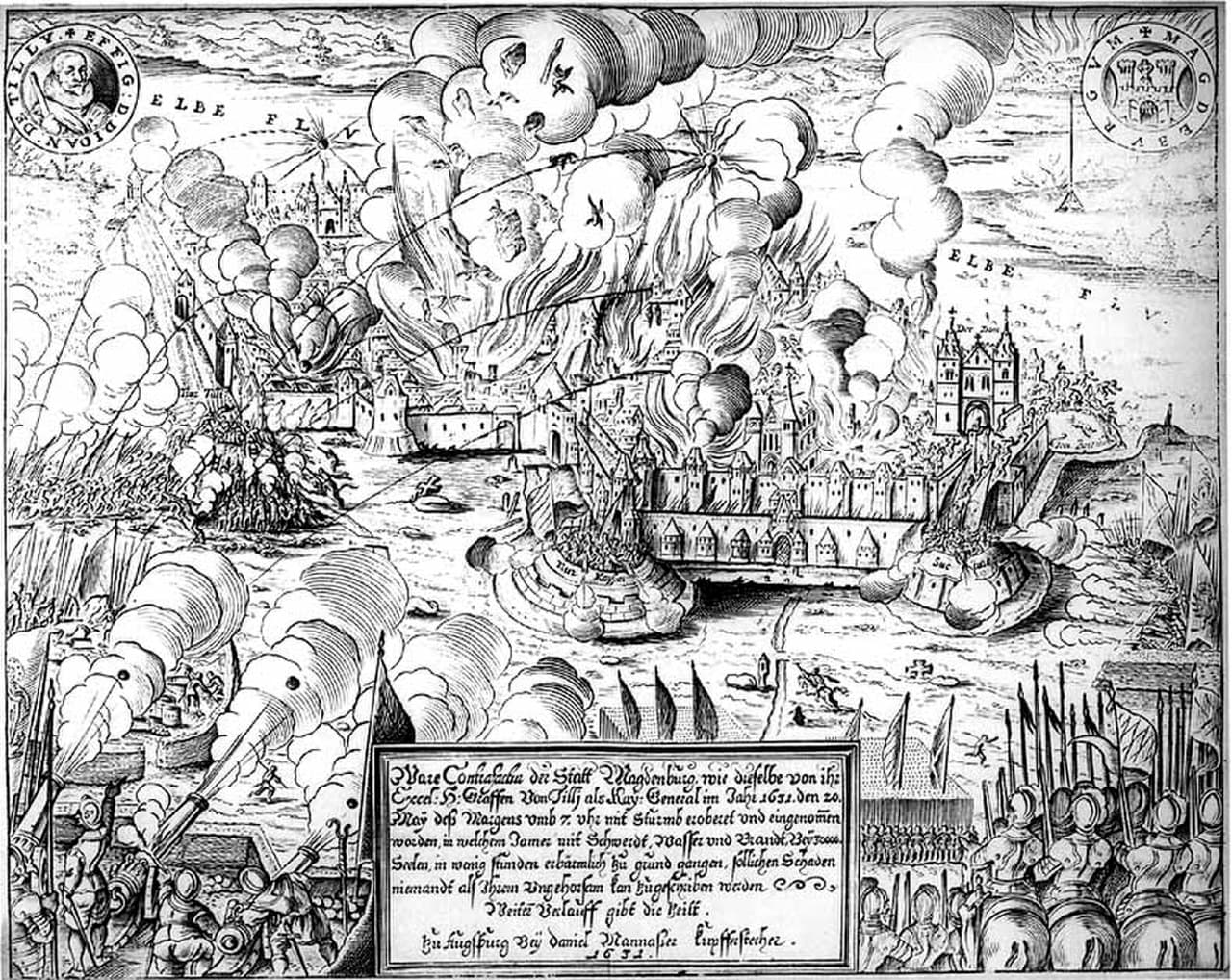
Magdeburg in flames after the Imperial sack of 20 May 1631, the war's defining atrocity. Place: Magdeburg, free imperial city on the Elbe Figures: Tilly, Imperial and Catholic League commander · Gottfried Heinrich Graf zu Pappenheim, cavalry commander · Dietrich von Falkenberg, Swedish-appointed city commandant (killed) · Christian William of Brandenburg, deposed administrator The City and the Promise Magdeburg, a free imperial city of perhaps 30,000 souls on the Elbe, has declared for Sweden in autumn 1630 on the strength of Gustavus Adolphus's promise to relieve any siege. Tilly's army arrives that November. Through the spring of 1631 the siege tightens; Swedish relief does not come, blocked by the diplomatic maneuvering required to extract a guarantee of passage from the Elector of Brandenburg. On the morning of 20 May the city falls. What follows over the next three days is the most notorious atrocity of the war, and one of the most notorious in European history. The fires that begin during the assault, possibly set by the defenders, possibly by Pappenheim's cavalry, possibly both, become unstoppable. By 23 May the city is ash. Perhaps 20,000 to 25,000 inhabitants are dead, the great majority of the population. Approximately 5,000 survivors are pulled from the cathedral, where Tilly has belatedly ordered the killing to stop. A Verb Enters the Language The pamphlet literature explodes. Roughly two hundred separate broadsheets and prints on the sack circulate within a year, the largest media event of the seventeenth century to date. Magdeburgisieren enters German as a verb meaning to obliterate utterly. The Swedish recruitment offices in the Protestant cities fill within weeks. Gustavus Adolphus, militarily late, is rhetorically transformed: the man who could not save Magdeburg becomes the man who will avenge it. Tilly, who had ordered no general massacre and could not control his troops once the assault opened, is now indelibly the butcher of Magdeburg in Protestant memory. The propaganda asymmetry is total. By autumn Saxony, which has spent twelve years trying to remain neutral, signs an alliance with Sweden. The next battle, three months later at Breitenfeld, will be Sweden's first major field victory and the beginning of the war's tactical revolution. Video: Twenty thousand dead in four days. The massacre that turned Protestant Germany toward Sweden.
Source: westphalia-oracle.vercel.app