The Second Partition of Poland
JAN 23 1793 · 12:00
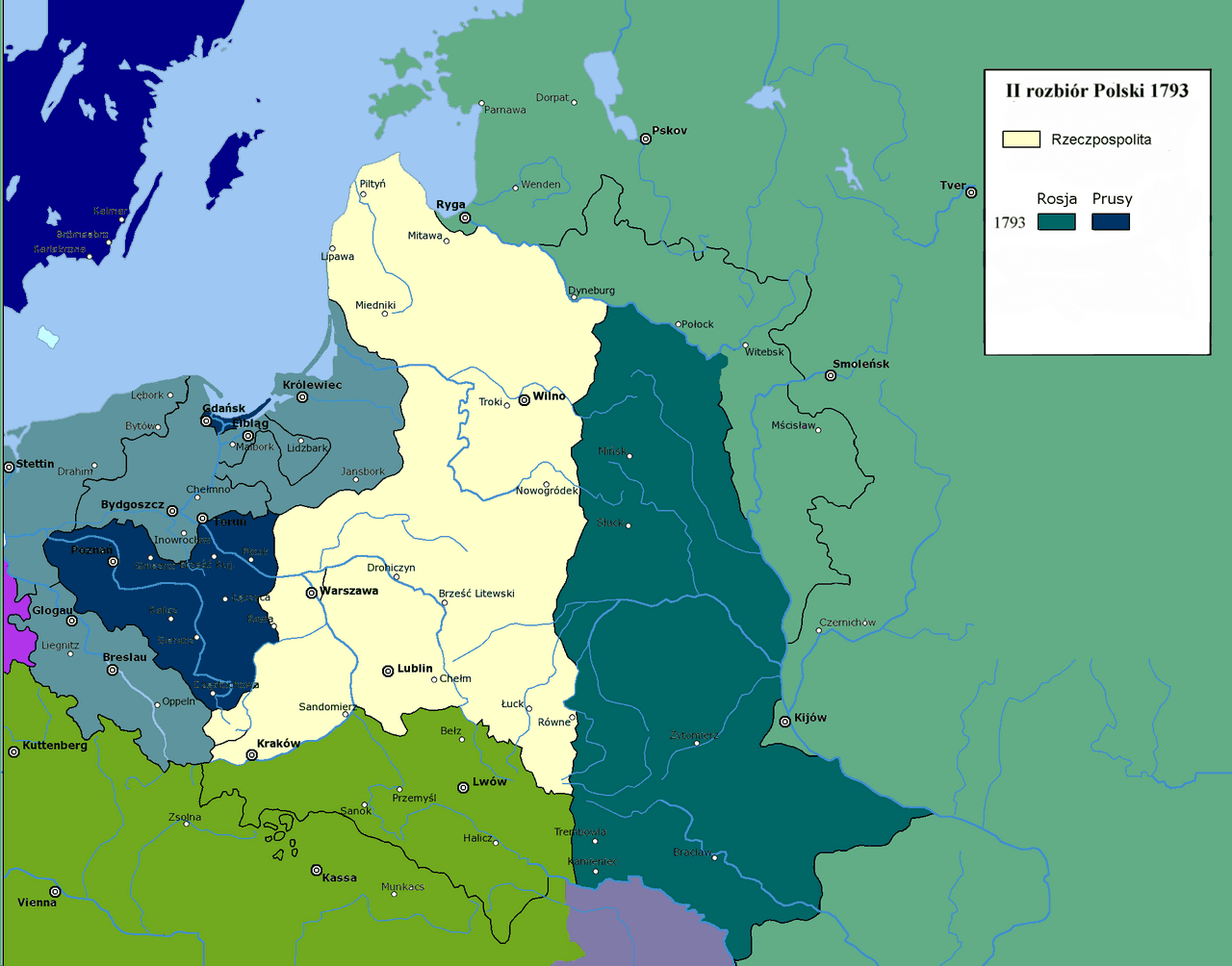
The Polish-Lithuanian Commonwealth after the Second Partition of 1793, reduced to a Russian protectorate. Place: St Petersburg, with parallel signatures at Grodno Figures: Catherine II of Russia · Frederick William II of Prussia · Stanisław August Poniatowski, the powerless king at Grodno · the Grodno Sejm, sitting under Russian guns Berlin and St Petersburg, Two Days After Paris Two days after the Convention guillotines Louis XVI in Paris, the Russian and Prussian ambassadors sign a convention at St Petersburg dividing roughly 300,000 km² of the Polish-Lithuanian Commonwealth between their crowns. Russia takes most of Belarus and right-bank Ukraine: 250,000 km², perhaps three million subjects. Prussia takes Greater Poland with Gdańsk and Toruń: 58,000 km², a million subjects. Austria, occupied with the war on France, gets nothing in this round. The pretext is the Polish reform movement: a Commonwealth that had spent four years drafting and ratifying its Constitution of 3 May 1791 (the second written national constitution in the world, after the United States) is, on the partitioners' reading, infected by French Jacobinism and must be amputated for the safety of the monarchical order. Two Westphalian Crises in Parallel While Paris is killing its king in person, Berlin and St Petersburg are killing a kingdom by treaty. Both operations claim Westphalian legitimacy. The Convention argues that the sovereign nation has the right to depose and execute its monarch; Catherine argues that great powers have the right to dismember a state whose internal politics threaten their security. Both arguments shred different parts of the 1648 settlement. The Polish king Stanisław August is forced to convene a Sejm at Grodno in June, surrounded by Russian troops, to ratify the partition. Deputies who object are arrested. On the night of the final vote, the chamber sits in silence; the presiding marshal interprets the silence as consent. Poland loses half its remaining territory and over four million subjects. A third partition (see [[third-partition-of-poland-1795]]) two years later will finish what this one began. Video: Animated account of the three partitions, with the 1793 carve-up that followed the May Constitution.
Source: westphalia-oracle.vercel.app