The Napoleonic Code
MAR 21 1804 · 12:00
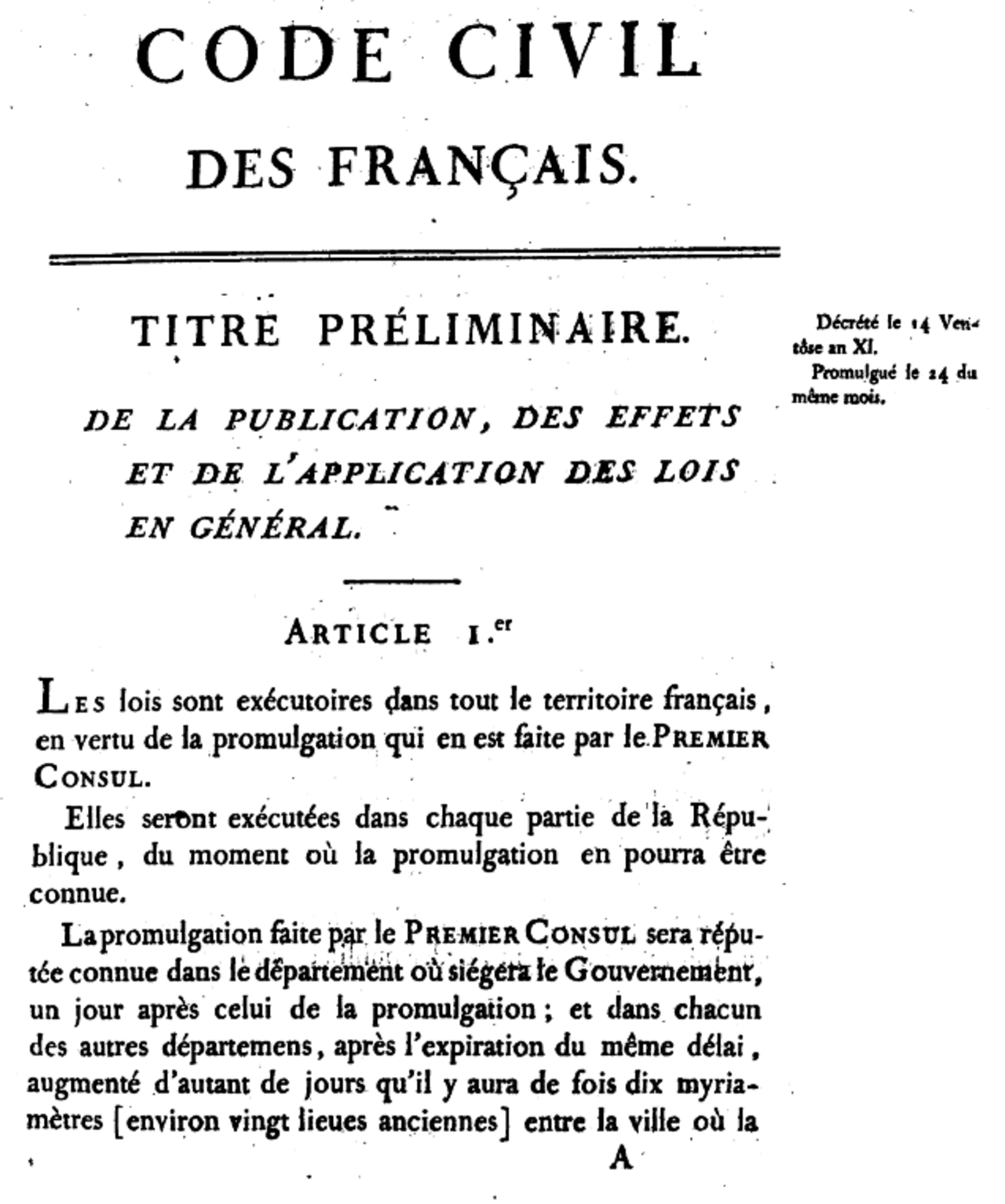
Title page of the first edition of the Code civil des Francais, promulgated 21 March 1804. Place: Paris Figures: Napoleon, presiding over more than half the drafting sessions · Jean-Étienne-Marie Portalis, principal drafter · François Tronchet, Félix-Julien-Jean Bigot de Préameneu, Jacques de Maleville, the drafting commission Thirty-Six Sessions Chaired in Person The four-man commission appointed in August 1800 produces a draft within four months. Napoleon, as First Consul, then chairs 36 of the 102 Council of State sessions that revise it, intervening on questions ranging from paternal authority to the status of mining concessions. He has no legal training; his contribution is to insist on plain language and on resolving theological-sounding disputes by executive fiat. The completed code is promulgated on 30 Ventôse An XII (21 March 1804) as the Code civil des Français; it is renamed the Code Napoléon in 1807. Its 2,281 articles consolidate centuries of customary and Roman law into a single instrument. Property is secular and absolute. Contract is freely entered. Marriage is a civil ceremony. Births, marriages, and deaths are recorded by the municipality, not the parish. Primogeniture is abolished. Privileges of caste and corporation are erased. Adult sons and daughters inherit equally (a partial advance; the code remains deeply patriarchal, subordinating wives to husbands and restricting divorce within a generation). The Most Successful Revolutionary Export Where French armies go, the Code goes. Belgium, the Netherlands, the Rhineland, Westphalia, the Kingdom of Italy, Naples, the Grand Duchy of Warsaw, parts of Spain. Some of these regimes collapse with Napoleon in 1815, but the Code does not. Belgium and Luxembourg retain it. The Netherlands models its 1838 code on it. Italy's 1865 code is a direct descendant. Romania, Egypt, Bolivia, Chile, the Dominican Republic, Quebec, Louisiana all adopt or model on it. Napoleon's military empire lasts fifteen years; the legal empire is a two-century structure still operating. Ma vraie gloire n'est pas d'avoir gagné quarante batailles. Waterloo effacera le souvenir de tant de victoires. Ce que rien n'effacera, ce qui vivra éternellement, c'est mon code civil. (Saint Helena, dictated late.) The Westphalian state of the nineteenth century, even where it explicitly rejects French rule, inherits the French specification for what a civil legal system looks like.
Source: westphalia-oracle.vercel.app