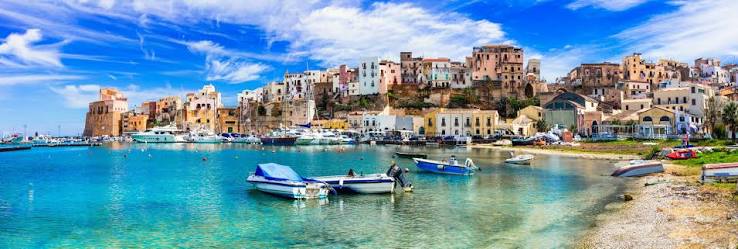
Trapani
A documentary loreline of Trapani and its province — the sickle-shaped harbour of western Sicily, the white pyramids of the salt pans, the bloody ritual of the tuna mattanza, medieval Erice on its mountain, the Egadi Islands, Marsala wine, and the Greek and Phoenician ruins that ring the coast. Thematic chapters across the corner of Sicily where Europe meets Africa.
A chronological documentary of 47 moments spanning 8000 BC–2023 on Loreline.
last updated 2026-07-21
Eras
- Greeks, Phoenicians & Romans — The deep antiquity of the western corner of Sicily — the Elymians of Erice and Segesta, the Phoenician island-city of Motya, the great Battle of the Egadi that ended the First Punic War, and the Roman peace that followed.
- Arabs, Normans & Aragonese — The medieval centuries — Arab Sicily and the salt and tuna trades, the Norman conquest, and the long Aragonese and Spanish rule that gave Trapani its churches, its towers and its baroque heart.
- The Salt Pans — The shimmering saline between Trapani and Marsala — the windmills, the white pyramids of harvested salt, the flamingos of the Stagnone lagoon, and one of the oldest industries in the Mediterranean, still worked by hand.
- Tuna & the Mattanza — The bluefin tuna run and the tonnara of Favignana — the ancient maze of nets, the songs of the tonnaroti, and the mattanza, the bloody and now-vanishing ritual slaughter that fed and defined these islands.
- Erice & the Egadi Islands — The mountaintop medieval town of Erice wreathed in cloud, and the three Egadi Islands — Favignana, Levanzo and Marettimo — with their tuna palaces, prehistoric cave paintings and crystalline coves.
- Faith & the Misteri — The religious heart of the city — the Madonna di Trapani, the baroque churches, and the Processione dei Misteri, the twenty-hour Good Friday procession of life-size sculptures that is among the oldest continuously running in Europe.
- Food, Wine & Couscous — The flavours of a frontier where Sicily meets North Africa — fish couscous, busiate pasta with pesto trapanese, Marsala wine, sea salt and the almond, tuna and citrus that the land and sea provide.
- City, Coast & Today — The sickle of the old town reaching into the sea, the Ligny tower, the cable car to Erice, the beaches and reserves of the Zingaro and San Vito, and the working port-city of western Sicily today.
- — The Grotta del Genovese. On Levanzo, a cave of Paleolithic and Neolithic art — engraved deer and bison and painted dancing figures, some 10,000 years old.
- — Eryx of the Elymians. The ancient mountaintop city of Eryx (Erice), sacred to the Elymians and famed across the Mediterranean for its temple to the fertility goddess — Astarte, then Aphrodite, then Venus Erycina.
- — The Youth of Motya. The exquisite marble statue of a young charioteer in a clinging tunic, carved around 470-450 BC and unearthed on Mozia — one of the masterpieces of Greek sculpture.
- — The Temple of Segesta. The astonishingly preserved Doric temple of the Elymian city of Segesta, built around 420 BC and never finished — standing alone in the hills above Trapani.
- — Motya, the Phoenician island. The Phoenician trading city of Motya (Mozia) on its island in the Stagnone lagoon — a Carthaginian stronghold destroyed by Syracuse in 397 BC and never rebuilt.
- — The Theatre of Segesta. The Greek-style theatre carved into Monte Barbaro, looking out over the valley to the Gulf of Castellammare — still used for performances today.
- — Drepana, the sickle harbour. Carthage moves the people of Eryx down to the sickle-shaped headland and harbour they call Drepanon — 'the sickle' — the founding of Trapani itself.
- — The Battle of Drepana. In 249 BC the Carthaginian admiral Adherbal crushes a Roman fleet off Trapani — Rome's worst naval defeat of the First Punic War.
- — The Battle of the Egadi Islands. On 10 March 241 BC a rebuilt Roman fleet annihilates the Carthaginians off the Egadi — ending the 23-year First Punic War and handing Rome its first overseas province: Sicily.
- — Arab Trapani. Under Arab rule from the 9th century, Trapani flourishes as a port — coral, salt and tuna trades grow, and Sicilian-Arabic words still season the local dialect and cuisine.
- — The Norman conquest. The Normans under Roger I take western Sicily in the late 11th century, beginning the Latin-Christian Trapani of churches and castles.
- — Castello di Terra. The medieval castle guarding the city, with foundations reaching back to Punic and Roman fortifications on the headland.
- — The Castle of Venus. The Norman castle of Erice built over the ruins of the ancient temple of Venus Erycina, on a sheer crag with views to the Egadi and, on clear days, to Africa.
- — Aragonese & Spanish rule. After the 1282 Sicilian Vespers, Trapani passes to the Crown of Aragon and then to Spain — centuries that build its towers, walls and baroque churches.
- — Medieval Erice. The walled stone town 750 metres above Trapani, often wrapped in cloud — cobbled lanes, sixty churches and the Venus Castle on the cliff edge.
- — The Sanctuary of the Annunciation. The 14th-century sanctuary housing the Madonna di Trapani and the Cappella dei Marinai — the chapel of the sailors.
- — The Madonna di Trapani. The serene marble Madonna and Child attributed to Nino Pisano (14th century), venerated in the Sanctuary of the Annunciation and copied across the Mediterranean.
- — Cùscusu — fish couscous. The Trapanese fish couscous — North African in origin, hand-rolled semolina steamed and served with a rich broth of rockfish — celebrated each autumn at San Vito's Cous Cous Fest.
- — The salt pans of Trapani. The shallow rectangular basins stretching along the coast toward Marsala, worked since antiquity — seawater evaporated by sun and wind into sea salt.
- — Trapani coral. From the 15th to the 18th century Trapani is Europe's capital of worked red coral — intricate reliquaries, crucifixes and jewellery prized in courts and churches.
- — The salt windmills. The wooden windmills that pump and grind the salt — turning the wind of the Stagnone into one of the most photographed landscapes in Sicily.
- — The Processione dei Misteri. Trapani's Good Friday procession — twenty life-size sculpted groups of the Passion carried through the streets for twenty unbroken hours, one of the oldest in Europe.
- — The Cathedral of San Lorenzo. Trapani's baroque cathedral on the Corso, rebuilt in the early 18th century with a luminous columned façade.
- — The Ligny Tower. The 17th-century watchtower at the very tip of the Trapani sickle, where the Tyrrhenian and the Mediterranean meet — now a prehistory museum.
- — Chiesa del Purgatorio. The church that houses the twenty sculpted groups of the Misteri — the heart of Trapani's Good Friday procession.
- — The white pyramids. Harvested salt heaped into glittering white pyramids and capped with terracotta tiles to weather the rain — the signature image of the saline.
- — Trapani sea salt. The hand-harvested IGP sea salt of the saline — mineral-rich flakes that season the whole of Sicilian cooking.
- — The twenty Mysteries. The carved and dressed wooden tableaux of the Passion, each maintained by a guild — borne on the shoulders of bearers in a swaying, music-led 'annacata'.
- — The old town. The narrow baroque heart of Trapani reaching out into the sea — the Corso, the Rua Nova, the fish market and the seafront promenade.
- — Marsala wine. The fortified wine first shipped by the Englishman John Woodhouse in 1773 — sweet and dry, drunk and cooked with, the most famous product of the province.
- — Busiate al pesto trapanese. Coiled busiate pasta with pesto alla trapanese — tomato, almond, garlic and basil pounded together, the inland cousin of Genoese pesto.
- — Favignana. The butterfly-shaped largest Egadi island — tuff quarries turned into sunken gardens, the Cala Rossa coves, and the looming Florio tonnara.
- — The Florio empire. The Florio family industrialise the tuna trade in the 19th century, inventing tuna canned in olive oil and turning Favignana into a company island.
- — The tonnara of Favignana. The great Florio tuna cannery on Favignana — once the largest in the Mediterranean, where the bluefin catch was processed and tinned in oil.
- — Marsala. The province's wine city, founded on the ruins of Phoenician Lilybaeum — and the beach where Garibaldi and his Thousand landed in 1860 to begin the unification of Italy.
- — The mattanza. The ancient ritual slaughter — bluefin tuna funnelled through a maze of nets into the 'chamber of death', then hauled up by chanting tonnaroti in a churning red sea.
- — Marettimo. The wildest and farthest Egadi island — a single white village, no cars, sheer cliffs and sea caves, ringed by some of the clearest water in the Mediterranean.
- — The cialoma. the rhythmic work-songs the tonnaroti sang to coordinate the brutal labour of raising the nets, an oral tradition now nearly silent.
- — The Salt Museum. A restored salt-worker's house at Nubia museum-ing the ancient craft — the tools, the basins and the seasonal rhythm of the harvest.
- — The Zingaro Reserve. Sicily's first nature reserve, a roadless stretch of coast between Scopello and San Vito lo Capo — dwarf palms, hidden coves and clear turquoise water.
- — San Vito lo Capo. The white-sand bay under the great limestone cape of Monte Monaco — the province's most famous beach and home of the Cous Cous Fest.
- — Flamingos of the Stagnone. The Stagnone lagoon nature reserve — pink flamingos, herons and avocets feeding in the warm shallow brine.
- — The Erice cable car. The funivia opened in 2005 that lifts visitors from Trapani up the mountain to Erice in ten swaying minutes, with the salt pans laid out below.
- — The bronze rams of the Egadi. Bronze warship rams recovered from the seabed off the Egadi Islands — physical relics of the 241 BC battle, raised by underwater archaeologists.
- — The salt pans from above. A drone flight over the saline of Trapani and the Marsala lagoon — the geometric basins glowing pink and gold, the windmills turning.
- — Erice in the clouds. An aerial flight over medieval Erice on its mountaintop, the town drifting in and out of cloud above the coast.
- — A walk through Trapani. A real-time stroll through the old town — the Corso, the baroque churches, the fish market and the seafront of the sickle city.
Full text archive: /loreline-text/trapani.md