Relics, Texts & Earliest Images
The physical trail Jesus left in history: the scrolls of his world, the stone that names Pilate, the oldest scraps of the Gospels, and the first images Christians ever made of him.
14 moments in this segment.
- — The Dead Sea Scrolls. The scrolls found at Qumran preserve Hebrew scripture and the Jewish world into which Jesus was born, copied from the 3rd century BC. (Qumran community, c. 250 BC – 68 AD)
- — The Pilate Stone. A limestone block from Caesarea bears the name of Pontius Pilate — the only archaeological evidence of the man who condemned Jesus. (Roman, c. 26–36 AD)
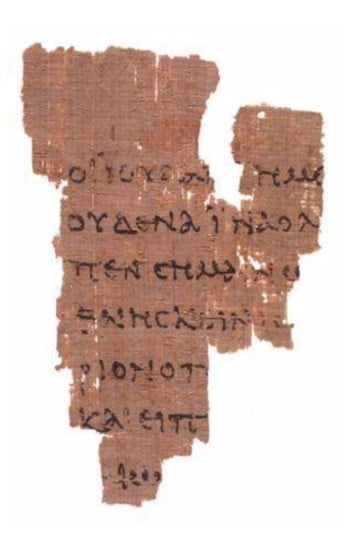
- — Papyrus 52 (Rylands Library). The oldest surviving fragment of the New Testament, a scrap of John's Gospel copied around 125 AD. (Unknown scribe, c. 125 AD)
- — The Alexamenos graffito. A crude Roman graffito mocking a Christian worshipping a crucified, donkey-headed figure — the earliest known image of the Crucifixion. (Anonymous Roman, c. 200 AD)
- — Papyrus 66 (Bodmer). A near-complete early codex of John's Gospel, one of the oldest substantial New Testament manuscripts. (Unknown scribe, c. 200 AD)
- — The Dura-Europos house church. The oldest known Christian house church, in Syria, holds the earliest datable images of Jesus healing and walking on water. (Anonymous, c. 240 AD)
- — The Good Shepherd fresco. In the Catacombs of Rome, Christ appears not crucified but as a young shepherd carrying a lamb — the earliest Christian art. (Anonymous, c. 250 AD)
- — The Codex Sinaiticus. One of the two oldest complete Bibles, this 4th-century Greek manuscript is among the greatest treasures of the British Library. (Unknown scribes, c. 350 AD)
- — The Sarcophagus of Junius Bassus. A richly carved Roman marble sarcophagus of 359 AD showing scenes from the life of Christ. (Roman workshop, 359 AD)
- — The Christ Pantocrator of Sinai. The oldest surviving icon of Christ, at Saint Catherine's Monastery, painted in encaustic wax in the 6th century. (Byzantine, c. 550 AD)
- — The mosaics of Ravenna. The 6th-century mosaics of Sant'Apollinare and San Vitale in Ravenna show Christ in imperial Byzantine splendour. (Byzantine, c. 550 AD)
- — The Book of Kells. An Irish illuminated Gospel book of about 800 AD, one of the most lavishly decorated manuscripts ever made. (Insular monks, c. 800 AD)
- — Relics of the True Cross. Fragments venerated as the cross of the Crucifixion have been enshrined in reliquaries across Christendom for over a millennium. (Various, medieval)
- — The Shroud of Turin. A linen cloth bearing the faint image of a crucified man, venerated as Jesus's burial shroud, first documented in 14th-century France. (Unknown, first recorded c. 1354)