The Lore of Aldabra
How a drowned limestone platform in the western Indian Ocean became the last place on Earth where Indian Ocean giant tortoises still walk free. Arab navigators, a Darwin petition, a military airfield that was almost built, and a World Heritage listing.
Part of Aldabra
66 moments in this segment.
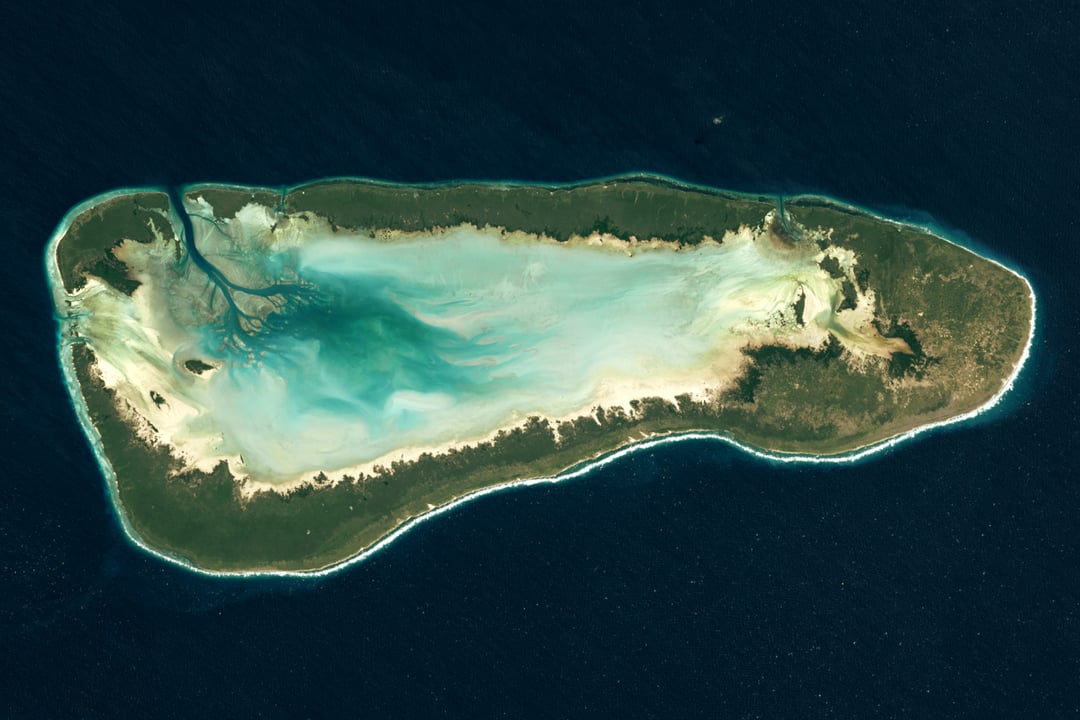
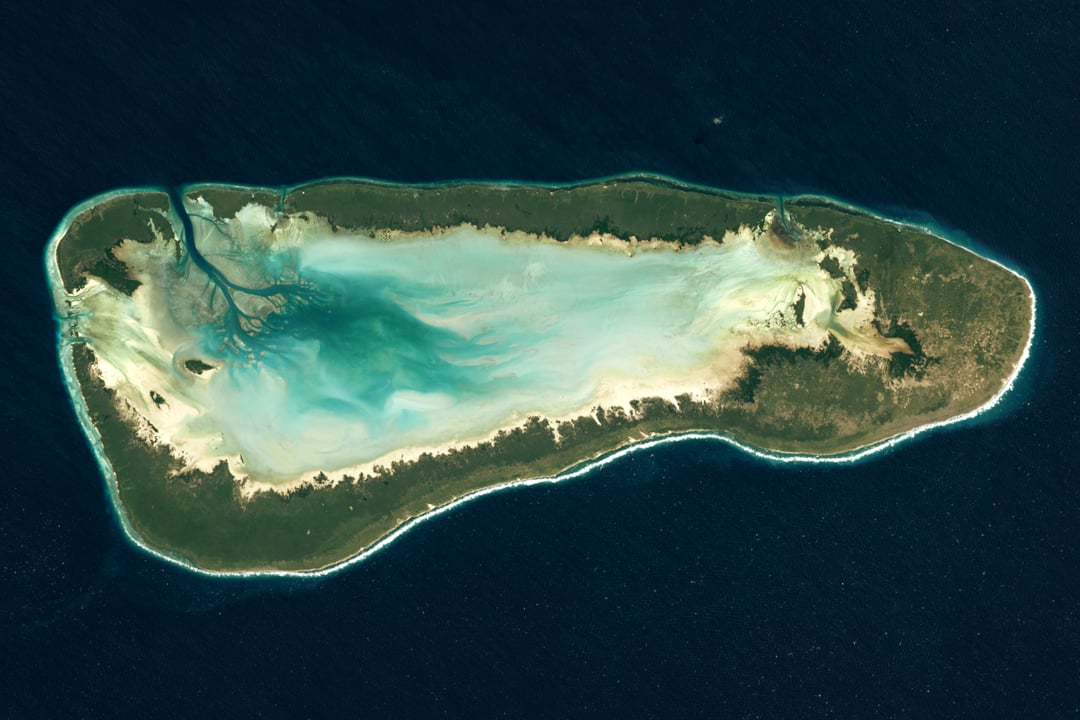
- — The Atoll Drowns. During the Last Interglacial high stand the whole of Aldabra went under, wiping out every land animal on it — a total ecological reset that later made the atoll a natural laboratory for watching recolonisation happen from scratch. The Aldabra Limestone that forms the land surface today has been radiometrically dated to roughly 118,000–136,000 years old.
- — The Limestone Comes Back Up. As glacial sea levels fell the platform emerged again and rainwater began dissolving it into the two terrain types that define Aldabra: "champignon", a pitted mushroom-rock surface so sharp it shreds boots, and flatter "platin" cut with pools. That terrain is the single biggest reason the atoll was never farmed, settled or built on.
- — A Rail Loses Flight, and the Sea Takes It. Fossils from before the inundation show a Dryolimnas rail had already lost the power of flight on Aldabra once, and was annihilated when the atoll submerged. The same lineage later flew back in from Madagascar and lost flight a second time — the clearest case of iterative evolution known in birds.
- — Tortoises Drift In and Restock an Empty Atoll. Once emergent again, Aldabra was restocked by giant tortoises drifting in from Madagascar and by rails, ibises and drongos flying the gap. The Aldabrachelys lineage had split from the extinct Madagascan A. abrupta some 4.5 million years earlier — but nothing living on the atoll today is older than this recolonisation.
- — Arab Traders Reach the Aldabra Group. The Seychelles Islands Foundation dates the first reported human contact with Aldabra to Arab traders in 916 AD, working the routes between the Swahili coast and the Indies. The attribution is traditional — no primary Arab document naming the atoll in that year has been traced — but the name they left behind stuck.
- — The Name Enters the Charts. Aldabra is an Arabic name carried into European use by Portuguese navigators, though the sources disagree on which word: SIF gives Al-Khadra, "the green", while others derive it from the harsh, sun-baked character of the place. Both readings survive; the atoll is green and it is merciless, so neither is obviously wrong.
- — Portuguese Ships Sight the Atoll. Portuguese vessels working the Mozambique Channel route recorded Aldabra in 1511, and it appears on Portuguese maps through the sixteenth century. The year is the conventional figure rather than a documented landfall — no named Portuguese chart pins it — and nobody stayed, because there is no anchorage and almost no fresh water.
- — Lazare Picault Makes the First French Visit. The French captain Lazare Picault, sent from Mauritius to reconnoitre the islands that would become the Seychelles, made what SIF records as the earliest documented visit to Aldabra. The largest island of the atoll still carries his name — Picard — and so does the settlement on it.
- — The Charles and the Elizabeth Chart the Islands. A running survey made from the boat Charles and the tartan Elizabeth produced the first detailed plan of the Aldabra islands, later engraved and published by the East India Company hydrographer Alexander Dalrymple. It is the oldest genuinely usable picture of the atoll that exists.
- — Aldabra Passes to Britain. After the capture of Mauritius and Mahé in the Napoleonic Wars, Aldabra passed with the rest of the Seychelles into British hands. Every later concession, lease and protection order over the atoll runs through the colonial government at Port Louis — including the one Darwin would petition sixty years later.
- — Schweigger Names the Giant Tortoise. August Friedrich Schweigger formally described the animal as Testudo gigantea — the name that, after a bruising nomenclature fight, the ICZN finally conserved in 2013 as the basis of Aldabrachelys gigantea. Naming it mattered: it made the tortoise a scientific object at the exact moment sailors were eating the last of its relatives.
- — Every Other Indian Ocean Giant Tortoise Is Gone. The giant tortoises of Mauritius, Rodrigues, Réunion and the granitic Seychelles were eaten out by passing crews who stacked them alive in the hold as fresh meat that kept for months without food or water. By about 1840 all of them were extinct except the Aldabra population, which survived for one reason: the atoll was murderously hard to land on.
- — Two Ships Take Twelve Hundred Tortoises. In a single reported season two vessels removed 1,200 giant tortoises from Aldabra. The atoll had become the last larder in the ocean, and the harvest was running at a rate the population could not absorb.
- — Darwin Signs the Petition to Save the Tortoises. When Mauritius announced a mangrove-timber industry on Aldabra, Charles Darwin, Joseph Hooker, Richard Owen and other naturalists petitioned Governor Arthur Hamilton Gordon, arguing the tortoises were "a contemporary of the Dodo and Solitaire" and of great scientific interest as survivors of a past geological age. The timber scheme was dropped, and logging rights were later granted only on condition the tortoises were left unharmed. No day is recorded for the petition — only the month.
- — Günther Publishes on the Mascarene Giants. Albert Günther of the British Museum, the scientific engine behind the Darwin petition, published in Nature on the Mascarene and Galápagos giant tortoises, documenting how close the Indian Ocean animals had come to disappearing. His 1877 monograph on the museum's giant land-tortoises fixed the whole group in the scientific record.
- — Wharton Charts Aldabra for the Admiralty. W. J. L. Wharton, later Hydrographer of the Navy, carried out survey work that fixed the atoll's shape, passes and anchorages for the next century. The Admiralty sheet covering Aldabra, Cosmoledo and Farquhar dates from the following year and was still the working chart when the airfield surveyors arrived in the 1960s.
- — Forty Norwegians Try to Settle the Atoll. A party of 27 adults and 13 children sailed from Bergen to colonise Aldabra. The settlement failed quickly — there is essentially no soil, no reliable fresh water, and the limestone will not take a plough. No picture of the expedition itself survives; this is Vågen, the Bergen harbour they sailed from, crowded with the same class of small two-masted vessel.
- — The First Permanent Settlement. Jules Cauvin established the first lasting settlement on Aldabra under concession, working mangrove timber, turtles and fish with imported labour. Continuous human occupation of the atoll dates from here, and the camp on Picard is still called Settlement.
- — The Lessee Bans Tortoise Killing. The concessionaire James Spurs prohibited killing the tortoises on the atoll he leased — an extraordinary act for a commercial operator in 1891, and by most accounts the single intervention that saved the population. Conservation on Aldabra began as a lessee's house rule, not as government policy.
- — W. L. Abbott Collects on Aldabra. The American naturalist William Louis Abbott made the first of the four great collecting expeditions to the atoll, gathering the flora and fauna material that put Aldabra on the scientific map. The endemic sacred ibis of the atoll, Threskiornis bernieri abbotti, carries his name.
- — Voeltzkow Spends a Month on the Atoll. The German zoologist Alfred Voeltzkow worked on Aldabra for just over a month, making the first known collection of Entomostraca from the atoll and adding to the reef-geology picture. His Indian Ocean work fed straight into the long argument over how atolls form. The chart he published from that visit keys three symbols: Mr Spurs’ settlement, where he found the tortoises, and the anchorage of his own ship.
- — Three Days of Searching for One Tortoise. By the turn of the century the population had been pushed so low that a visiting crew could hunt for three days before finding a single animal. Everything the atoll holds today — around 100,000 tortoises — is a recovery from that floor.
- — Keller Publishes His Map of the Islands. The Swiss zoologist Conrad Keller published a detailed map of the Aldabra group in his work on the East African islands — the clearest cartographic picture of the atoll before aerial survey, showing the four main islands and the channels between them essentially as they are today.
- — The Dupont Expedition. The third of the four foundational collecting trips added further flora and fauna material from the atoll. Together with Abbott, Voeltzkow and Fryer, these four expeditions supplied nearly everything science knew about Aldabra before the 1960s.
- — The Percy Sladen Trust Expedition Reaches Aldabra. J. C. F. Fryer worked the atoll as part of J. Stanley Gardiner's Percy Sladen Trust Expedition, which used HMS Sealark and produced decades of published monographs on the region. Fieldwork closed when Fryer and Hugh Scott sailed home on 29 March, Scott carrying more than 40,000 insects.
- — The Birds Start Going Too. By 1928 the small labour force working the atoll was taking sea and land birds at a rate that put several species at risk of local extinction, on top of decades of turtle and sea-cucumber extraction. A tiny resident workforce quietly stripping a huge unwatched atoll is a pattern that persisted into the 1960s.
- — Aldabra Is Cut Out of the Seychelles. Britain detached Aldabra, Farquhar and Desroches from the Seychelles, and the Chagos Archipelago from Mauritius, to create the British Indian Ocean Territory — a colony assembled specifically to host Anglo-American military facilities east of Suez. Aldabra's near-destruction begins with this administrative act.
- — Two Scientists Fly In With the Military Survey. The Royal Society arranged for David Stoddart of Cambridge and Chris Wright of the Natural History Museum to accompany the military and BBC survey teams to Aldabra and report on its ecology. Their preliminary report became the evidence base for everything that followed.
- — The Royal Society Memorandum Against the Airfield. The Council of the Royal Society told the Ministry of Defence in a twenty-three-page memorandum that Aldabra was "one of the last elevated reef islands remaining essentially unaltered by man", and that an airfield would cause considerable changes to its animal and plant life. It was an unusually direct intervention by the Society in a live defence procurement decision.
- — The Americans Join the Fight. Opposition crossed the Atlantic: the Smithsonian Institution came out against the scheme, and the US National Academy of Sciences said it had persuaded the Defense Department to press London for an alternative staging post. It is an early case of a transnational scientific lobby beating a defence ministry.
- — The Commons Debates the Staging Post. The airfield reached the floor of the House of Commons under the heading "Island of Aldabra (Staging Post)" — the moment a scientific argument about a coral atoll turned into a parliamentary fight over defence spending east of Suez.
- — Sterling Is Devalued and the Budget Cracks. The devaluation of the pound forced an emergency review of public expenditure, and the Aldabra airfield — already under sustained scientific attack, with costs rising as survey work deepened — became an obvious casualty. The atoll was saved by an argument about ecology and a run on the currency at the same time.
- — Wilson Tells the Commons Aldabra Will Not Proceed. In the Economic Situation statement Harold Wilson said: "In overseas terms, we have decided not to proceed with the Aldabra project — the establishment of a staging post in the British Indian Ocean territory." Earlier that same day Denis Healey had refused to answer written questions about frigatebird strikes and airfield walls, telling members to wait for the Prime Minister.
- — The Royal Society Expedition Documents the Atoll. With Stoddart in charge, the Royal Society mounted the full expedition the campaign had promised, producing the body of work later published as a dedicated Philosophical Transactions volume and an Atoll Research Bulletin series. Aldabra went from barely known to one of the best-described tropical islands on Earth in about five years.
- — The Royal Society Buys the Lease. Rather than leave the atoll open to the next commercial or military proposal, the Royal Society acquired the lease outright — an extraordinary move for a learned society, and the mechanism that turned a protest victory into permanent protection.
- — The Research Station Opens on Picard. Construction begun in 1969 finished with a permanent station at Settlement, giving scientists year-round presence on an atoll that had been visited perhaps four times in a century. Continuous occupation by researchers is what makes Aldabra's long-run monitoring datasets possible at all.
- — Aldabra Returns to the Seychelles. With Seychelles independence, Aldabra, Farquhar and Desroches were detached from the British Indian Ocean Territory and handed back, leaving BIOT as the Chagos Archipelago alone. Aldabra escaped the fate of Diego Garcia by a margin of about nine years.
- — The Seychelles Islands Foundation Is Created. SIF was established by presidential decree as a public trust to manage Aldabra on behalf of the nation, taking over from the Royal Society. It remains the atoll's sole manager, running the station, the rangers and every monitoring programme on it.
- — The Royal Society Hands Over the Station. The Royal Society transferred the Picard research station to SIF, completing the move from British scientific custody to Seychellois national management. It is the reason Aldabra is not a foreign-run reserve inside an independent country.
- — Aldabra Is Gazetted a Special Reserve. Under the Seychelles National Parks and Nature Conservancy legislation the atoll became a Special Reserve — the country's strictest protected-area category, banning extraction and requiring a permit for any landing. This is the domestic legal spine that World Heritage status was later layered on top of.
- — UNESCO Inscribes Aldabra as a World Heritage Site. Aldabra was listed under natural criteria (vii), (ix) and (x) as an outstanding raised coral atoll and a natural laboratory for evolutionary and ecological processes, covering 35,000 hectares. It was one of the earliest natural sites inscribed anywhere in Africa — and the designation the campaign of the 2020s keeps holding up.
- — BirdLife Names Aldabra an Important Bird Area. The designation recognised the largest frigatebird breeding colony in the Indian Ocean — second largest in the world — alongside red-footed boobies, the endemic drongo, the endemic rail and the Aldabra sacred ibis. Long-term tortoise monitoring also began this year and has run continuously since.
- — The 1998 Bleaching Kills Two-Thirds of the Shallow Coral. The 1997–98 El Niño, the strongest since 1950, drove mass bleaching across the Western Indian Ocean; at Aldabra coral mortality reached about 66% at 10 m depth and 38% at 20 m. Five years later, despite high recruitment, hard-coral cover still had not meaningfully recovered.
- — Eighteen Flightless Rails Are Carried Back to Picard. The Aldabra rail had been wiped off Picard by introduced cats; eighteen birds were carried over from Malabar to re-found the population. By 2013 a survey counted 2,765 rails on Picard alone, with the atoll-wide population estimated at around 10,000 breeding pairs.
- — The Aldabra Banded Snail Is Declared Extinct. Rhachistia aldabrae, endemic to the atoll, was pronounced extinct and widely cited as one of the first molluscs lost to climate-driven drying — a claim that carried a lot of weight in the conservation literature, and one the atoll would complicate seven years later.
- — Aldabra Becomes a Ramsar Wetland. The atoll's roughly 2,000 hectares of mangrove and its 200 km² shallow lagoon were listed under the Ramsar Convention, adding a wetland-specific protection layer on top of the Special Reserve and World Heritage designations. Aldabra now carries about as many protective labels as any place on Earth.
- — Forty Years of Data Show the Green Turtles Coming Back. Analysis of nesting records from 1968 to 2008 documented a 500–800% increase in nesting green turtles at Aldabra, to roughly 3,100–5,225 females a year — the second-largest nesting population in the Western Indian Ocean, and one of the clearest demonstrations anywhere that simply stopping the harvest works.
- — Solar Power Replaces the Station's Diesel. A 25 kWp hybrid photovoltaic-diesel system was installed at the research station; in its first year it supplied 94% of the station's electricity and cut diesel demand by 97%. Every drum of fuel had to be shipped 1,150 km, so this was as much a logistics fix as an environmental one.
- — The Last Feral Goats Are Removed. A programme running roughly 25 years finally eradicated the goats that had been browsing the atoll's vegetation since the settlement era — one of the largest goat eradications attempted on any tropical island. Native vegetation recovery on Malabar and Grande Terre follows from this.
- — The Red-Whiskered Bulbul Is Eradicated. SIF removed the introduced red-whiskered bulbul from Aldabra, and from neighbouring Assumption the following year, closing off a seed-dispersal route for invasive plants. The same year SIF launched a standing marine monitoring programme for coral and reef fish.
- — The Extinct Snail Is Found Alive on Malabar. Seven years after being declared extinct, Rhachistia aldabrae was rediscovered on Malabar Island — a rare and widely reported reversal that also complicated the climate-extinction claim built on it. Aldabra was designated an IOSEA marine turtle site the same year.
- — India and Seychelles Sign the Assumption Island Deal. An agreement to build Indian military facilities, including an airstrip, on Assumption Island — 27 km from Aldabra — was signed during Narendra Modi's visit to Seychelles. Conservationists immediately warned about biosecurity and disturbance risk to the World Heritage site next door. It is the first time Assumption becomes the fight.
- — The 2016 Bleaching Strips Half the Reef Again. The global 2015–16 bleaching event killed roughly 35% of lagoon coral at 2 m and 54–55% on the seaward reef. Aldabra's isolation then showed in the recovery: by 2019 lagoon hard-coral cover was back to 93% of pre-bleaching levels, against 54% at eastern seaward sites.
- — Parliament Blocks the Assumption Island Base. A revised India–Seychelles agreement signed in January 2018 collapsed when the opposition-controlled National Assembly said it would not ratify it, with proximity to the Aldabra World Heritage site among the stated objections. In 2020 the then opposition leader Wavel Ramkalawan declared the agreement dead — the second time public pressure stopped a project on Assumption.
- — Seychelles Issues the World's First Sovereign Blue Bond. Building on a 2016 debt-for-nature swap brokered by The Nature Conservancy, Seychelles launched the first sovereign blue bond with the World Bank — the financing structure that became the largest national-level funder of Aldabra's management. Conservation money for the atoll now comes out of restructured national debt.
- — The Clean-Up Project Lifts Twenty-Five Tonnes of Plastic. SIF, The Queen's College Oxford and young Seychellois volunteers ran a five-week expedition that removed roughly 25 tonnes of plastic from the atoll's shores — flip-flops, fishing gear and bottles washed in from thousands of kilometres away. Their own estimate was that over 500 tonnes remained.
- — The Rail That Evolved Flightlessness Twice. Julian Hume and David Martill published fossil evidence that a flightless Dryolimnas existed on Aldabra before the atoll's inundation, and that the recolonising birds independently lost flight again afterwards. It is the first documented case of iterative evolution in rails and one of the strongest in the entire bird record.
- — Seychelles Protects Thirty Percent of Its Ocean. Seychelles announced the final marine protected area designations that took its protected share of the exclusive economic zone from 0.04% to 30%, delivering on the debt-swap commitment. The waters around Aldabra fall in the strictest tier, with all extractive use — fishing and petroleum exploration alike — banned.
- — The Research Station Turns Fifty. SIF marked half a century of continuous research presence at Settlement with a time-capsule ceremony, closing a fifty-year arc from the airfield fight to permanent Seychellois-run science on the atoll.
- — SIF Sets Out to Remove the Rats and Cats. SIF announced its intention to eradicate rats and cats from Aldabra — an operation that would be the largest rodent eradication ever attempted in mangrove forest and among the largest on any tropical island. Rats and cats are the last major reason parts of the atoll cannot hold rails, seabirds or hatchling tortoises.
- — The Plastic Is Coming From Somewhere Else. A drift-modelling study concluded that most plastic debris landing on Seychelles beaches, Aldabra included, originates from distant sources rather than local ones. The atoll cannot clean its way out of the problem: the 25 tonnes lifted in 2019 will keep being replaced.
- — The RaCE Feasibility Team Deploys. SIF began recruiting crew leads and technicians for the Aldabra Rat and Cat Eradication project, embedding a team on the atoll for two years inside a three-year study to determine whether eradication is achievable across that terrain at all. It is a rare conservation project that budgets years just to decide whether the operation is possible.
- — Fifty-One Years of Shoreline Data. Comparing imagery across 51 years, researchers found a low average rate of shoreline change on the raised atoll — evidence that Aldabra's limestone rim is far more stable against sea-level rise than the low sand cays around it. The geology that kept the settlers out is now what makes it durable.
- — Friends of Aldabra Starts Posting. A youth-led coalition of Seychellois and international campaigners begins publishing on Instagram against a Qatari-funded luxury resort under construction on Assomption Island, 27 km from Aldabra. The first post goes up on 20 October 2024; everything in the segments that follow is their own archive of the third fight over these islands.
- — The RaCE Project Reaches Its Decision Point. Seychellois press reported on the state of the rat-and-cat feasibility work under the headline "The RaCE for Aldabra's future", with the team weighing whether an eradication across 155 km² of karst and mangrove can actually be delivered. The answer determines whether the last flightless bird of the Indian Ocean gets the whole atoll back.
- — A Hundred Thousand Tortoises and a Contested Neighbour. Aldabra today carries roughly 100,000 giant tortoises — about four times the entire Galápagos population — the largest frigatebird colony in the Indian Ocean, a recovering green turtle rookery and a rediscovered endemic snail, all managed by SIF under a strict permit system and a few hundred visitors a year. The unresolved question is next door: what gets built on Assomption, 27 km upwind of the most intact raised atoll on Earth.