Early Cinema
The first decade of moving pictures. Edison's Kinetoscope and the tar-paper Black Maria, the Lumières' cinématographe and the workers leaving the factory, Méliès painting a rocket into the moon's eye, the magic lantern that preceded all of it, and the actualities audiences watched simply because they moved.
Part of Cameras
76 moments in this segment.
- - The magic lantern (1880) (1 of 4). The magic lantern, the camera itself, 1880. In the years cinema was invented, the camera learned to capture not a moment but motion itself.
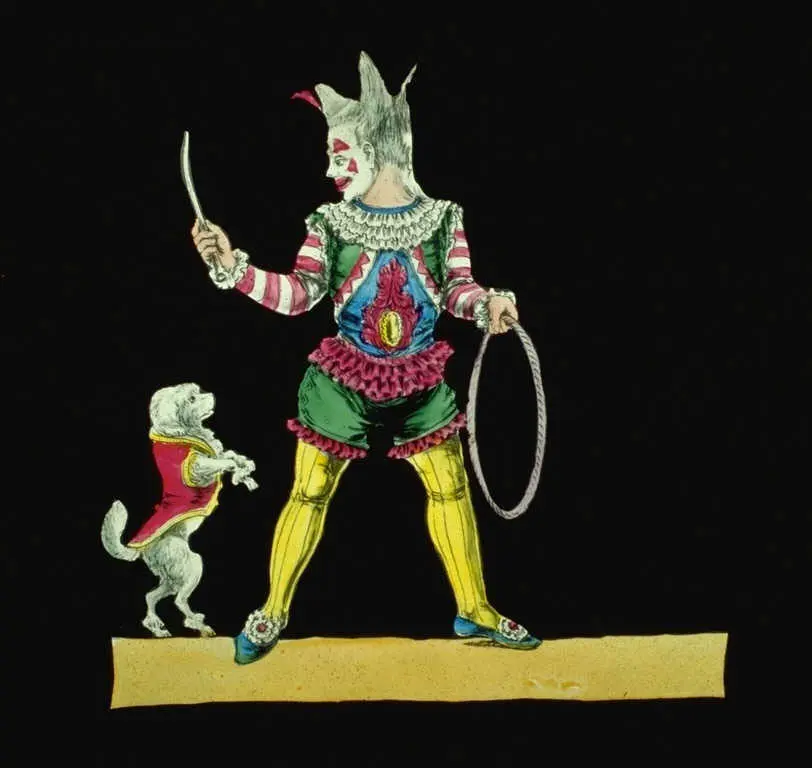
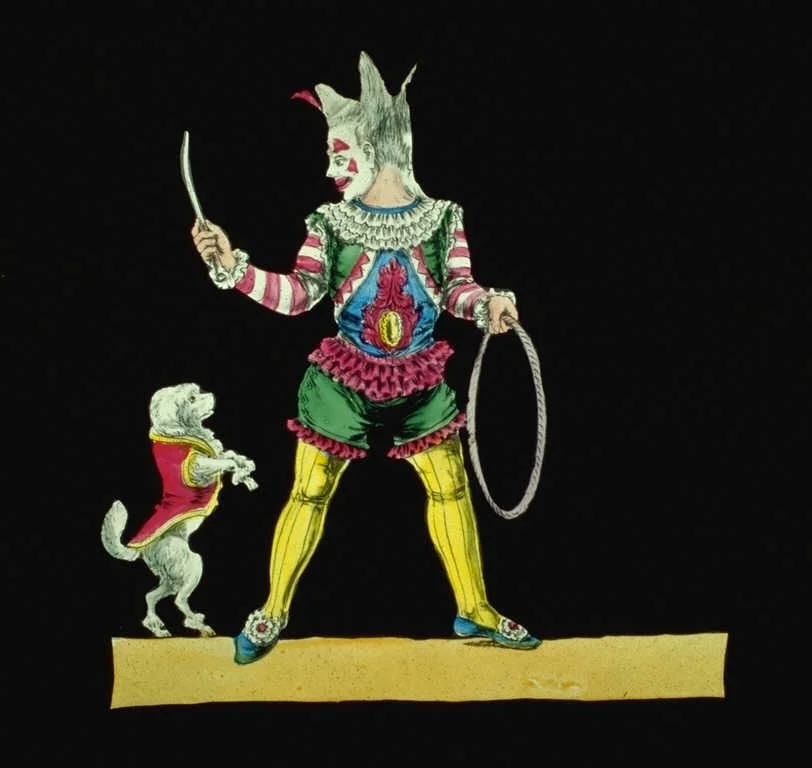
- - The magic lantern (1880) (2 of 4). This Victorian magic-lantern slide illustrating the story "Curfew Must Not Right Tonight," is one of about 2,100 lantern slides by Joseph Boggs Beale, America's foremost lantern artist.
- - The magic lantern (1880) (4 of 4). a) Figure of a seated figure in blue-gray trousers and green coat, on circular plinth decorated with masks and shells. Threaded circular opening on belly. b) conical pierced hat. c) tube with square slide holder. d) upainted projector tube, lens missing. e) circular slightly domed cover.
- - Roundhay Garden Scene (1888) (1888). Roundhay Garden Scene (1888), an image made in 1888. In the years cinema was invented, the camera learned to capture not a moment but motion itself.
- - Roundhay Garden Scene (1888). (1888). In the years cinema was invented, the camera learned to capture not a moment but motion itself.
- - Dickson Greeting (1891). ). In the years cinema was invented, the camera learned to capture not a moment but motion itself.
- - Dickson Greeting. SUMMARY\r Experimental film fragment made with the Edison-Dickson-Heise experimental horizontal-feed kinetograph camera and viewer, using 3/4-inch wide film.\r \r OTHER TITLES\r Variant LC title: Early Edison camera tests; DLC \r \r CREATED/PUBLISHED\r [United States, 1891].\r \r NOTES\r Copyright: no reg.
- - Edison Kinetoscopic Record of a Sneeze, Jan. 7, 1894. Edison Kinetoscope (1894). In the years cinema was invented, the camera learned to capture not a moment but motion itself.
- - The Dickson Experimental Sound Film. Dickson Experimental Sound Film (1894). In the years cinema was invented, the camera learned to capture not a moment but motion itself.
- - Fred Ott's Sneeze (1894). Fred Ott's Sneeze (Edison) (1894). In the years cinema was invented, the camera learned to capture not a moment but motion itself.
- - William Dickson: Fred Ott's Sneeze (1894). Fred Ott's Sneeze is a film realized by William Dickson for Edison's Kinetoscope. The film stars Fred Ott, an employee of Thomas Edison's laboratory. Fred Ott's Sneeze was the first film to be copyrighted in the US. It was filmed on the 7th of January 1894 in the interior of the Black Maria Studio.
- - Thomas Edison's - Carmencita - Black Maria Studio (1894) World's First Film Studio. Carmencita (Edison Black Maria) (1894). In the years cinema was invented, the camera learned to capture not a moment but motion itself.
- - Carmencita. (Edison) (1894). In the years cinema was invented, the camera learned to capture not a moment but motion itself.
- - Edison Kinetoscope (1894). Edison Kinetoscope, the camera itself, 1894. In the years cinema was invented, the camera learned to capture not a moment but motion itself.
- - Edison Kinetoscope (1894). Title: The souvenir strip of Edison Kinetoscope Eugene [i.e. Eugen] Sandow, the modern Hercules / / taken and copyrighted by W.K.L. Dickson. Abstract/medium: 1 photographic print on card mount ; print 17 x 8.5 cm.
- - 1894 - Buffalo Dance - William Kennedy Laurie Dickson (Edison Studios). Buffalo Dance (Edison) (1894). In the years cinema was invented, the camera learned to capture not a moment but motion itself.
- - Annie Oakley (1894): by Thomas A. Edison Kinetoscope. Annie Oakley (Edison) (1894). In the years cinema was invented, the camera learned to capture not a moment but motion itself.
- - Annie Oakley. 1894 (1894). In the years cinema was invented, the camera learned to capture not a moment but motion itself.
- - Early Traffic (1890-1899). Early traffic (British Pathe) (1895). In the years cinema was invented, the camera learned to capture not a moment but motion itself.
- - L'arroseur arrosé [The Sprinkler Sprinkled] (Louis Lumière, 1895). The Sprinkler Sprinkled (Lumiere) (1895). In the years cinema was invented, the camera learned to capture not a moment but motion itself.
- - 1895 - Serpentine Dance by Annabelle - William Kennedy Laurie Dickson (Edison Studios). Annabelle Serpentine Dance (Edison) (1895). In the years cinema was invented, the camera learned to capture not a moment but motion itself.
- - Boat Leaving The Port (1895). Boat Leaving the Port (Lumiere) (1895). In the years cinema was invented, the camera learned to capture not a moment but motion itself.
- - Baby's Dinner - Repas de Bebe (Lumiere - 1895). Baby's Meal (Lumiere) (1895). In the years cinema was invented, the camera learned to capture not a moment but motion itself.
- - [Actual 4K Scan] The Arrival of a Train at La Ciotat Station - Lumière Brothers - 1896.. Lumiere Arrival of a Train La Ciotat 1895 (1895). In the years cinema was invented, the camera learned to capture not a moment but motion itself.
- - Workers Leaving the Lumière Factory (1895) - The First Motion Picture in History | Lumière Brothers. Workers Leaving the Lumiere Factory (1895). In the years cinema was invented, the camera learned to capture not a moment but motion itself.
- - "Workers Leaving the Lumière Factory in Lyon" (Lumière Brothers, France, 1895). Workers Leaving the Lumiere Factory (1895). In the years cinema was invented, the camera learned to capture not a moment but motion itself.
- - Workers Leaving The Lumiere Factory - Lumiere Brothers 1895. Lumiere Workers Leaving the Factory 1895 (1895). In the years cinema was invented, the camera learned to capture not a moment but motion itself.
- - La Sortie de l'Usine Lumière à Lyon (Workers Leaving the Lumiere Factory) 2 (1895) Louis Lumiere. Workers Leaving the Lumiere Factory (1895). In the years cinema was invented, the camera learned to capture not a moment but motion itself.
- - Repas de bébé (Baby's Breakfast) (1895) Louis Lumiere. Lumiere Baby's Breakfast 1895 (1895). In the years cinema was invented, the camera learned to capture not a moment but motion itself.
- - The Lumière Cinématographe (1895) (2 of 4). The Lumière Cinématographe, the camera itself, 1895. In the years cinema was invented, the camera learned to capture not a moment but motion itself.
- - The Lumière Cinématographe (1895) (4 of 4). The Lumière Cinématographe, the camera itself, 1895. In the years cinema was invented, the camera learned to capture not a moment but motion itself.
- - Arrival of a Train at La Ciotat, 1895 (Lumière brothers). Lumiere Arrival of a Train (1895). Colour, instant prints and home movies brought the camera into everyday life, and one rode to the Moon.
- - Feeding the Doves 1896. Feeding the Doves (Lumiere) (1896). In the years cinema was invented, the camera learned to capture not a moment but motion itself.
- - Auguste and Louis Lumière - Démolition d'un mur (1896). Demolition of a Wall (Lumiere) (1896). In the years cinema was invented, the camera learned to capture not a moment but motion itself.
- - The Arrival of a Train at La Ciotat (1896) Louis Lumière. Arrival of a Train at La Ciotat (Lumiere) (1896). In the years cinema was invented, the camera learned to capture not a moment but motion itself.
- - The Arrival of a Train at La Ciotat Station 1896 - Lumière Brothers (4K scan). Arrival of a Train at La Ciotat (Lumiere) (1896). In the years cinema was invented, the camera learned to capture not a moment but motion itself.
- - 1896 - On Brighton Beach - George Albert Smith ou Robert William Paul (?). On Brighton Beach (G.A. Smith / R.W. Paul) (1896). In the years cinema was invented, the camera learned to capture not a moment but motion itself.
- - Démolition d'un mur [Demolition of a Wall] (Lumière, 1896). Demolition of a Wall (Lumiere) (1896). In the years cinema was invented, the camera learned to capture not a moment but motion itself.
- - The Kiss (1896) May Irwin, John Rice - First kiss in commercial cinema. The Kiss (May Irwin / John Rice, Edison) (1896). In the years cinema was invented, the camera learned to capture not a moment but motion itself.
- - May Irwin Kiss. The Kiss (May Irwin Kiss, Edison) (1896). In the years cinema was invented, the camera learned to capture not a moment but motion itself.
- - Early English Traffic: Turn of the Century London (1896-1903) | British Pathé. Early London traffic (British Pathe) (1900). In the years cinema was invented, the camera learned to capture not a moment but motion itself.
- - The One Man Band (1900) George Melies. This film was released by director George Melies in 1900. One man magically duplicates himself and creates an entire orchestra.
- - grandma's reading glass / short experimental film directed by George Albert Smith 1900. Grandma's Reading Glass (G.A. Smith) (1900). In the years cinema was invented, the camera learned to capture not a moment but motion itself.
- - The One-Man Band (L'Homme-Orchestre, 1900) ㅡ Georges Méliès. The One-Man Band (Melies) (1900). In the years cinema was invented, the camera learned to capture not a moment but motion itself.
- - 1901 - The Big Swallow - James Williamson. The Big Swallow (Williamson) (1901). In the years cinema was invented, the camera learned to capture not a moment but motion itself.
- - A Trip to the Moon (1902) (1902) (1 of 4). Photographic print of a production still for Georges Méliès's 1902 film A Trip to the Moon. This is the scene in which the projectile designed to travel to the Moon is loaded into its cannon. This still featured in an exhibition at La Caixa Foundation.
- - A Trip to the Moon (1902) (1902) (2 of 4). Photographic print of a production still for Georges Méliès's 1902 film A Trip to the Moon. This is the scene in which mythological figures representing planets look down on the sleeping space travelers. This still featured in an exhibition at La Caixa Foundation.
- - A Trip to the Moon (1902) (1902) (3 of 4). Photographic print of a production still for Georges Méliès's 1902 film A Trip to the Moon. This is the scene in which stars look down on the sleeping space travelers. This still featured in an exhibition at La Caixa Foundation.
- - A Trip to the Moon (1902) (1902) (4 of 4). A Trip to the Moon (1902), an image made in 1902. As the snapshot and the silent film arrived, photography left the studio and the movies were born.
- - Le Voyage dans la Lune (1902) - Georges Méliès - (HQ) - Music by David Short - Billi Brass Quintet. Melies A Trip to the Moon 1902 (1902). As the snapshot and the silent film arrived, photography left the studio and the movies were born.
- - A Trip to the Moon (1902) - ORIGINAL B/W Movie by Georges Méliès (le voyage dans la lune). A Trip to the Moon (Melies) (1902). In the years cinema was invented, the camera learned to capture not a moment but motion itself.
- - Life of an American Fireman (1903) Edison. Life of an American Fireman (Porter) (1903). In the years cinema was invented, the camera learned to capture not a moment but motion itself.
- - EdisonElectrocutesElephant. Electrocuting an Elephant (Topsy, Edison) (1903). In the years cinema was invented, the camera learned to capture not a moment but motion itself.
- - Electrocuting an Elephant. (Topsy, Edison) (1903). In the years cinema was invented, the camera learned to capture not a moment but motion itself.
- - The Great Train Robbery (1903) (1903) (1 of 3). The Great Train Robbery (1903), an image made in 1903. As the snapshot and the silent film arrived, photography left the studio and the movies were born.
- - The Great Train Robbery (1903) (1903) (2 of 3). Still from the 1903 film The Great Train Robbery Caption reads as follows:2. The Great Train Robbery, the first story-telling picture ever made, directed by Edwin S. Porter for Edison and released in 1903.
- - The Great Train Robbery (1903) (1903) (3 of 3). The Great Train Robbery (1903), an image made in 1903. As the snapshot and the silent film arrived, photography left the studio and the movies were born.
- - The Great Train Robbery (1903) Edwin S. Porter. Released in December 7, 1903 CAST Gilbert M. 'Broncho Billy' Anderson as Bandit / Shot Passenger / Tenderfoot Dancer Justus D. Barnes as Bandit Leader, Who Fires at Camera Robert Milasch as Trainman / Bandit PRODUCTION / CREW Directed by Edwin S. Porter Second Unit Direction by Gilbert M.
- - The Great Train Robbery. (Porter) (1903). In the years cinema was invented, the camera learned to capture not a moment but motion itself.
- - Le voyage à travers l'impossible [An Impossible Voyage] (Georges Méliès, 1904). The Impossible Voyage (Melies) (1904). In the years cinema was invented, the camera learned to capture not a moment but motion itself.
- - Rescued by Rover (Lewin Fitzhamon, Cecil M. Hepworth, 1905). Rescued by Rover (Hepworth) (1905). In the years cinema was invented, the camera learned to capture not a moment but motion itself.
- - Rescued by Rover (1905) Hepworth [original version]. Rescued by Rover (Hepworth) (1905). In the years cinema was invented, the camera learned to capture not a moment but motion itself.
- - Rescued by Rover (1905). In 1903, Cecil Hepworth made a worthwhile attempt to film 'Alice In Wonderland' featuring May Clark but it wasn't until 1905 that he made the film now considered by many to be advanced for that period, with regard to structure and continuity. With a running time of six minutes.
- - A Trip Down Market Street, 1906 - With Sound!. A Trip Down Market Street, San Francisco (1906). In the years cinema was invented, the camera learned to capture not a moment but motion itself.
- - Public wash-house Liverpool (1959) - BFI National Archive. 1959 amateur archive film (1959). Colour, instant prints and home movies brought the camera into everyday life, and one rode to the Moon.
- - The magic lantern (1880) (3 of 4). The magic lantern, the camera itself, 1880. In the years cinema was invented, the camera learned to capture not a moment but motion itself. The subject dates from 1880; this photograph was taken in 2006.
- - The Autochrome - Thanks, Lumiere Brothers. Autochrome Lumiere 1907 (1907). Colour, instant prints and home movies brought the camera into everyday life, and one rode to the Moon.
- - PBS|The Black Maria. Edison Black Maria studio (1893). In the years cinema was invented, the camera learned to capture not a moment but motion itself.
- - PBS|The Kinetoscope. Edison Kinetoscope (1891). In the years cinema was invented, the camera learned to capture not a moment but motion itself.
- - The Lumiere Brothers: Crash Course Film History #3. Lumiere Cinematographe (1895). In the years cinema was invented, the camera learned to capture not a moment but motion itself.
- - The Lumière Cinématographe (1895) (1 of 4). The Lumière Cinématographe, the camera itself, 1895. In the years cinema was invented, the camera learned to capture not a moment but motion itself. The subject dates from 1895; this photograph was taken in 2017.
- - The Lumière Cinématographe (1895) (3 of 4). Caméra cinématographe vue de l'arrière (couvercle ouvert). On voit le couloir du film et la fenêtre de cadrage du film. La manivelle est mise ici en décoration. Normalement, elle traverse la couvercle arrière (à droite).
- - Rediscovered film takes a trip through San Francisco in ruins. A Trip Down Market Street, San Francisco (1906). In the years cinema was invented, the camera learned to capture not a moment but motion itself.
- - EARLY MOVIE THEATERS: A LOOK AT NICKELODEON FILM HISTORY. Nickelodeon early cinema history (1905). As the snapshot and the silent film arrived, photography left the studio and the movies were born.
- - G.A. Smith Stop Motion. (1898). In the years cinema was invented, the camera learned to capture not a moment but motion itself.
- - A Brief Introduction to… George Albert Smith. Brighton School / George Albert Smith (1900). In the years cinema was invented, the camera learned to capture not a moment but motion itself.