Word Itself
What we call these groups decides what we can say about them. Sociologists of religion mostly dropped "cult" by the late 1970s in favour of "new religious movement"; critics answer that the softer term launders real harm. Behind the vocabulary sits a contested science: Lifton built his model of thought reform from Maoist state coercion, not from churches, and when American psychology tried to turn it into courtroom evidence the APA rejected the report and the courts ruled the testimony inadmissible. This facet is the argument about the frame.
Part of Cults
11 moments in this segment.
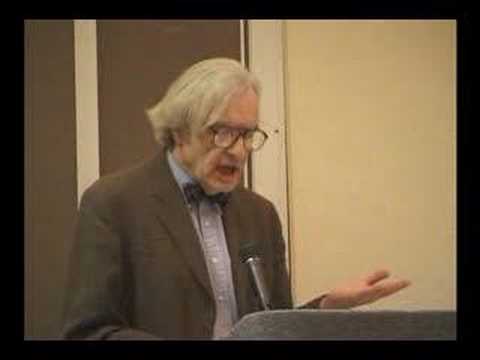
- - An address on doomsday groups. Robert Jay Lifton speaking on 17 March 2000 about apocalyptic violence, drawing on his work on Aum Shinrikyo alongside his earlier studies of Hiroshima survivors and Nazi doctors.
- - A protest sign using the word cult, London. A placard at a London demonstration in May 2008. Whether the word applies is the argument itself: most sociologists of religion dropped it in favour of new religious movement from the late 1970s, while critics hold that the replacement launders documented harm.
- - A lecture on new religious movements. A professor of religious studies gives the standard academic account of what a new religious movement is. One historian of religion noted that in 1970 the researchers working on new religions could be counted on one's hands, before the field's rapid growth after the controversies of the early 1970s.
- - The psychiatrist who named thought reform. Robert Jay Lifton explains the model he published in 1961 in Thought Reform and the Psychology of Totalism, built on interviews with 25 American servicemen held in the Korean War and 15 Chinese nationals who had left after university indoctrination. The model describes state coercion in Maoist China; applying it to voluntary religious groups is an extension, and that extension is what the field argues about.
- - An author on Hubbard's science fiction years. Alec Nevala-Lee discussing Astounding, his history of the editor John W. Campbell and the writers around him including L. Ron Hubbard, at a public library in Oak Park, Illinois.
- - Eight criteria for totalism. A summary of Lifton's eight criteria: milieu control, mystical manipulation, demand for purity, confession, sacred science, loading the language, doctrine over person, and dispensing of existence. They describe mechanisms rather than beliefs, which is why they organise this archive.
- - Totalism outside the compound. Lifton discusses his book Losing Reality and the question of whether a model built from closed institutions can describe political movements. The extension is contested; the conversation is with an author who is himself contested in the academy.
- - Behaviour, information, thought, emotion. Steven Hassan sets out the BITE model, first presented in his 2012 book Freedom of Mind and widely misdated to his 1988 debut. It is contested: sociologists have argued it generalises particular manipulative leaders into a universal ideology, and a critic from within the anti-cult field has questioned whether its counselling steers people to predetermined conclusions.
- - Thought reform back where it started. A researcher re-applies Lifton's 1961 framework to contemporary state re-education in China, returning the model to the setting it was built from rather than to religious groups.
- - A legal model for undue influence. A law professor sets out a proposed causation model for coercive control that removes the vulnerability element from undue-influence doctrine. Courts have been the field's hardest problem since United States v. Fishman in 1990 ruled brainwashing testimony inadmissible as expert evidence.
- - How Western scholars sort Japanese movements. A religious-studies researcher introduces his book on new religious movements in Japan and the taxonomic problems Western scholarship brings to them. Sociologists of religion largely abandoned the word cult by the late 1970s in favour of new religious movement; anti-cult organisations argue the replacement launders documented harm.