Modernism & Chanel (1900-1939)
Poiret kills the corset. Chanel's jersey, her little black dress, her No.5. Schiaparelli's surrealism. Vionnet's bias cut. The Roaring Twenties' flapper. Hollywood and the great couturiers feed each other.
Part of Fashion
18 moments in this segment.
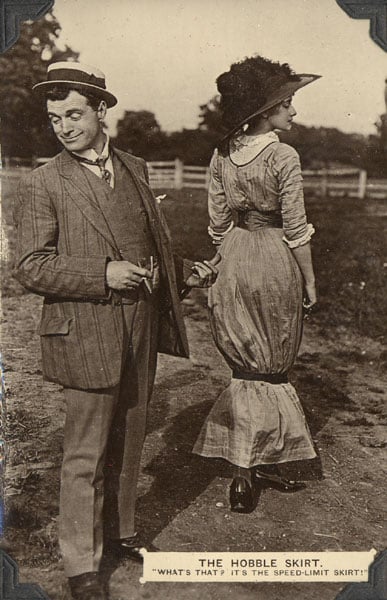
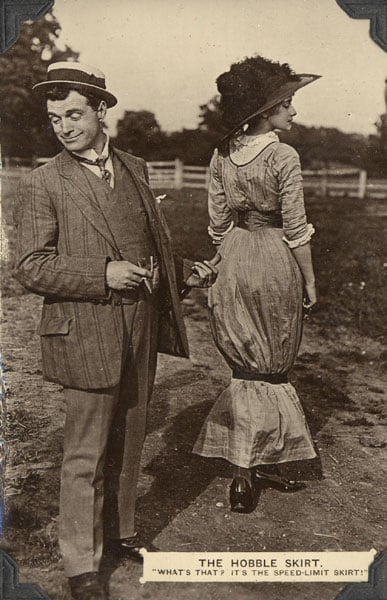
- — Poiret's Hobble Skirt. (1908-1914) — so narrow at the ankle that women shuffled. The defining "anti-corset but new-constraint" silhouette.
- — Erté + Harper's Bazaar. 1913. Romain de Tirtoff ("Erté") begins illustrating for Harper's Bazaar. His Art Deco line — sinuous, jewel-encrusted — defined the visual language of 1910s-30s fashion illustration before photography fully replaced drawing.
- — Chanel Jersey Garment. Soft, drapey, machine-knitted jersey — a men's undergarment fabric Chanel made elegant. The garment that began 20th-century ease.
- — Cartier Tank Watch. 1917. Louis Cartier designs the Tank watch — inspired by the rectangular silhouette of WWI Renault FT tanks. JFK wore one, Andy Warhol famously wore one. Still the most-imitated rectangular-watch design.
- — Chanel No. 5. May 5, 1921. Chanel No. 5 launched. First perfume to mass-use synthetic aldehydes; first "designer fragrance." Marilyn Monroe famously slept in nothing but five drops. Still the best-selling perfume in the world a century later.
- — The Bias-Cut Gown. Vionnet's 1920s-30s bias-cut silk evening gowns — fabric cut diagonally so it drapes in fluid curves. Madonna's 1991 Met Gala dress, Galliano's 90s revivals, all descend from here.
- — The Little Black Dress. October 1926. Vogue publishes a sketch of Chanel's minimal black crepe dress; calls it "Chanel's Ford" (after the universally-affordable Model T). The "little black dress" enters the fashion lexicon as the singular essential garment.
- — Schiaparelli Lobster Dress. Schiaparelli x Dalí, 1937. White silk evening dress with a large lobster painted on the skirt by Dalí. Worn by Wallis Simpson in Cecil Beaton's Vogue portraits — the most-photographed Surrealist garment ever made.
- — Hollywood Glamour — Adrian. 1930s. MGM costume designer Adrian (Adolphus Greenburg) dresses Joan Crawford, Greta Garbo, Jean Harlow. The bias-cut satin Hollywood gown — Adrian's 1932 Letty Lynton dress for Crawford was copied by Macy's and sold 500,000 units. Movies become the fashion-marketing engine.
- — Mainbocher Corset. September 1939. Horst P. Horst photographs the "Mainbocher Corset" — back view of a woman lacing her corset, Paris collections. Published the week WWII broke out; became a defining image of "fashion as final luxury before catastrophe."
- — The Corset. The 19th-century corset that fashion spent the whole 20th century undoing and re-adopting. Horst's 1939 "Mainbocher Corset" photograph caught it on the brink of disappearing — only to come back via Versace, Gaultier, Mugler.
- — Paul Poiret Opens His House. 1903. Paul Poiret opens his Paris atelier. By 1906 he's designed dresses without corsets — the first major couturier to abandon them. Brought Eastern + Orientalist motifs into mainstream Paris. Dominated 1910s fashion; was the first global fashion celebrity. The subject dates from 1903; this photograph was taken in 2011.
- — Fortuny Delphos Gown. 1907. Mariano Fortuny patents the Delphos pleated silk gown — fine accordion-pleat silk, ancient-Greek inspired. Worn by Sarah Bernhardt, Isadora Duncan, Eleonora Duse. Still hand-made by the Fortuny atelier in Venice. The subject dates from 1907; this photograph was taken in 2011.
- — Chanel Tweed Suit. 1925-onward. Chanel's collarless tweed suit — borrowed from her lover the Duke of Westminster's sporting wardrobe. Worn by Jackie Kennedy on November 22, 1963 (the pink Chanel-style Cassini bouclé suit). The most enduring single garment Chanel designed. The subject dates from 1929; this photograph was taken in 2012.
- — Madeleine Vionnet — The Bias Cut. Early 1920s. Madeleine Vionnet perfects the bias cut — fabric cut diagonally across the weave, draping in fluid curves over the body. The defining 1930s evening-gown technique; Vionnet is widely considered the greatest pure dressmaker of the century. The subject dates from 1922; this photograph was taken in 2015.
- — Chanel's Jersey Sportswear. 1916. Chanel debuts her wartime jersey-knit sportswear — soft, comfortable, designed for movement. Jersey was a men's undergarment fabric; Chanel made it elegant. The first sign that 20th-century fashion would be about ease, not constraint.
- — Elsa Schiaparelli. 1927. Elsa Schiaparelli opens her Paris house. Surrealist collaborations with Dalí (the lobster dress, 1937); shocking pink. The artistic counterweight to Chanel's minimalism. House closed 1954; revived 2014 under Daniel Roseberry.
- — Chanel Opens Her Hat Shop. 1910. Gabrielle "Coco" Chanel opens her millinery at 21 rue Cambon. By 1913 she's expanded to Deauville, by 1915 to Biarritz. Within 20 years the most powerful woman in fashion; within 60, the most-quoted designer in history.