Folklore
Labelled as folklore throughout, never as fact. Manannan mac Lir, the sea god who shrouds the island in mist and may or may not have given it its name. The Moddey Dhoo, the black dog of Peel Castle, first written down in the 1700s. The Buggane, the Phynnodderee, and the Fairy Bridge at Ballalonna where you greet the Little People as you pass. The taboo words, including the one for rat. Hop tu Naa with its turnip lanterns rather than pumpkins, Yn Chruinnaght, the Manx Folk Awards, and the traditional music and dance that came back with the language.
Part of Isle of Man
82 moments in this segment.
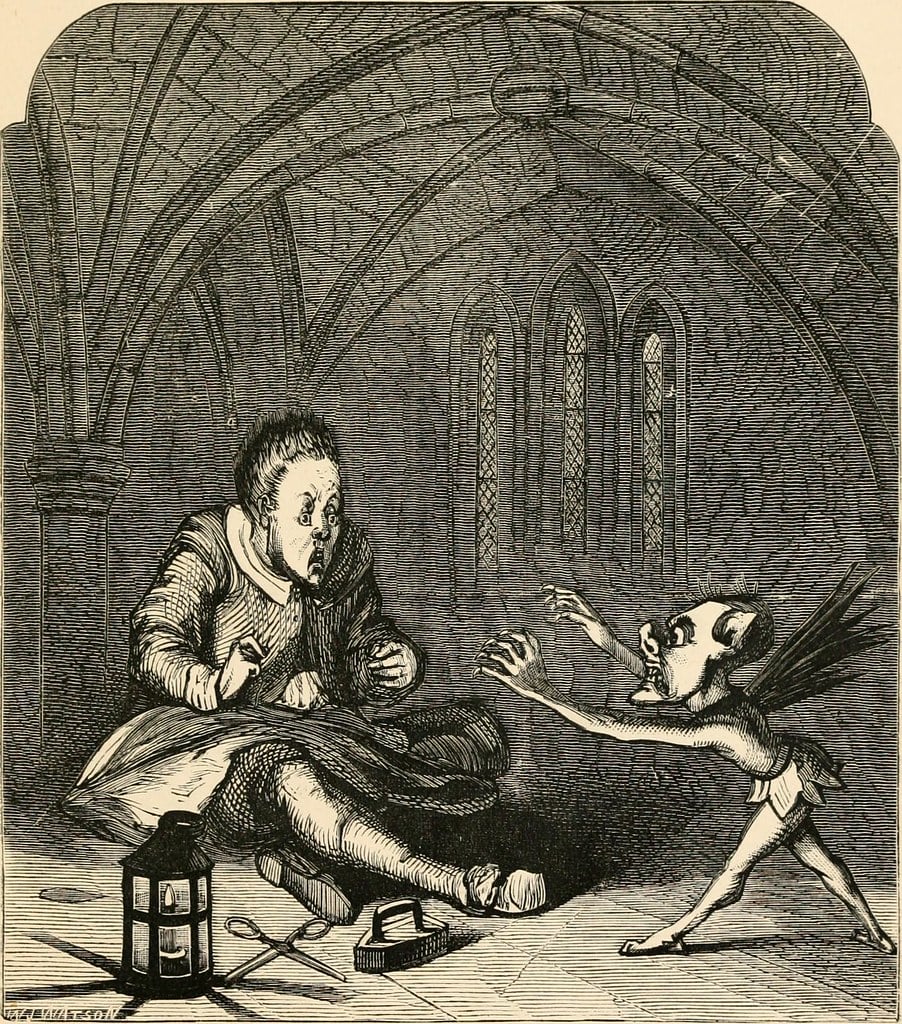
- - Tim mylrea and the buggane. ', an illustration from 'The Phynodderee, and other legends of the Isle of Man', 1882. The Buggane is a malicious shape-shifting giant of Manx legend; the best known one is said to have torn the roof off St Trinian's Church each time builders finished it, which is offered as the reason the chapel stands roofless.
- - The cliffs of Spanish Head. 's southern end. The name is attached to a legend of a wrecked Spanish galleon, for which no evidence has been found; the same Armada story is also told to explain the tailless Manx cat, and is folklore in both cases.
- - Manx Flag. A Manx flag hanging with others from the ceiling of a bar in Key West, Florida. The triskelion is one of the most travelled Manx exports, carried by a heavy nineteenth and early twentieth century emigration, particularly to the United States and Australia.
- - Liverpool scene from Pier Head landing stage. Liverpool's Pier Head landing stage, the former berth for the Isle of Man ferry. The service now runs from the Isle of Man Ferry Terminal on Triskelion Way, named for the island's three legs.
- - House-of-Manannan vikinger Peel-Man 03. A display at the House of Manannan in Peel (Purt ny hInshey) showing a longship being put ashore. Manannan mac Lir is the island's tutelary sea god of legend, said to shroud Ellan Vannin in mist to hide it from invaders; the museum named for him interprets the Norse-Gaelic period through objects and reconstruction because no contemporary image of any king of Mann exists.
- - Manannan Douglas. HSC Manannan in Douglas Harbour. The Steam Packet fast craft is named for the legendary sea god Manannan mac Lir, whose cloak of mist is the island's living idiom for its sea fog.
- - House-of-Manannan Peel-Man 01. Part of the House of Manannan at Peel, with sculptures of Vikings dragging a longship through the window display. Museum reconstruction of this kind is interpretation and should not be read as a picture of the Norse-Gaelic kingdom.
- - House-of-Manannan vikinger Peel-Man 04. Viking figures on display at the House of Manannan, Peel. The Norse-Gaelic kingdom that ruled here was a hybrid society, and its real material evidence is the runic crosses that cut Scandinavian myth alongside Christian imagery.
- - The Witches Mill at Castletown. (Balley Chashtal). The island's witchcraft associations are folklore and later revival rather than documented history, and the building's fame rests on twentieth century occult interest.
- - House-of-Manannan Minneplate2002. A memorial plate for King Harald V and Queen Sonja of Norway, set into the wall of the House of Manannan at Peel in 2002. The island's Norse inheritance is real and institutional, but the Kingdom of Mann and the Isles was a Norse-Gaelic sea kingdom spanning Mann and the Hebrides, not a Norwegian outpost.
- - Isle of Man hydrofoil leaving the floating landing stage, Pier Head, Liverpool. The Isle of Man fast craft Manannan leaving the floating landing stage at Pier Head, Liverpool. The vessel carries the name of the island's legendary sea god.
- - The House of Manannan. (Purt ny hInshey), the Manx National Heritage museum named for the legendary sea god. Manannan is popularly linked to the island's own name, Mannin or Ellan Vannin, though scholars dispute which was named for which.
- - Sculptures outside the Museum. Viking sculptures outside the House of Manannan at Peel. These are modern museum statuary rather than evidence: the Norse period on the island survives in runic crosses, keeills and castle sites, not in contemporary images of people.
- - Doolish 2013 17. An exterior lantern on Loch Promenade, Douglas, bearing the Manx triskelion. Douglas is Doolish in Manx, and the triskelion appears on its street furniture as a matter of course.
- - 'Manx Tales' - 1899 Manx short story book. The cover of 'Manx Tales', a collection of short stories published by S. K. Broadbent in 1899. Print collections like this one are how Manx legend was fixed in English at exactly the moment the Manx language itself was receding.
- - Hop-tu-naa turnips by Sarah Callow (02). Turnips carved for Hop tu Naa by Sarah Callow. The festival keeps its Manx name and its own song and is observed at the end of October across the island.
- - Hop-tu-naa Turnip: Jinny the Witch (Maughold 2016). A turnip carved as Jinny the Witch for Hop tu Naa, Maughold, 2016. Hop tu Naa is the Manx end-of-October festival with its own song, distinct from imported Halloween, and it is carved in turnip rather than pumpkin.
- - Hop-tu-naa turnip by Jason O'Connor (01). A turnip carved for Hop tu Naa in 2016 by Jason O'Connor. Hop tu Naa turnips are hollowed and cut as 'moots', with a repertoire of traditional faces and figures.
- - Hop-tu-naa turnip carving: A cat & a cauldron. A Hop tu Naa turnip cut with a cat and a cauldron, two of the standard elements of a traditional carving. The forms are conventional rather than improvised, which is what makes it a tradition rather than decoration.
- - Hop-tu-naa Turnip (Maughold 2016). A Hop tu Naa turnip carved for the competition at Maughold Social Club, 2016. The 'moot' is the hollowed turnip lantern, carried and lit on Hop tu Naa night.
- - Hop-tu-naa turnip by Cori Philips (2016). A Hop tu Naa turnip carved by Cori Philips, 2016. The Manx festival predates and is distinct from imported Halloween, and the turnip rather than the pumpkin is the point of it.
- - Hop-tu-naa turnip carving: A Castle. A Hop tu Naa turnip carved with a castle, one of the standard elements of a traditional Peel turnip. The forms are inherited rather than invented, and vary by town.
- - Hop-tu-naa turnip by Graham Midghall (02). A Hop tu Naa turnip carved by Graham Midghall, 2016. Culture Vannin photographs the year's carvings, which is why a domestic custom has a documented visual record.
- - Hop-tu-naa "moot" by Finn Franklin, 2016. A Hop tu Naa 'moot' carved by Finn Franklin, 2016. Moot is the Manx word for the hollowed turnip lantern.
- - "Fer ny Clien Click" a Manx song performed by the Dhoon School [The Maughold Show, Pt. 7]. 'Fer ny Clien Click' sung by the Dhoon School at the Maughold Show. Manx song is taught in island schools and performed at agricultural shows and at the Manx Folk Awards.
- - Haunting Ghosts Legends of the Isle of Man NEW Paranormal Haunting Documentary 2014 360p. A paranormal documentary on Manx legends. The stories it draws on, including the Moddey Dhoo of Peel Castle, first documented in the 1700s, are folklore; Peel Castle itself is real, originally built by the Norse in the eleventh century.
- - Manx Song: Sea Invocation, performed by Caarjyn Cooidjagh. 'Sea Invocation' performed by Caarjyn Cooidjagh. Manx fishermen maintained a vocabulary of taboo replacements at sea, the best known being longtail for rat, a taboo whose origin stories are folklore rather than record.
- - Hop-tu-naa turnip... deep into November. A Hop tu Naa turnip still in place at Cregneash deep into November. The festival falls at the end of October and its lanterns are made fresh each year.
- - Hop-tu-naa: Manx song performed by Biskee Brisht. The Hop tu Naa song performed by Biskee Brisht. Hop tu Naa is marked with carved turnip lanterns rather than pumpkins, and has its own melody and words distinct from imported Halloween customs.
- - Eisht as Nish: A traditional Manx song performed by Phil Gawne. 'Eisht as Nish' performed by Phil Gawne. The title means 'then and now'; the song tradition is one of the strongest continuous threads between the Gaelg of the nineteenth century and the language spoken today.
- - Manx Fairy Tales | Sophia Morrison | Myths, Legends & Fairy Tales | Soundbook | English | 2/2. The second part of Sophia Morrison's 'Manx Fairy Tales' read aloud. Morrison published the collection in 1911, drawing on oral tradition gathered on the island; it remains the standard popular source for Manx legend.
- - Manx Fairy Tales | Sophia Morrison | Myths, Legends & Fairy Tales | Talkingbook | English | 1/2. The first part of Sophia Morrison's 'Manx Fairy Tales', read aloud. Morrison published the collection in 1911 from oral tradition she gathered on the island; the tales are folklore, and what they document is that Manx people told them.
- - The Isle of Man from Scotland.... The Isle of Man seen from the Scottish coast, with an aircraft in the frame. The island sits in the middle of the Irish Sea, visible from Scotland, Ireland, England and Wales in clear weather, which is the material basis for the legend of Manannan's cloak of mist.
- - Level crossing near Fairy Bridge. A level crossing near the Fairy Bridge at Malew. The tradition at Ballalonna is to greet the fairies when crossing, saying 'Laa mie', good day, on pain of bad luck; the custom is genuinely current, and locals distinguish between the official bridge on the main road and an older one nearby.
- - Manx song lesson: S'feayr yn Oie. A lesson in the Manx song 'S'feayr yn Oie'. Culture Vannin publishes song lessons as a teaching route into Gaelg, which the 2021 census recorded 2,223 people as speaking conversationally.
- - Manx song lesson: Arrane ny Niee. A lesson in the Manx song 'Arrane ny Niee', a washing song. Traditional Manx work songs attach to specific tasks, in the way that the Manx fishermen's sea vocabulary attached to specific taboos.
- - Mona Melodies: A complete performance of Manx music from 1820. A complete performance of 'Mona Melodies', the Manx music collection printed in 1820. It is one of the earliest published sources for the island's tunes and songs.
- - Arrane Oie Voaldyn - Paul Rogers. 'Arrane Oie Voaldyn', the Manx May Eve song, performed by Paul Rogers. May Eve and Hop tu Naa are the two calendar customs with the strongest surviving Manx song tradition.
- - Traditional Manx Song: 'Manannan Song' performed by Ruth Keggin Gell. The traditional 'Manannan Song' performed by Ruth Keggin Gell. Manannan mac Lir is the island's tutelary sea figure of legend, said to hide the island under mist; the mist is still called Manannan's cloak.
- - Traditional Manx Song: 'Arrane ny Niee' performed by Ruth Keggin Gell. 'Arrane ny Niee' performed by Ruth Keggin Gell. Keggin Gell has served as the island's Manx Language Development Officer, a post employed by Culture Vannin.
- - Arrane Ben Vlieaun, Yn Mheillea & The Black and the Grey - CRHS Folk Group [Manx Folk Awards 2022]. Sophia Morrison's 'Manx Fairy Tales', read aloud. Morrison was a central collector of Manx folklore and language at the turn of the twentieth century; the stories she gathered are folklore, and the fact they document is that people told them.
- - Manx music for trombone: Arrane Ben-Vlieaun. The Manx tune 'Arrane Ben-Vlieaun' arranged for trombone. Manx traditional tunes circulate in modern arrangements as well as in their sung forms.
- - Talking and Telling Stories about the Fairies: A talk by Stephen Miller RBV. Stephen Miller on the collecting of Manx fairy belief. Fairies are traditionally not named directly on the island, and the euphemism is part of a wider taboo system that also replaced the word rat with longtail.
- - Bearded Sprite,2021, Isle of Man. 'Bearded Sprite', a 2021 mural at Castletown Town Hall drawing on Manx myth and folklore. The murals gave the island's legendary figures a contemporary public form, which is how folklore mostly survives now.
- - Peel House of Manannan 2. Inside the House of Manannan at Peel, the Manx National Heritage museum of the island's maritime and Norse-Gaelic past. Its subject is objects and sites, because there is no contemporary likeness of Godred Crovan, Magnus Olafsson or any other king of Mann.
- - Tiles with mermaid illustration. Tiles with a mermaid illustration on Bank Street, Castletown. The Ben-varrey, the mermaid, is one of the creatures of Manx legend alongside the Glashtin, the Phynnodderee and the Tarroo Ushtey.
- - Peel House of Manannan Courtyard 2. The inner courtyard of the House of Manannan at Peel. The museum sits beside Peel Castle, which the Norse originally built in the 11th century on St Patrick's Isle.
- - Adult Baby Hands, 2018, Isle of Man. 'Adult Baby Hands', a 2018 mural at Castletown Town Hall, part of a series drawing on Manx myths, sea creatures and supernatural visions. The murals put folklore back into public space rather than into a museum case.
- - Lampposts with triskelions on the seafront path near Gansey. Lampposts carrying the triskelion on the seafront path near Gansey, Port St Mary (Purt le Moirrey). The Three Legs of Mann, tri cassyn, is medieval in adoption; its motto 'Quocunque Jeceris Stabit', whichever way you throw it it will stand, is Latin and later than the symbol itself.
- - Triskelion design on metal plate. A triskelion on a metal plate near the Snaefell Summit café. The Three Legs of Mann appear on the flag and on almost every piece of public metalwork on the island; the symbol's origin before its medieval adoption is genuinely obscure.
- - Peel Peel Bay 02. Peel Bay at Peel (Purt ny hInshey), with the House of Manannan on the shore. Peel Castle across the harbour was originally built by the Norse in the 11th century and is the setting of the Moddey Dhoo legend.
- - Tangled fairy lights
- - Brown William: A Manx song from 'Mona Melodies' (1820). 'Brown William', from 'Mona Melodies' of 1820, one of the earliest printed collections of Manx music. The volume predates the great collecting efforts of the 1890s by seventy years.
- - Daunse Hop tu Naa: Lessoon marish ny paitçhyn. Children learning the Hop tu Naa dance. Hop tu Naa is the Manx Halloween, marked with turnip lanterns and its own song, and is distinct from the imported American-influenced Halloween.
- - O Sheign Doin: A Manx song from 'Mona Melodies' (1820). 'O Sheign Doin', from the 1820 'Mona Melodies' collection. Printed collections like this one preserved tunes that were still being sung in Manx at a time when perhaps a third of the island spoke the language.
- - Manx Song Lesson: Arrane Oie Vie. A lesson in 'Arrane Oie Vie', the Manx goodnight song. It is one of the best known pieces in the language and is commonly sung to close an evening gathering.
- - Arrane Oie Vie: The traditional Manx Goodnight Song. 4,419 in 1901 to 165 by 1961.
- - My Hen Whoomey Vien: A Manx song from 'Mona Melodies' (1820). 'My Hen Whoomey Vien', from the 1820 'Mona Melodies'. The collection was printed while Manx was still the ordinary spoken language of much of the island.
- - False Isabel: A Manx song from 'Mona Melodies' (1820). 'False Isabel', from the 1820 'Mona Melodies' collection of Manx music. The printed collections of the nineteenth century are a principal source for tunes that were otherwise carried only by memory.
- - Ne Kirree Fo'n Sniaghtey: A Manx song from 'Mona Melodies' (1820). 'Ne Kirree Fo'n Sniaghtey', the sheep under the snow, from 'Mona Melodies' of 1820. It is among the best known Manx songs and belongs to the island's upland sheep-farming world.
- - Hunt the Wren: A Manx song from 'Mona Melodies' (1820). 'Hunt the Wren', from the 1820 'Mona Melodies'. Hunt the Wren is a St Stephen's Day custom still practised on the island, with the wren carried on a decorated pole from house to house.
- - Molly Charrane: A Manx song from 'Mona Melodies' (1820). 'Molly Charrane', from the 1820 collection 'Mona Melodies'. Narrative ballads in Manx were printed and sung well before the collecting movement of the late nineteenth century.
- - The Storm is Up: A Manx song from 'Mona Melodies' (1820). 'The Storm is Up', from 'Mona Melodies' of 1820. Sea and weather dominate the Manx song repertoire, on an island whose crossings to Britain were irregular and unreliable until the Steam Packet was founded in 1830.
- - Celtic Myths and Legends Podcast - Manx Magic. A podcast episode on Manx myth and legend. The stories are folklore: Manannan mac Lir's mist, the Moddey Dhoo at Peel Castle, the Buggane who tore the roof off St Trinian's, and the fairies greeted at the Fairy Bridge.
- - Birlinn Ghorree Chrovan: A Manx song by Cliogaree Twoaie. 'Birlinn Ghorree Chrovan' performed by Cliogaree Twoaie. The song names Godred Crovan, who took Mann in 1079 and founded the Crovan dynasty; he is conventionally identified with the legendary Manx king Orry, though that identification is an inference rather than a documented fact.
- - Traditional Manx Song: Shiaull Ersooyl. The traditional Manx song 'Shiaull Ersooyl'. Manx song survived the decline of everyday spoken Gaelg and became one of the routes back into the language during the twentieth century revival.
- - From Lil' Fellas to Big Bugganes: Five Aspects of Manx Folklore. A talk on five aspects of Manx folklore. The island's legendary figures include Manannan mac Lir, said to shroud the island in mist, the Buggane, the Phynnodderee and the Moddey Dhoo of Peel Castle; all are folklore, and are presented as such.
- - She Lhong Honnick Mee: A Manx song by Cliogaree Twoaie. 'She Lhong Honnick Mee' performed by Cliogaree Twoaie. The title means 'it was a ship I saw'; sea songs are prominent in the Manx repertoire, the herring fishery having been the island's historic mainstay.
- - Mainshter Frank: A Manx song by Cliogaree Twoaie. 'Mainshter Frank' performed by Cliogaree Twoaie, a Manx choir from the north of the island. Choral singing in Gaelg is one of the most active parts of the modern language community.
- - Manx Music Session (Lowender Peran 2017). A Manx music session recorded at Lowender Peran, the Cornish inter-Celtic festival. The island's own inter-Celtic gathering is Yn Chruinnaght.
- - The Isle of Man Ferry Terminal. 's traffic.
- - Yn Arragh Feayr: A concert of Manx song from Caarjyn Cooidjagh, & the RBV award to Annie Kissack. A concert of Manx song by Caarjyn Cooidjagh, with the Reih Bleeaney Vanannan award presented to Annie Kissack. The RBV is the island's principal annual award for contribution to Manx culture.
- - Manx song lesson: Juan y Jaggad Keeir. A lesson in the Manx song 'Juan y Jaggad Keeir'. Song lessons are one of Culture Vannin's main outputs; Culture Vannin is the trading name of the Manx Heritage Foundation, established by the Isle of Man Government in 1982.
- - THE ARCHIVE ROOM - with an auction, a ghost, a shop - and another episode of our archive serial!. Manx Radio's Archive Room, drawing on the station's recordings, including a ghost story. Manx Radio has broadcast since 1964 and its archive is one of the island's larger sound collections outside Manx National Heritage.
- - Two doctors, a big anniversary, a saint, and some beautiful Manx music - it's all here!. An episode mixing island anniversaries, a saint and Manx music. St Maughold gives his name to Maughold parish (Maghal), a major early Christian site with a significant collection of cross slabs.
- - Katie Lawrence Concert - Yn Chruinnaght Celtic Gathering 2024. Katie Lawrence in concert at Yn Chruinnaght Celtic Gathering 2024. The festival is one of the main annual platforms for Manx traditional music and song.
- - The Folklore of Port St Mary. A talk on the folklore of Port St Mary (Purt le Moirrey). The village was half of the Rushen women's internment camp in 1940, when the wire was drawn around Port St Mary and Port Erin together.
- - Isle of Song: Traditional Manx Folk Music. A programme of traditional Manx folk music. The living repertoire draws on printed collections such as 'Mona Melodies' of 1820 and the extensive collecting done in the 1890s by figures including Sophia Morrison.
- - A Manx Christmas Ghost Story
- - The Calf of Man | An Island shaped by Nature and Legend. The Calf of Man (Yn Cholloo), the small island half a mile off the south west coast, in nature and in legend. It is a nature reserve and bird observatory run by Manx National Heritage, where around 33 species of seabird breed.
- - Scran live in concert at Yn Chruinnaght Celtic Gathering 2025. The band Scran in concert at Yn Chruinnaght Celtic Gathering in 2025. Yn Chruinnaght is the island's inter-Celtic festival, connecting Manx tradition with Irish, Scottish, Welsh, Cornish and Breton counterparts.
- - Caggey as Graih: A Manx song by 'Sy Vagher. 'Caggey as Graih' performed by 'Sy Vagher. New songs continue to be written and performed in Manx, which is why the language is described as living rather than as a museum object.