Piast Dynasty (966-1370)
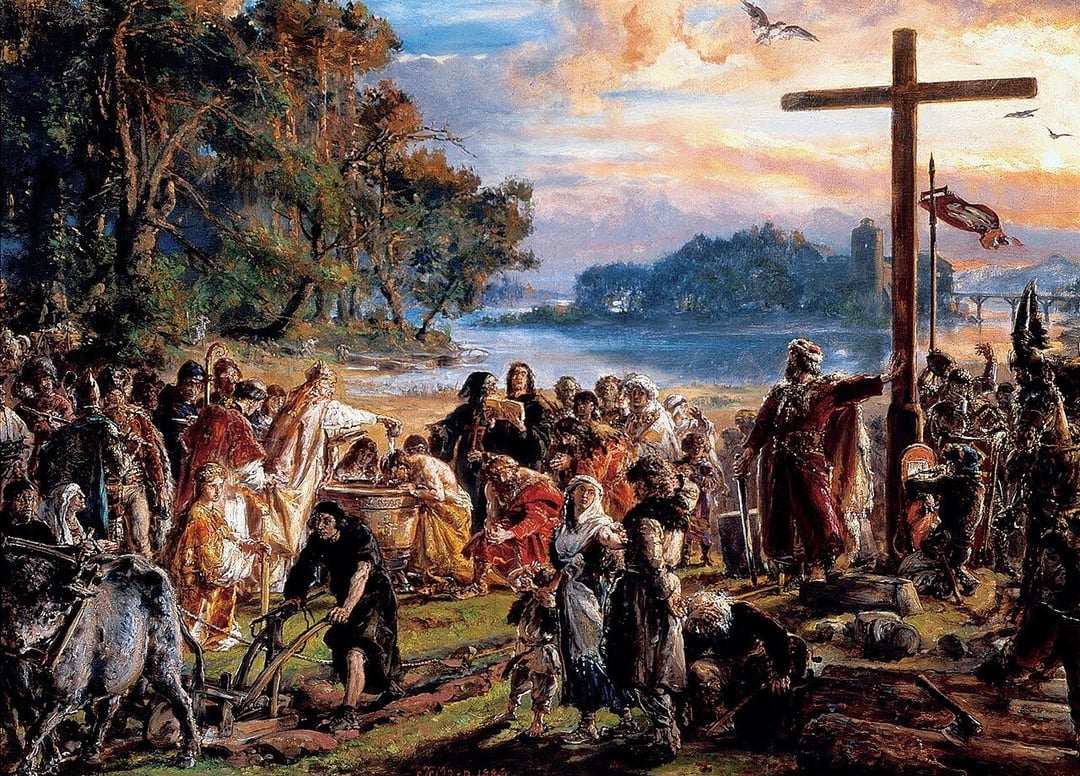
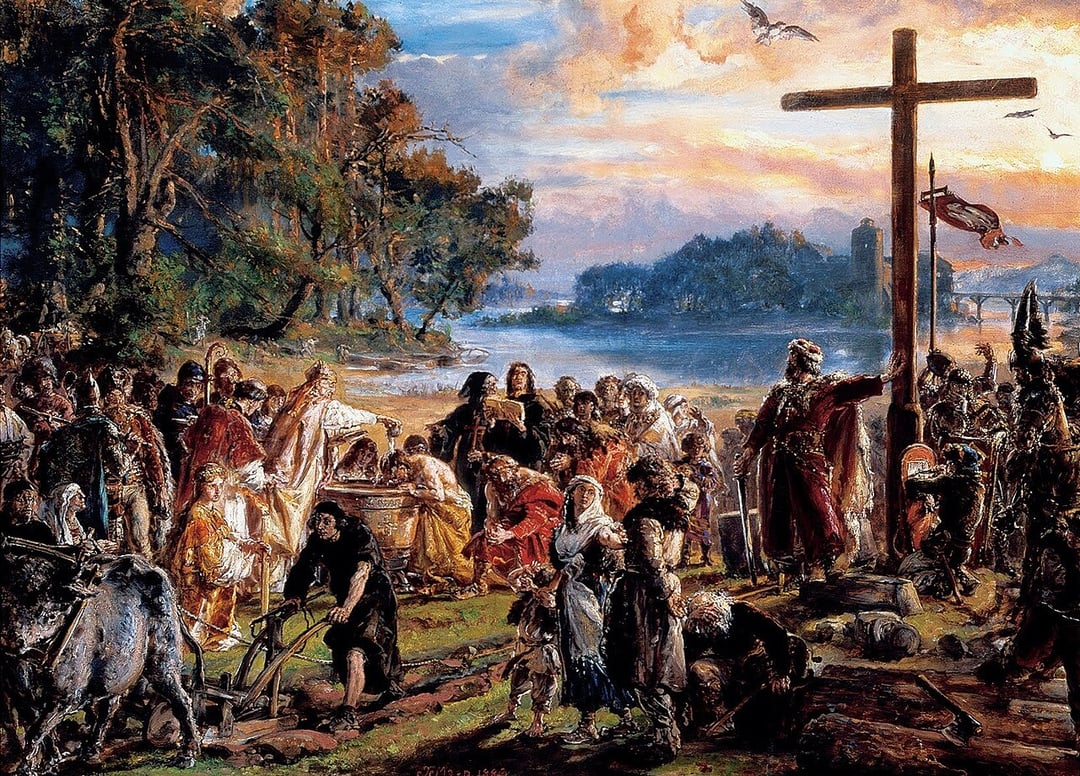
Mieszko I baptises Poland in 966. The Piast dynasty unifies the Slavic tribes, accepts Latin Christianity, and builds the first Polish kingdom. Crown moves to Kraków; Casimir the Great codifies the law.
Part of Poland
16 moments in this segment.
- — Baptism of Poland. April 14, 966. Mieszko I, first ruler of the Polans, accepts Latin Christianity — likely in Regensburg under Bohemian wife Dobrawa. The founding event of the Polish state; modern Poland still celebrates April 14 as Baptism of Poland Day.
- — Congress of Gniezno. March 1000. Holy Roman Emperor Otto III makes pilgrimage to Gniezno to venerate the relics of Saint Adalbert (Wojciech). Recognises Bolesław as quasi-equal; establishes the Archbishopric of Gniezno. The diplomatic moment that integrated Poland into Latin Christendom.
- — Gniezno Cathedral. The first metropolitan cathedral of Poland. Site of the coronation of the first Polish kings. The bronze "Doors of Gniezno" (c. 1175) depict the martyrdom of St Adalbert — one of medieval Europe's great Romanesque artworks.
- — Bolesław I the Brave. 992-1025. First King of Poland (crowned April 18, 1025, days before his death). Conquered Kievan Rus to the east, defeated Henry II of Germany. Established Gniezno as the first archdiocese (1000) — the Congress of Gniezno effectively recognised Poland as an independent kingdom.
- — Kraków Becomes Capital. c. 1040. Casimir the Restorer moves the royal seat from Gniezno to Kraków on the Wisła River. Kraków remains the capital for 556 years (until 1596).
- — Martyrdom of St Stanislaus. April 11, 1079. Bishop Stanislaus of Kraków killed by King Bolesław II during Mass — the most consequential church-state conflict of medieval Poland. Stanislaus canonised 1253; patron saint of Poland.
- — Wawel Cathedral. The Cathedral on Wawel Hill, Kraków — coronation site of 38 Polish kings, burial site of national heroes (Kościuszko, Mickiewicz, Piłsudski). The most sacred building in Polish national mythology.
- — Mongol Invasion of Poland. April 9, 1241. Polish forces under Henry the Pious crushed at the Battle of Legnica by the Mongol army of Baidar and Kadan. Henry killed; his head paraded on a spear. The Mongols withdraw to Hungary; Poland enters a feudal-fragmentation period.
- — Kraków Receives Magdeburg Rights. June 5, 1257. Bolesław V the Chaste grants Kraków the Magdeburg charter — German urban law that established the city's self-governance, market layout, and merchant rights. The Main Market Square (Rynek Główny) dates from this grant.
- — Statute of Kalisz. September 8, 1264. Bolesław the Pious grants Jews extensive legal protections — among the most comprehensive in medieval Europe. Extended by Casimir the Great in 1334. Polish lands become Europe's largest Jewish refuge for the next 600 years.
- — Wawel Royal Castle. Built atop Wawel Hill in Kraków by successive Polish kings. The seat of the Polish crown from the 11th to the 17th century. UNESCO World Heritage Site.
- — Władysław I the Elbow-High. 1320 coronation. Reunified the fragmented Polish lands after 188 years of feudal division. The crowning of Władysław Łokietek as king restored the Polish kingdom; his son Casimir III would build it into a major European power.
- — Casimir the Great. 1333-1370. The only Polish king called "Great." "Found Poland built of wood, left it built of stone." Codified the Statutes of Wiślica + Piotrków, founded Kraków University (1364), invited Jews fleeing persecution from the Rhineland. Doubled the size of Poland.
- — Jagiellonian University Founded. May 12, 1364. Casimir the Great founds Kraków Academy. After Charles University in Prague (1348), the second-oldest university in Central Europe. Renamed Jagiellonian University 1817. Among its later students: Nicolaus Copernicus and Karol Wojtyła (Pope John Paul II).
- — Jadwiga Crowned King of Poland. October 16, 1384. Eleven-year-old Jadwiga of Anjou crowned as "Rex Poloniae" — Latin for "King," not Queen (Poland had no provision for a female sovereign). Two years later she marries Jogaila of Lithuania, beginning the Jagiellonian dynasty.
- — Union of Krewo. August 14, 1385. Jogaila of Lithuania (pagan grand duke) agrees to convert to Catholicism, marry Jadwiga, and unite Lithuania with Poland in exchange for the Polish crown. The Personal Union that lasted four centuries.