Commonwealth (1569-1772)
Union of Lublin formalises the Polish-Lithuanian Commonwealth — Europe's largest, most religiously tolerant state. Elective monarchy, golden liberty, Vasa kings, the Deluge with Sweden, John III Sobieski rescues Vienna from the Ottomans (1683).
Part of Poland
16 moments in this segment.
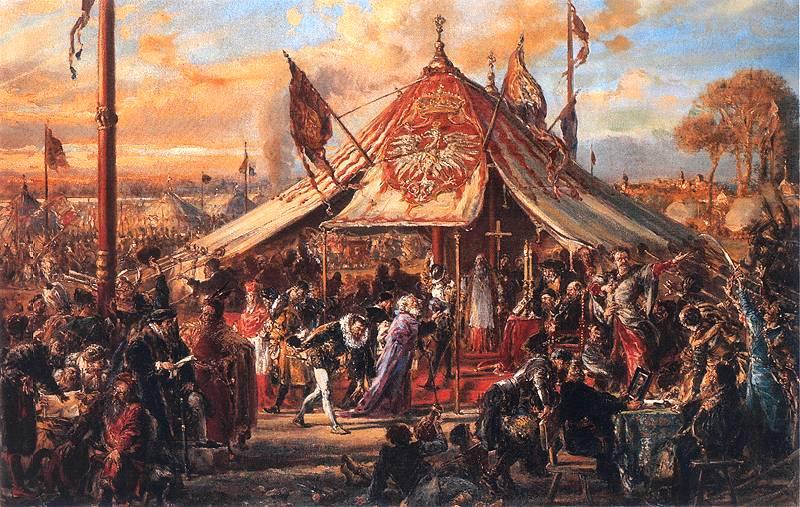
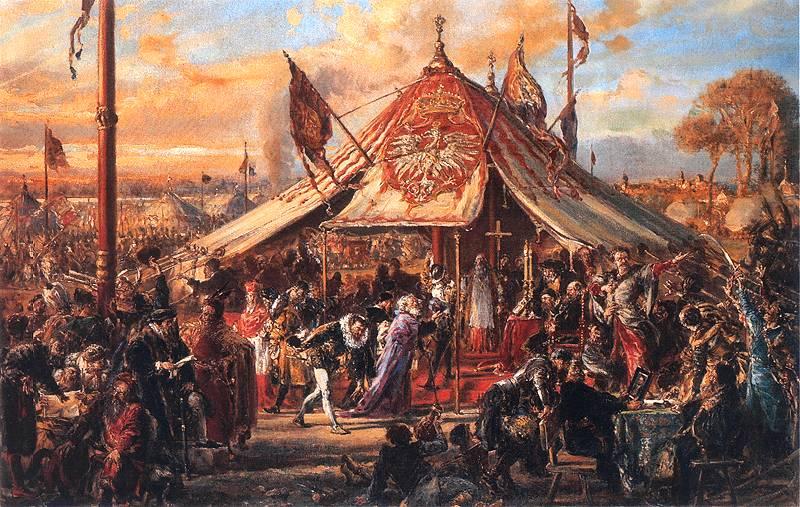
- — First Royal Election. April 4-11, 1573. The first royal free election of the Polish-Lithuanian Commonwealth. ~50,000 nobles vote on horseback at Kamień, near Warsaw. Henry of Valois elected; flees back to France 4 months later.
- — Warsaw Confederation. January 28, 1573. The Polish nobility pledges mutual religious toleration. The Warsaw Confederation became the legal foundation of the Commonwealth's religious tolerance; on UNESCO's Memory of the World register.
- — Henrician Articles. May 12, 1573. The Henrician Articles — the constitutional contract every elected Polish king swore to uphold. Set forth religious tolerance, parliamentary supremacy, right of revolt. The most progressive 16th-century European constitution.
- — Stephen Báthory. 1576-1586. Transylvanian prince elected King of Poland. Reformed the army; defeated Ivan the Terrible in the Livonian War. Founded Vilnius University (1579). One of the Commonwealth's most effective elected kings.
- — Sigismund III Vasa. 1587-1632. Swedish-Polish king who initiated the disastrous Polish-Swedish wars and lost the Swedish crown in 1599. His son and grandson would suffer the catastrophic Swedish Deluge of the 1650s.
- — Capital Moves to Warsaw. 1596. Sigismund III Vasa moves the royal residence from Kraków to Warsaw, closer to the Polish-Lithuanian centre after the Union of Lublin. Kraków remains the coronation city; Warsaw becomes the political capital.
- — Battle of Kłuszyn. July 4, 1610. Polish Hussars under Stanisław Żółkiewski annihilate a Russian-Swedish army five times their size. Two months later Polish troops occupy Moscow — the only foreign army to hold the Kremlin until 1812.
- — The Swedish Deluge. 1655-1660. Sweden invades Poland; the entire Polish-Lithuanian state collapses in months. ~40% of the population dies through war, famine, plague. The defining catastrophe of pre-partition Polish memory; subject of Henryk Sienkiewicz's "Potop" (1886).
- — Siege of Jasna Góra. November 18 - December 27, 1655. 70 monks + 180 soldiers defend the Pauline monastery at Częstochowa for 40 days against 3,000 Swedes. Reframes the Deluge as a religious-national struggle; the Black Madonna of Częstochowa becomes the spiritual centre of Catholic Poland.
- — John III Sobieski Elected. 1674. Jan III Sobieski elected King of Poland after his victories against the Ottomans. Reputation as Christendom's shield was set before the throne; cemented at Vienna nine years later.
- — Battle of Vienna. September 12, 1683. John III Sobieski leads the largest cavalry charge in history (18,000 horsemen, mostly Polish hussars) down the Kahlenberg into the Ottoman army besieging Vienna. Decisive Habsburg-Polish victory; the high-water mark of Ottoman expansion in Europe.
- — Augustus the Strong Elected. 1697. Augustus II (Elector of Saxony) elected King of Poland after converting to Catholicism. Began the Saxon dynasty period — generally considered the start of Poland's slow descent toward partition.
- — Great Northern War. 1700-1721. Poland devastated as the battleground of the Swedish-Russian Great Northern War, despite formally being neutral. The damage permanently weakens the Commonwealth; sets up the conditions for partition.
- — Stanisław Leszczyński. Twice elected King of Poland (1704, 1733). Lost both times to Saxon-Russian intervention. His daughter Marie married Louis XV of France; Stanisław spent his final decades as Duke of Lorraine, building Place Stanislas in Nancy.
- — Stanisław August Poniatowski. 1764-1795. Last King of Poland. Lover of Catherine the Great in his youth; she made him king. An Enlightenment patron who tried to reform Poland out of decline; failed against Russian, Prussian, Austrian opposition. Abdicated 1795; died in exile 1798.
- — First Partition of Poland. August 5, 1772. Russia, Prussia, Austria annex 30% of Polish territory + ~37% of population. Justified by Frederick the Great as "communion." The Polish Sejm forced to ratify under military duress.