WWII & PRL (1939-1989)
September 1, 1939: Germany invades. The Holocaust; Auschwitz; the Warsaw Uprising. 6 million Poles dead — 1 in 6 of the prewar population. Postwar communism, Stalinist terror, Wojtyła elected pope 1978, Solidarność 1980.
Part of Poland
20 moments in this segment.
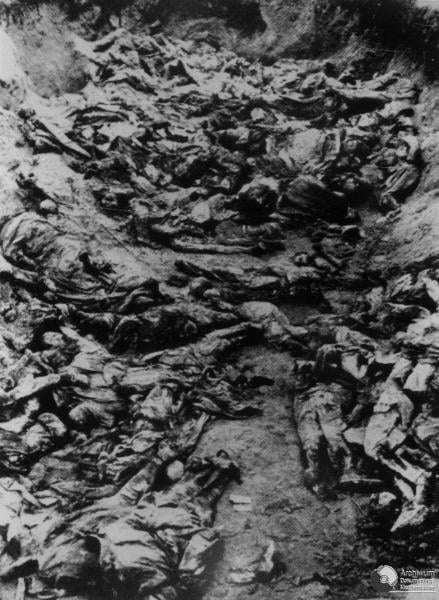
- — Katyn Massacre. April-May 1940. Soviet NKVD murders ~22,000 Polish officers, intelligentsia, and police in the Katyn Forest and other sites. Soviet Union denied responsibility until 1990. The pre-war Polish officer class effectively eliminated.
- — Auschwitz Opens. May 20, 1940. The first concentration-camp inmates arrive at Auschwitz — initially a Polish-political-prisoner camp; expanded into the largest Nazi death camp 1941-42. 1.1 million people killed; ~960,000 of them Jews.
- — Auschwitz Liberated. January 27, 1945. Soviet 60th Army liberates Auschwitz — finds ~7,000 surviving prisoners. Most had been forced on death marches west days earlier. January 27 is now International Holocaust Remembrance Day.
- — Warsaw Ghetto Sealed. November 16, 1940. The Germans seal off the Warsaw Ghetto — at peak, ~460,000 Jews in 3.4 km². The largest Nazi ghetto. ~92,000 die from starvation and disease before deportations to Treblinka begin (July 22, 1942).
- — Warsaw Ghetto Uprising. April 19 - May 16, 1943. The largest Jewish revolt of the Holocaust. ~700 fighters hold off the SS for nearly a month before the ghetto is razed. ~13,000 Jews killed during the uprising; the rest deported to Treblinka.
- — Warsaw Uprising. August 1 - October 2, 1944. Polish Home Army (Armia Krajowa) launches a 63-day uprising against the German occupation. Soviet forces wait across the Vistula. ~200,000 dead; Warsaw razed by Germans in reprisal. The defining Polish wartime trauma.
- — Yalta Conference. February 4-11, 1945. Roosevelt, Churchill, Stalin agree at Yalta that postwar Poland will be under Soviet sphere of influence. The wartime Polish-government-in-exile in London not invited. Sealed 44 years of communist Poland.
- — Polish Borders Shifted West. 1945. Poland's borders shifted ~200km west — gaining Silesia and former East Prussia from Germany, losing Vilnius and Lwów to the USSR. ~15M people displaced. The most consequential single border-shift of the postwar era.
- — Communist Consolidation. 1948. Polish Workers' Party absorbs the Socialists into the new Polish United Workers' Party (PZPR). Stalinist period begins. Will rule Poland for 41 years.
- — Poznań Protests. June 28-30, 1956. Workers at Poznań's Cegielski factory strike for bread and political freedom. ~100,000 demonstrators; security forces kill at least 57. The first major anti-communist uprising in the Eastern Bloc.
- — Polish October. October 1956. Władysław Gomułka returns to power after the Poznań protests. Brief liberalisation: Soviet troop limits, Catholic Church reopened, agricultural collectivisation halted. Most reforms reversed within a few years; Gomułka becomes increasingly conservative.
- — December 1970 Protests. December 14-22, 1970. Workers at Baltic shipyards (Gdańsk, Gdynia, Szczecin) strike against food-price hikes. Military fires on protesters; 45 killed in Gdynia alone. Brought down Gomułka; Edward Gierek became First Secretary.
- — Karol Wojtyła Elected Pope. October 16, 1978. Cardinal Karol Wojtyła of Kraków elected Pope John Paul II — first non-Italian pope in 455 years. Polish Catholic Church suddenly the most important moral force in Soviet-bloc politics.
- — Solidarność Founded. September 17, 1980. Solidarność founded in Gdańsk — first independent trade union in the Soviet bloc. Within a year: 10M members (1/3 of Poland's working-age population). The mass-democratic movement that would topple Polish communism.
- — Martial Law. December 13, 1981. General Jaruzelski declares martial law. Solidarność leaders interned, organisation banned. ~90 deaths. Martial law formally lifts July 1983; informal repression continues until 1989.
- — Lech Wałęsa Wins Nobel Peace Prize. October 5, 1983. Lech Wałęsa awarded the Nobel Peace Prize. His wife Danuta accepts in his place — he fears the communist government won't let him back in.
- — Murder of Father Popiełuszko. October 19, 1984. Father Jerzy Popiełuszko — Solidarność chaplain — murdered by Polish secret police (SB). 800,000 people attend his funeral. The defining martyrdom of the Solidarność era; canonised 2010.
- — Round Table Talks. February 6 - April 4, 1989. Government-Solidarność negotiations at the Round Table. Agreement: partially-free elections + legalisation of Solidarność. The first major negotiated transition out of communism in Europe.
- — June 4, 1989 Election. June 4, 1989. Solidarność wins 99 of 100 Senate seats and every contested Sejm seat. The same day Chinese tanks crushed Tiananmen Square. The single day on which European communism began to die.
- — Mazowiecki Government. August 24, 1989. Tadeusz Mazowiecki becomes Prime Minister — first non-communist head of government in the Soviet bloc since 1948. Begins the "shock therapy" Balcerowicz Plan.