Tech Boom
The city has had a boom roughly every fifty years and has never once handled one gracefully: gold, silver, shipping, the 1934 general strike that shut down the waterfront, the dot-com bubble, and the platform era. Each one arrived promising to remake the place and each one mostly remade who could afford to live in it.
Part of San Francisco
69 moments in this segment.
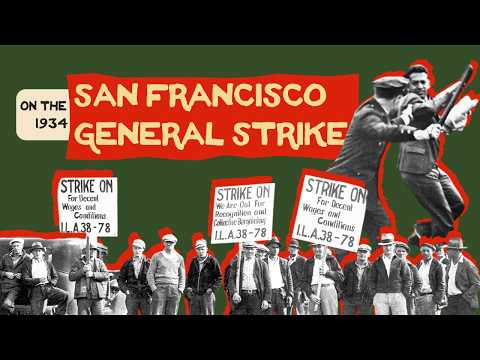
- - Lessons from the 1934 San Francisco General Strike. In 1934, the working classes across the West Coast were engaged in a fierce battle against the capitalists and the labor aristocracy. They were slandered, beaten, and raided, but they did not back down. Today, faced with the failures of capitalism, we must learn from the past. Further Reading: The
- - Longshoremen shut the Port of San Francisco. Silent period film of the coastwide longshore walkout that closed the Port of San Francisco in spring 1934. Every West Coast port stopped, with the union-controlled hiring hall as the central demand. The print circulates through the Internet Archive from a public-domain source.
- - The San Francisco General Strike of 1934. General strikes have long been a dream of America’s radical labor leaders. 90 years ago, dock workers made that dream a reality in San Francisco, sending ripples across the country for generations. What happened to bring this dream to life? For more information visit: laborontheline.org #ILWU #l
- - San Francisco General Strike, 1934 - Part 1
- - What can the 1934 San Francisco General Strike teach us today?. In 1934, workers across San Francisco rose up in one of the greatest general strikes in U.S. history. As the billionaire war on the working class continues, we must learn from our history to fight back. For more information visit laborontheline.org
- - Unedited newsreel rushes of the waterfront rioting. Raw, unedited newsreel material from the 1934 waterfront strike held by a commercial historical film library. Because it is uncut rushes rather than a released newsreel, it shows the street action without the narration a studio would later lay over it. Footage Farm posts such reels as unedited historical documents for research.
- - San Francisco General Strike (silent, 1934). This footage captures San Francisco in the throes of the 1934 general strike, ignited by escalating violence in the longshore strike. The city appears eerily deserted, with empty streets and closed stores, while abandoned vehicles sit where they ran out of fuel. Mayor Angelo Rossi addresses the tens
- - The city stops during the general strike. Period film of the San Francisco general strike, voted by the Labor Council's strike committee after the silent funeral march for Sperry and Bordoise up Market Street on 9 July. Roughly 130,000 workers across the city stopped work from 16 to 19 July in support of the longshoremen. Only a handful of designated services were allowed to keep running.
- - Dockworkers hold out for eighty-eight days. Archival strike film assembled around the West Coast walkout led by Harry Bridges as chair of the strike committee. Police and National Guard troops beat and shot workers, with deaths in California, Oregon and Washington. The dispute went to arbitration, and the October 1934 award granted the coastwide contract and the hiring hall.
- - Longshore pickets march through San Francisco. Silent 16mm footage of San Francisco longshore workers on the picket line during the 1934 waterfront strike, marching with hand-lettered demands. The coastwide walkout began on 9 May 1934 over the union-controlled hiring hall that would replace the shape-up. Held and digitised by the A/V Geeks 16mm film archive.
- - Unedited newsreel rushes from the longshoremen's strike. Raw, unedited newsreel material of the 1934 longshoremen's strike, held by the commercial stock library Footage Farm and posted as a research document. Unlike cut newsreels, this preserves the camera takes as shot on the waterfront. The San Francisco Film and Photo League's own strike footage was destroyed in the vigilante raids of 17 July 1934, which makes surviving rushes unusually valuable.
- - British Pathe rushes of American strikes and marches. Unissued British Pathe material from 1934 showing demonstration marches in an American city, with a Maritime Federation of the Pacific banner among the ranks. Pathe's own paperwork for the reel is missing, so the cameraman and precise location are not recorded. It survives as an unedited fragment of how the waterfront dispute looked to a newsreel camera.
- - Stock footage of the city stopped by the general strike. Unedited archival film of San Francisco during the general strike of July 1934, presented by CriticalPast in the form it survives. The general strike ran from 16 to 19 July, called by the Labor Council after the funeral march for the two men killed on the waterfront. Shuttered shops and emptied streets are the documentary record of a city where only designated services kept running.
- - Police clubs against union pickets on the waterfront. Archival footage of San Francisco police fighting union pickets as employers tried to move cargo off the docks. The confrontations ran through early July 1934 and culminated on the fifth, when police and vigilantes fired on strikers and killed longshoreman Howard Sperry and cook Nick Bordoise. CriticalPast presents the reel unedited and without a broadcast narration track.
- - Longshoremen packed into a hall to vote the strike. Archival film of San Francisco dock workers assembled in a union meeting during the 1934 waterfront dispute. The mass meeting was the strike's real machinery: Harry Bridges chaired the strike committee, and the coastwide walkout that began on 9 May ran 82 days on decisions taken in rooms like this one. The footage survives without sound.
- - Newsreel cameras on the Embarcadero during the waterfront strike. A 1934 theatrical newsreel on the West Coast longshore strike, which ran 82 days from 9 May to 30 July and turned on the union's demand for a hiring hall to replace the shape-up. The footage covers the Embarcadero fighting of Bloody Thursday, 5 July, when police moved to open the docks and Howard Sperry and Nick Bordoise were shot dead. Sixty-four others were injured that day.
- - Police fire tear gas at strikers on the waterfront. Stock-footage transfer of 1934 film shot at the Port of San Francisco during the West Coast waterfront strike. Police in gas masks use tear gas and drawn guns against longshoremen on the Embarcadero. This is the repression that preceded Governor Frank Merriam ordering the National Guard onto the waterfront on the evening of 5 July.
- - Movietone cameras on the Embarcadero as the general strike opens. British Movietone newsreel filmed on 16 July 1934, the first day of the San Francisco general strike, when roughly 130,000 workers stopped work across the city. The camera holds on massed strikers, mounted police and tear-gas canisters bursting in the street. The West Coast waterfront strike had by then run since 9 May over the longshoremen's demand for a union-controlled hiring hall.
- - British Movietone films the militia in the streets. British Movietone material dated 23 July 1934, filmed in the week after the San Francisco general strike ended on 19 July. The shots show crowds and militia in the streets, tear gas bursting, and stretchers carried from buildings. It is a foreign newsreel service recording an American city under armed guard, now held through the AP Archive.
- - A wartime film follows a Richmond hull from keel to launch. A 1940s American educational documentary on the Richmond shipyards, following a ship from the laying of the keel through to launch. Yard No. 2's prefabrication plant and 27 shipways were the signature Richmond sight, and prefabrication is what allowed the SS Robert E. Peary to go from keel to launch in four days in November 1942 against a realistic yard average of about 42 days.
- - A wartime travelogue tours the working waterfront. A black-and-white Columbia Pictures theatrical short released in 1941, surveying San Francisco from Fisherman's Wharf outward. It films the port and the city in the last months before the shipyards took over the Bay, when the Navy was acquiring the Hunters Point drydocks from Bethlehem Steel and construction was beginning on Richmond Yard No. 1. Preserved and posted by an orphan-film archive.
- - Lena Horne launches the SS George Washington Carver. Silent newsreel of Lena Horne sponsoring the Liberty ship SS George Washington Carver at Richmond Yard No. 1, launched before a crowd of about 1,500. The ship was named for the Black scientist and was built by a workforce that included roughly a thousand Black women across the four Richmond yards. The launch drew the OWI photographer E. F. Joseph, whose series on the Carver's builders is now at the Library of Congress.
- - The Carver goes down the ways at Richmond Yard One. Archival newsreel of the launch of the Liberty ship George Washington Carver, sponsored by Lena Horne before a crowd of about 1,500 at Kaiser's Richmond Yard No. 1 on 7 May 1943. The Office of War Information sent photographer E.F. Joseph to document the largely African American workforce that built her. Footage Farm holds the reel as an unedited historical document.
- - Birth of Victory at the Richmond shipyards. A 1946 industrial film on the Richmond shipyards and their part in wartime production, following the prefabrication plant and the shipways that made Yard No. 2 the highest-volume yard on the coast. The Richmond yards closed in 1945 to 1946 having delivered 747 ships, among them 519 Liberty ships, about a fifth of the American total. Preserved by the Charlie Dean Archives.
- - Strikestory: the ILWU's own account of 1934. The union-produced documentary Strikestory, made in 1988, built from first-person accounts by men who worked the San Francisco waterfront and from archival footage of the eighty-two-day strike. It is the ILWU telling the story of the dispute that won the hiring hall. Preserved here from a VHS transfer.
- - The Dot Com Bubble Explained in One Minute. A one-minute video which explains what the dot com bubble was all about. By knowing what generated the dot com bubble and how things unfolded, you'll understand a thing or two about how markets function and ultimately about what makes human beings tick. Please like, comment and subscribe if you've
- - Dot Com Bubble Wall Street Documentary. The documentary about the end of the dot com bubble on Wall Street 2000.
- - On this day | 15th April 2000 | Wall Street stockmarket crash. On the 15th of April 2000, Wall Street experienced a points drop never before seen on the US markets. At the time, the American markets' worst single day ever, left traders and investors shell shocked. See more at tennews.com.au
- - Dot-com Boom Stories from Silicon Valley. Company founders, entrepreneurs, and leaders tell the story of what happened in Silicon Valley during the Dot-com boom. In order of appearance: Ravi Rishy-Maharaj (founder, Kinaare Networks and Gigsky), Meg Whitman (former CEO, eBay), Curt Carlson (CEO, SRI International), Joe Parisi (founder, Therm
- - Are We in an Internet Bubble Like 1999?. Feb.14 -- Goldman Sachs Managing Director Heath Terry discusses internet sector valuations, Amazon’s growth, artificial intelligence and whether Netflix is an M&A target. He speaks with Caroline Hyde on “Bloomberg Technology” from Goldman Sachs Technology and Internet Conference in San Francisco.
- - Is tech in a bubble Unease, but no panic, over good times. Some well-known venture capitalists have been warning that the good times for tech start-ups can't last. USA Today interviews workers at tech companies in downtown San Francisco about whether tech is in a bubble, and what may be different from 1999. Laura Mandaro
- - Kevin Epps films Hunters Point from inside Hunters Point. The trailer for Kevin Epps's documentary on the Bayview-Hunters Point neighbourhood, made by a filmmaker who grew up there. The shipyard that drew Black workers to the district during the war closed in 1974, and the film records what the withdrawal of that work left behind. Released in the mid-2000s and posted here in 2006.
- - An ILWU member recounts the Big Strike. A recorded account from an International Longshore and Warehouse Union member on the 1934 San Francisco general strike and West Coast maritime strike. The strike produced the coastwide contract and the jointly run hiring hall with a union-selected dispatcher, which was the point of the walkout. The ILWU itself was formed in 1937, splitting from the ILA under Harry Bridges.
- - Black clubs on Pacific Avenue and the sound of the Coast. A tribute to the Black musicians and dancers of the Barbary Coast's Pacific Avenue clubs, among them Purcell's So Different Club at 520 Pacific, which was Black-owned and housed a band reportedly the first to use the word jazz in its name. The quarter's dance halls were crippled by the Police Commission's September 1913 resolution and taxi dancing was finally prohibited in 1921.
- - KQED on the bay as the greatest shipbuilding centre in the world. An episode segment from KQED's Saving the Bay on the wartime transformation of San Francisco Bay into the largest shipbuilding operation anywhere. Henry Kaiser's Richmond yards produced 747 ships in four years, and by mid-1944 women made up more than a quarter of Richmond's production workers. Broadcast and posted in 2010.
- - Giannini enters the California Hall of Fame. The California Museum's induction film for Amadeo Peter Giannini, presented at the ceremony of 14 December 2010 with an introduction by John Doerr. Giannini founded the Bank of Italy in a converted North Beach saloon on 17 October 1904 to serve immigrant depositors other banks turned away, and the bank was renamed Bank of America in 1930. He died on 3 June 1949 leaving an estate of $489,278.
- - San Francisco is not for sale. Protesters blocking a Google shuttle chant that San Francisco is not for sale, in English and Spanish. The action of 9 December 2013 in the Mission was the first major tech-bus blockade and the origin image of the whole tech-backlash genre. Filmed by the Demotix news agency.
- - A staged confrontation at a blocked shuttle on Valencia Street. San Francisco Bay Guardian footage from 9 December 2013, the day activists first blocked and boarded a Google commuter bus in the Mission. A man who berated the protesters as a Google employee was reported within about a day to be a union organiser, and the reveal became a media-ethics story in its own right. Filming this exchange is why it travelled.
- - Protesters pulled off a Google bus in the Mission. News footage of San Francisco protesters being removed from a tech commuter shuttle, filmed the day after the first major blockade at 24th and Valencia on 9 December 2013. Heart of the City activists had stopped and boarded a Google double-decker there, and copycat actions followed across the Bay Area. The protests ran until the permanent Commuter Shuttle Program took effect in February 2016.
- - An Apple shuttle is blockaded in the Mission. Footage of the 20 December 2013 blockade of an Apple commuter shuttle in San Francisco, organised around evictions and rising housing costs attributed in part to bussing tech workers to Silicon Valley. It followed the first major blockade on 9 December at 24th and Valencia, when activists stopped and boarded a Google double-decker. The protest era ran from December 2013 until the permanent Commuter Shuttle Program took effect on 1 February 2016.
- - Protesters block a shuttle at 24th and Valencia. Reporting for the San Francisco Bay Guardian from the morning of 20 December 2013, when between 70 and 100 protesters gathered at 24th and Valencia to blockade a private tech shuttle over evictions. The corner had become the recognised stage for these actions after the first blockade there on 9 December. Contemporaneous street coverage rather than later retrospective.
- - Eviction Free San Francisco holds an Apple bus in the Mission. An estimated 100 to 150 people organised by Eviction Free San Francisco and Our Mission No Eviction gathered at 24th and Mission on 20 December 2013, then marched to 24th and Valencia to hold up an Apple employee shuttle. Filmed from within the crowd on the day. The action lasted about thirty minutes and used loudspeakers.
- - A TechCrunch reporter on who pays for the boom. Labor Video Project interviews the TechCrunch reporter Greg Ferenstein on the widening divide in San Francisco between tech workers and everyone else, recorded in the weeks after the first shuttle blockades. It puts the industry's own press on camera at the moment the backlash began.
- - A resident films an anti-displacement protest from his balcony. Raw amateur footage shot from an apartment balcony as demonstrators gather outside a newly built Mission District complex in early January 2014. The shuttle blockades that began weeks earlier had opened a broader fight over who the new housing was for. The filmer's own commentary makes clear he disagrees with the protesters, which is part of what the record shows.
- - News asks what the boom is doing to the city. A February 2014 news segment on the tech boom's effect on San Francisco, framed around the argument that it was changing the character of the city. It aired between the December 2013 shuttle blockades and the April 2014 Gmuni action, when costumed protesters at 24th and Valencia staged a satirical public-access programme for the buses. Contemporaneous broadcast reporting rather than retrospective.
- - Local news asks whether Google is moving into the city. A KRON 4 tech segment from February 2014 on Google's expanding footprint in San Francisco itself, broadcast at the height of the shuttle protests. The city had already granted the Central Market payroll tax exclusion in 2011, the break that kept Twitter in Mid-Market, and by 2014 it was saving participating companies around $34 million a year. Contemporaneous local broadcast news.
- - Transamerica's own portrait of its founder. A short corporate film from Transamerica on the life and philanthropy of Amadeo Pietro Giannini, who founded the company and played a large part in San Francisco's recovery after the 1906 earthquake. It is the institution telling its founder's story in its own words, which is itself the useful thing: the familiar account of gold hauled out under crates of oranges and lending from a plank desk on the Washington Street wharf is corporate retelling, and researchers put the sum nearer $80,000 than the $2 million usually quoted. The bank's vault also survived, which complicates the rescue premise.
- - Tech Companies In The Tenderloin District | CNBC. Tech companies in California are moving from the suburbs to the city, and they're settling in San Francisco's historic Tenderloin district. » Subscribe to CNBC: About CNBC: From 'Wall Street' to 'Main Street' to award winning original documentaries and Reality TV series
- - Poet Lawrence Ferlinghetti laments changing San Francisco. Ninety-six-year-old Lawrence Ferlinghetti settled in San Francisco in the 1950s, where he opened the City Lights bookshop and publishing house. But today San Francisco is better known as a central hub of the tech boom than of countercultural creativity. Jeffrey Brown offers a look at how the poet se
- - Smithsonian on the Bank of Italy and its depositors. A Smithsonian Channel segment on Giannini, the son of Italian immigrants who built a San Francisco neighbourhood bank into one of the largest commercial banks in the world. He died in 1949 leaving an estate of under half a million dollars. Broadcast as part of a series and posted in 2015.
- - Streets by VICE: San Francisco (Market St.). As part of our VICE Guide to San Francisco, Streets By VICE: Market Street is a new documentary on one of San Francisco's most iconic streets. Hosted by Karley Sciortino, the episode traces the street's history from its time as the entry point for new immigrants to San Francisco to its rich history
- - Betty Reid Soskin on being Black in the wartime shipyards. Betty Reid Soskin, who worked in a segregated Boilermakers union hall during the war and later became a ranger at the Rosie the Riveter home front park she helped create, speaks about what the shipyards were actually like for Black workers. In 1943 the Boilermakers forced Black Marinship workers into a segregated auxiliary, and over 200 who refused to pay its dues were fired. Recorded in 2016.
- - Ron Magden's film on the West Coast longshore strike. A documentary by labour historian Ron Magden on the 1934 Pacific Coast longshore strike, made for the Seattle Civil Rights and Labor History Project. It sets out what the strikers were after: control of the hiring process, a coastwide contract and union recognition in every port. Archival stills and film are cut with historical narration.
- - The banker of North Beach and the fire that made his name. A short history programme on Amadeo Peter Giannini, who founded the Bank of Italy in a converted North Beach saloon in October 1904 to lend to immigrants other banks turned away. His conduct after the 1906 earthquake is the origin of the Bank of America legend, though the vivid details of the wagon and the plank desk are corporate retelling rather than documented record. Published in 2017.
- - A Library of Congress specialist on the real women workers. Sheridan Harvey, women's studies specialist at the Library of Congress, traces how the Rosie the Riveter image was built and what the women behind it actually did. The corrective matters in the Bay Area, where the shipyard workforce included over 6,000 Black workers across the four Richmond yards and around 1,000 Black women, photographed for the Office of War Information by E. F. Joseph, the first known Black professional photographer in the region.
- - Radiation cleanup fraud at the Hunters Point shipyard. KPIX Bay Area news report on the cleanup of radiological contamination at the former Hunters Point Naval Shipyard, which an environmental group called the biggest case of eco-fraud in United States history. The yard peaked at 17,000 to 18,500 wartime jobs and by 1945 covered 979 acres with six drydocks. From July 1946 it served as the decontamination site for ships irradiated at Bikini, and hosted the Naval Radiological Defense Laboratory until 1969.
- - ILWU Local 10 marks Bloody Thursday on the Embarcadero. The 2018 Bloody Thursday memorial, at which ILWU Local 10 honours Howard Sperry and Nick Bordoise, the longshoreman and the cook shot dead by police on 5 July 1934. Every West Coast port has stopped work on that date since. The ceremony is the strike's living annual observance rather than footage of the event itself.
- - Keck Museum curator on John Mackay in Virginia City. The University of Nevada, Reno's Keck Museum curator Garrett Barmore visits Virginia City with a descendant of John Mackay to discuss the miner who arrived on the Comstock in 1859 at four dollars a day and left it one of the richest men in America. Mackay's partnership with James Fair, James Flood and William O'Brien became the Bonanza firm whose silver founded the Nevada Bank of San Francisco. A university museum production.
- - Dr Ahimsa Sumchai on illness at the Hunters Point shipyard. An interview with Dr Ahimsa Sumchai of the Hunters Point Community Biomonitoring Program on the pattern of disease among shipyard workers and neighbouring residents. Hunters Point peaked at some 17,000 to 18,500 wartime jobs and then became the decontamination site for ships irradiated at Bikini, with a Naval Radiological Defense Laboratory operating there until 1969. Produced by Labor Video Project.
- - NBC News Learn on the migration that gold set off. A short educational segment from NBC News Learn on the 1848 discovery of gold in California and the mass movement west that followed. San Francisco went from a settlement of a few hundred to a city of tens of thousands within two years, and the merchants who supplied the miners took most of the money. Produced and published in 2020.
- - SF City Guides on making waves at the waterfront. A short talk from San Francisco City Guides' Moments in History series on the working waterfront, the volunteer-docent programme run through the San Francisco Public Library. It covers the port that the Gold Rush built and the labour that ran it.
- - Five women who built ships at the Kaiser yards. Trailer for a documentary following five women who travelled to Richmond, California during the Second World War to build ships at the Kaiser yards, then the largest shipbuilding operation in the world. Women rose from 13.7 percent of Richmond production workers in early 1943 to over 27 percent by mid-1944, and the real job there was overwhelmingly welding rather than riveting.
- - James Delgado on the Gold Rush ships buried under downtown. The maritime archaeologist James Delgado, author of Gold Rush Port, describes the excavation of the storeships and abandoned vessels buried beneath the downtown San Francisco street grid. The great fire of May 1851 sealed the layer that makes them readable today; the Niantic came up at Clay and Sansome in May 1978 and its stern is now at the San Francisco Maritime Museum. A Society for American Archaeology lecture.
- - Lincoln Cushing on the home front that remade Bay Area labor. Historian Lincoln Cushing presents for the Rosie the Riveter Trust on the wartime home front seen through the Kaiser shipyards at Richmond. The period reshaped labor organising, race and gender relations, and health care, with the Permanente Health Plan opening to the general public on 21 July 1945. The Richmond yards delivered 747 ships before closing in 1945 and 1946.
- - How a Kaiser in-house poster became a labour icon. Historian Lincoln Cushing traces the Westinghouse-era poster now universally known as Rosie the Riveter from obscure workplace notice to political shorthand. The Rosie the Riveter Trust recorded the talk in 2022. Cushing's point cuts against the image: the real Richmond job was overwhelmingly welding, and welders were over forty per cent female by 1944.
- - A maritime museum traces the long career of Harry Bridges. An hour-long museum programme from Foss Waterway Seaport on the Australian-born longshoreman who chaired the 1934 strike committee and led the ILWU from its 1937 founding until 1977. Employers and federal prosecutors spent three decades trying to deport him. The talk was recorded and published in 2022.
- - San Francisco before the strike of 1934. The opening chapter of the Strikestory documentary, on the conditions that produced the walkout: the shape-up on the Embarcadero, the company union, and the Depression-era waterfront. It sets up the eighty-two-day coastwide strike and the four days in July when roughly 130,000 San Francisco workers stopped work.
- - Sid LeProtti and the music of the vice quarter. Jazz researcher Dave Radlauer on pianist Sid LeProtti and the Barbary Coast music scene, built on the district's own venues and recorded recollections. The quarter's clubs included Purcell's So Different Club at 520 Pacific, Black-owned and home to the So Different Jazz Band, and the Thalia at 732 Pacific with its double-tiered slummers' balconies. LeProtti remembered the literal last night in March 1921, when a corporal walked in and stopped the music at one o'clock.
- - The Harry Bridges School of Labor teaches the general strike. A 2024 session of the Harry Bridges School of Labor on the 1934 San Francisco general strike, covering the conditions that produced it, the strike itself and its aftermath, and screening part of an older ILWU documentary. Bridges led ILA Local 38-79 in 1934 and went on to serve as ILWU president until 1977. The union still stops work in every West Coast port each 5 July.