It Got Out
Some of what happened inside this game left it entirely. A player charging into a raid shouting his own name became one of the most recognised things the internet has produced. South Park made an episode and won an Emmy. And in September 2005 a debuff escaped a raid and killed players in their thousands across whole servers, which produced actual peer-reviewed epidemiology, researchers arguing that watching real people flee, help, or deliberately spread an outbreak modelled human behaviour better than the mathematics then in use.
Part of World of Warcraft
30 moments in this segment.
- - Leeroy Jenkins. A guild plans an encounter in detail; one player, away from his keyboard, returns and charges in shouting his own name. It is the single most widely recognised thing WoW ever produced, known to enormous numbers of people who have never played it.
- - Australian television reports the in-game plague. An Australian news segment on the Corrupted Blood incident, drawing the parallel between the game's spreading disease and real epidemics. The archive already carries the incident itself; this is the moment it crossed into broadcast news and, later, into peer-reviewed epidemiology.
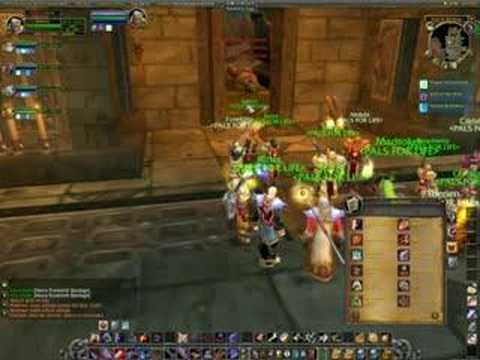
- - Ironforge during the plague. Player-shot footage of Hakkar's Corrupted Blood debuff loose in Ironforge, bodies stacking in a capital city because a raid-boss curse escaped its instance through pets and teleporting players. The incident of September 2005 was later modelled by epidemiologists as an accidental study of human behaviour in an epidemic. This is what it actually looked like from the ground.
- - The dry run. An earlier take of the same scene. The video was staged by the guild, which was known at the time and forgotten later, the joke was always that it was a joke.
- - Corrupted Blood. In September 2005 a debuff from a raid boss escaped into the cities through hunter pets and NPCs, and killed low-level players in their thousands until Blizzard reset the servers. It is the closest thing to an accidental epidemic ever run on a human population.
- - Randy Marsh plays. The parent-discovers-the-game sequence from the South Park episode. The joke lands because it was, in 2006, a recognisable domestic scene in a lot of houses.
- - Live to Win. The montage from the South Park episode. Its target was not the game so much as the amount of unglamorous work the game asked for.
- - The addiction segment. Local news on WoW addiction in 2006. The framing, a mother, a darkened room, a number of hours, was near-identical across dozens of these segments and set the tone for a decade of coverage.
- - An early documentary. One of the first attempts to explain the game to people outside it, made while it was still growing.
- - An editorial on internet addiction. A 2006 video editorial arguing that World of Warcraft is an addiction problem, made at the height of the mainstream panic about the game. It is worth keeping as an example of how the argument was actually framed at the time, clinical language applied to a hobby, with no clinical evidence behind it. The claim is the artifact here, not the diagnosis.
- - Make Love, Not Warcraft. South Park's WoW episode aired on 4 October 2006 and won an Emmy. Much of it was rendered inside the game by Blizzard staff, and it introduced the game to an audience that had only heard it mocked.
- - The William Shatner advert. The thirty-second television spot in which William Shatner explains his character to camera, part of the celebrity campaign Blizzard ran from 2007 onward alongside Mr. T, Verne Troyer and later Ozzy Osbourne. The ads are the clearest evidence of WoW being sold to people who did not play games. Dated to the broadcast campaign, not the 2010 re-upload.
- - Mr. T and the night elf mohawk. Blizzard's celebrity advertising campaign put Mr. T on television explaining his character build. The ads treated the game as mainstream entertainment years before the press did.
- - William Shatner explains his class. Shatner delivering a shaman monologue to camera. The campaign's conceit, real celebrities describing their characters completely straight, is why the ads are still watched.
- - Verne Troyer. Another entry in the celebrity campaign, this one built around a gnome mage.
- - Addiction on the evening news. A Philadelphia news report treating online games as a clinical problem. The reporting was rarely wrong that some people played destructively; it was usually wrong about why, and about how many.
- - Fox covers the expansion. A television report on the launch of The Burning Crusade, covering a midnight queue as a news event.
- - Ozzy Osbourne
- - True Life. MTV's documentary strand on a player who describes his own use of the game as compulsive. Worth carrying with the moral-panic coverage around it, because the individual accounts and the genre framing are not the same thing.
- - Game Overdose. A documentary on WoW addiction from the peak of the coverage. The panic subsided without the underlying question ever being settled.
- - A husband, a wife and the addiction segment. A television news item on a man said to have abandoned his wife and infant daughter for the game. It is a clear specimen of the addiction-panic genre that ran on local news through the late 2000s: the claim is presented as fact, the framing is the story, and no counter-view is offered. Kept for what the coverage looked like, not as a finding about the game.
- - The BBC reports on Azeroth. A BBC news segment on World of Warcraft, mirrored by a viewer with no attribution. Broadcast coverage is the record of how the game looked to people who never played it, which is why period news reports belong in the archive alongside the game footage.
- - Chuck Norris. The Chuck Norris advert, built on a meme format already several years old by the time it aired.
- - Aubrey Plaza. A later entry in the campaign, running after subscriber numbers had begun their long decline.
- - The film. The first trailer for Duncan Jones's Warcraft. It made over $430 million worldwide, most of it in China, and was still considered a disappointment in the United States.
- - Warcraft, trailer two. The second trailer, released ahead of a June 2016 opening.
- - The critics. Mark Kermode reviewing the Warcraft film. The critical reception in the West and the commercial reception in China were so far apart that the film became a standing example of the gap.
- - The man behind the meme. A documentary tracing what happened to Ben Schulz, the player behind Leeroy, and to the guild that made the video, after it escaped into the wider internet.
- - The epidemiologists took it seriously. Corrupted Blood produced actual peer-reviewed literature: researchers in epidemiology argued that the behaviour of players under an uncontrolled outbreak, fleeing, staying to help, deliberately spreading it, modelled human responses better than the mathematics then in use.
- - A Philippine newscast covers a Warcraft wedding. A segment on GMA's Balitanghali about a couple in Iloilo City who staged their wedding around the game. It is evidence of how far the game's iconography travelled from its Western player base and into ordinary local news. Distinct from the archive's 2018 in-Azeroth wedding: this one happened in the world, and made the evening news.