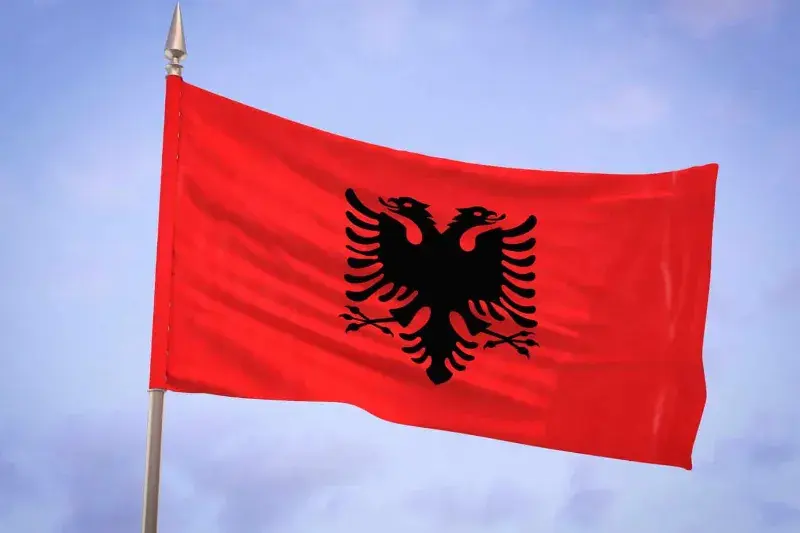
Albania
A country archive from the Illyrians to the present, Skanderbeg's twenty-five-year defiance, four Ottoman centuries, the declaration at Vlorë in 1912, the most isolated state in Europe and its bunkers, the crossing of the 1990s, and the mountains, coast and old law that outlasted all of it.
A chronological documentary of 905 moments spanning -3700–2026 on Loreline.
Curated by Olivier · last updated 2026-09-20
Eras
- Before Albania, The Illyrians held this coast and its mountains long before there was a country called Albania, trading and fighting with Greek colonies planted at Epidamnos, later Durrës, and at Apollonia, and with the Roman republic that eventually absorbed them. Queen Teuta's wars with Rome, the Via Egnatia driven across the Balkans, and the layered ruins of Butrint, inhabited from prehistory through Greek, Roman, Byzantine and Venetian hands, are what survives of the millennia before the Albanian state.
- Skanderbeg, Gjergj Kastrioti, taken as a hostage to the Ottoman court and returned as its enemy, seized Krujë in 1443 and held off two empires for twenty-five years. The League of Lezhë bound the Albanian lords together in 1444; after his death in 1468 the resistance collapsed within a decade. His birth year is usually given as about 1405 and is genuinely unknowable, no birth records survive for him or his siblings. This facet is both the man and his long afterlife as the national symbol, which is a separate story with its own dates.
- Diaspora, More Albanians live outside the country than in it. The Arbëreshë have been in southern Italy since the fifteenth century, when Skanderbeg's defeat sent them across the Adriatic, and still speak a form of Albanian. Later waves left under the Ottomans, under Zog, and in the 1990s. The best-known Albanian of the twentieth century, Anjezë Gonxhe Bojaxhiu, born in Skopje, known as Mother Teresa, never lived in Albania at all.
- Ottoman Rule, Albanian lords became Ottoman vassals after the Battle of Savra in 1385, and after Skanderbeg the land was ruled from Istanbul for four centuries. It was a period of conversion, of Albanians rising high in the imperial service, and of near-autonomous local rulers, Ali Pasha of Ioannina above all. It also built the towns: Berat and Gjirokastër, both later inscribed by UNESCO, are Ottoman-era architecture still standing and still lived in.
- Becoming a Country, The Rilindja, the national awakening, ran from the League of Prizren in 1878 through the Congress of Manastir in 1908, which settled the Albanian alphabet, to the declaration of independence at Vlorë on 28 November 1912. The flag was raised there on 4 December; the two dates are often conflated. What followed was borders drawn by others at Florence in 1913, a Dutch military mission sent to build a gendarmerie, Prince Wied's six-month principality, the Congress of Lushnjë, and Ahmet Zogu as president and then king.
- Written With Light, Pjetër Marubi, a political exile from Italy, made what is usually called the first photograph taken in Albania in 1858, a portrait of Hamza bey Kazazi. His studio in Shkodër, Dritëshkronja, "written with the light", passed to Kel and then Gegë Marubi and ran for over a century, leaving an archive of somewhere between 150,000 and 500,000 negatives depending on what is being counted. Around it: Kolë Idromeno, painter, photographer and the first Albanian to screen films; Kinostudio "Shqipëria e Re", which made the country's cinema from 1952 to 1992; and Gjon Mili of Korçë, who became one of LIFE's great photographers.
- Besa and the Old Law, The Kanun of Lekë Dukagjini codified northern Albanian life for centuries, hospitality, honour, property, and the blood feud, and at its centre stood besa, a word of honour treated as absolute. The same code produced the burrnesha, women who swore to live as men. This facet also holds what UNESCO calls Albanian folk iso-polyphony, proclaimed a Masterpiece in 2005 and inscribed on the Representative List in 2008: two solo voices over a choral drone, whose name comes from the ison of Byzantine chant, and whose Lab and Tosk forms differ in how that drone is sung.
- Mountains and Coast, The Accursed Mountains in the north, the Riviera in the south, and the Vjosa running between them, in 2023 declared Europe's first wild-river national park, undammed along its whole length. Theth and Valbona, long separate parks, were merged in 2022. This facet is the land itself: the coast, the lakes, the high valleys that kept the north beyond the reach of every empire that claimed it.
- War, For thirty years the new country was mostly fought over rather than governed. The Balkan Wars and the long siege of Shkodër ran straight into the First World War, when Austro-Hungarian, Italian, French and Serbian armies all held parts of Albania and the Austro-Hungarian war press office photographed its occupation in remarkable detail. Italy invaded on 7 April 1939, Greece and Italy fought across the southern mountains in 1940–41, German forces took over in 1943, and the partisan war ended with the liberation of Tirana on 17 November 1944. Much of the surviving photography of Albania from these decades was made by the armies occupying it.
- Hoxha, For forty-five years Enver Hoxha governed Albania as the most isolated state in Europe, breaking with Yugoslavia in 1948, the Soviet Union in 1961 and finally China in 1978, until the country stood alone on principle. In 1967 religion was abolished outright and Albania declared itself the world's first atheist state. From 1967 to 1986 the country was bunkered: the famous figure of 750,000 was Hoxha's target, not a count, and the best-evidenced number is 173,371 completed by 1983. The exact total is unknown.
- Emigration, Communism fell between 1990 and 1991, and what followed was not a smooth transition but a decade of leaving and collapse. On 8 August 1991 the freighter Vlora reached Bari carrying some twenty thousand people. In 1997 the pyramid schemes that had swallowed much of the country's savings collapsed, the state lost control of its own armouries, and Albania came close to civil war. In 1999 it took in refugees from Kosovo in numbers that would have strained a far larger country.
- Literature, The first book printed in Albanian is the Meshari of Gjon Buzuku, finished on 12 August 1555, and a single copy survives, in the Vatican Library, missing its first sixteen leaves. The language spent the next three and a half centuries being written in whichever alphabet was to hand until the Congress of Manastir adopted a Latin one in November 1908, a choice a second congress had to cement in 1910. Then came a literature: Naim Frashëri and the Rilindja poets, Fishta's highland epic, Migjeni dead at twenty-six, Musine Kokalari sentenced to thirty years for helping found a party and serving sixteen, and Ismail Kadare, who wrote inside the system and against it for fifty years and was read everywhere else.
- Tirana, A capital that repainted itself. The mayor who ordered the grey blocks covered in colour, the illegal buildings cleared from the river and the stadium, the station demolished and the boulevard driven over it, the pyramid rebuilt as a youth centre, and the tower they call the Rock going up on Skanderbeg Square.
- Protests, The street as the place where Albanian politics happens. Miners from Bulqizë outside the ministry, thousands on Skanderbeg Square over prices, the fight for public transport passes, the first Pride marches in Tirana, and the crowds that fill the Boulevard of the Martyrs of the Nation.
- - Copper Age figurines from Maliq. Small anthropomorphic cult figures excavated at Maliq near Korce, made between roughly 3700 and 3100 BC. The Maliq settlement is the key prehistoric site of the Albanian south-east.
- - Wine vessel from Apollonia, 575 BC. A ceramic wine vessel of about 575 BC from Apollonia, in the site museum. Apollonia was founded by Greek colonists from Corfu and Corinth around 600 BC and grew rich on trade with the Illyrian interior.
- - The Beauty of Durrës - Illyrian mosaic detail (4th c. BCE). The Beauty of Durrës, a celebrated Illyrian pebble mosaic of a woman's head, 4th century BCE, one of Albania's most famous ancient artworks, on display at the National Historical Museum, Tirana.
- - Banquet relief from Apollonia. A third-century BC relief showing a banquet scene, excavated at Apollonia and now in the National History Museum in Tirana. Apollonia, founded by Corinthian and Corcyraean settlers around 600 BC, was one of the great cities of the Illyrian coast.
- - The river Vjosa personified, from Apollonia. A third-century BC personification of the Vjosa, carved at Apollonia and now in Tirana. The river that the Greeks called the Aoos was already worshipped as a deity when the city stood on its plain.
- - Tombstone with an Illyrian name, Apollonia. A second-century BC tombstone from Apollonia carrying an Illyrian name, still kept at the site. Apollonia was a Greek colony where Illyrian and Greek populations lived alongside one another.
- - Bronze coin of King Gent. A coin of Gent, the Labeatan king who ruled from Shkodra and was defeated by Rome in 168 BC. His fall ended the independent Illyrian kingdom and brought the eastern Adriatic under Roman rule.
- - Butrint mosaic, Baptistery (5th century). Byzantine mosaic pavement at the Baptistery of Butrint, an early Christian/Byzantine archaeological site and UNESCO World Heritage Site in southern Albania, dated to the 5th century.
- - The mosaic of Mesaplik. The floor mosaic lifted from Mesaplik, in the hills behind Vlorë, displayed in the National History Museum in Tirana. Mosaic pavements of this kind mark the Christian basilicas that spread across the province in late antiquity.
- - Byzantine capital from Durrës. A carved Byzantine capital taken from Durrës, now in the lapidarium of the National Museum of Medieval Art in Korçë. Dyrrachium was the chief Byzantine city on the Adriatic and the western end of the Via Egnatia.
- - Butrint Baptistery mosaic pavement, early 6th century AD. The circular Paleochristian Baptistery of Butrint, its floor covered with a well-preserved Byzantine mosaic mixing Christian and aristocratic iconography, early 6th century AD.
- - Butrint Baptistery mosaic, animal and bird motifs. Byzantine mosaic of animals and birds on the floor of the 6th-century Paleochristian Baptistery at Butrint, usually kept covered with protective sand.
- - Half-moon earring from Shtish-Tufina. A crescent earring of the seventh or eighth century found at Shtish-Tufina near Tirana, in the Archaeological Museum. Finds like it fill the long gap between the Roman province and the first Albanian written record.
- - Koman-culture torque, Archaeological Museum of Tirana. A neck ring of the seventh or eighth century from Koman, in the Drin valley. The Koman finds document the population that lived on in the Albanian hills between late antiquity and the medieval principalities.
- - Glass bead necklace from Shurdhah. A glass necklace of the seventh or eighth century excavated at Shurdhah island near Shkodër, now in the Archaeological Museum of Tirana.
- - Drinking bowl from the Vrap treasure. A gold drinking bowl from the treasure found in 1902 in a field at Vrap, near Tirana, now in the Walters Art Museum. The hoard is usually linked to the Avars and speaks to the mixed world of the early medieval Balkans.
- - Byzantine mosaic from Mesopotam, Korce. A thirteenth-century Byzantine mosaic of fighting cocks, taken from the church of St Nicholas at Mesopotam and now in the National Museum of Medieval Art at Korce.
- - Byzantine mosaic griffin, Mesopotam basilica (13th c.). 13th-century Byzantine floor mosaic of a griffin from the Saint Nicholas church at Mesopotam, on display at the National Museum of Medieval Art, Korçë.
- - Byzantine mosaic of cocks, Mesopotam basilica (13th c.). 13th-century Byzantine mosaic depicting cocks, from the Saint Nicholas church at Mesopotam, National Museum of Medieval Art, Korçë.
- - Archangel Michael icon, 14th century. 14th-century icon of the Archangel Michael, one of the earliest works in the National Museum of Medieval Art, Korçë collection.
- - Andrea II Muzaka in the Kastoria church painting. A fourteenth-century wall painting showing Andrea II Muzaka in the church of St Athanasius of Mouzaki at Kastoria. The Muzaka were one of the great Albanian noble houses of the late Middle Ages, before the Ottoman advance.
- - Fresco of the prince Teodor Muzaka. A fifteenth-century fresco portrait of the Albanian prince Teodor Muzaka in the church of Saint Athanasius at Kastoria. The Muzaka were one of the great families who ruled parts of Albania before the Ottoman conquest.
- - Coin struck under Skanderbeg. A coin bearing the name of Gjergj Kastrioti, struck between about 1450 and 1468 and now in the Numismatic Museum in Athens. Minting his own coin was a claim to sovereignty as much as the war itself.
- - The helmet and sword of Skanderbeg in Vienna. The goat-headed helmet and the sword long identified with Gjergj Kastrioti, kept in the Kunsthistorisches Museum in Vienna. The helmet became the emblem on the Albanian coat of arms and, in bronze, the centrepiece of Krujë.
- - Miniature of Archbishop Pal Engjëlli. A painted miniature of Pal Engjëlli, archbishop of Durrës and chancellor to Skanderbeg, from the 1464 Statutes of Drisht. Engjëlli negotiated with Rome and Naples on Skanderbeg's behalf and issued the first surviving sentence written in Albanian.
- - Portrait of Skanderbeg made in his lifetime. A likeness of Gjergj Kastrioti drawn in 1466, two years before his death and while the war against the Ottomans was still being fought. It is among the very few images made while he was alive.
- - Holy Mary with Christ Child, Hodegetria icon (Onufri, c. 1500). Hodegetria-type icon of the Virgin and Child, attributed to Onufri, circa 1500, photographed in Berat.
- - Teuta of Illyria engraved in Italy. A Renaissance Italian engraving of Teuta, the Illyrian queen whose fleets provoked Rome into the first Illyrian war in 229 BC. Her name re-entered Albanian usage in the national revival.
- - 16th-century Albanian costumes. A costume-codex plate depicting Albanian men's dress in the 16th century, the earliest artwork-sourced costume document available, from the genre of European 'costume book' engravings.
- - Skanderbeg portrait of 1520. A north Italian panel portrait painted in 1520, barely fifty years after Skanderbeg's death, and among the earliest surviving painted likenesses.
- - Mehmed the Second before the walls of Shkodra. A relief of 1532 on the Albanian confraternity house in Venice shows the Ottoman sultan besieging Shkodra in vain. Albanian refugees in Venice commissioned the panels as a memorial to their lost city.
- - Mary and Jesus icon, iconostasis detail (Onufri Museum). Detail of a Virgin and Child icon on the iconostasis of the Church of the Dormition of St Mary, Berat citadel, the church that now houses the Onufri Museum.
- - Fresco of the Last Judgment, Church of the Dormition of St Mary (Onufri Museum). Last Judgment fresco on the wall of the Church of the Dormition of St Mary, Berat citadel, the church housing the Onufri Museum's icon collection.
- - Onufri - St. Theodore Tironi and Stratelates icon. Icon of Saints Theodore Tiro and Theodore Stratelates, attributed to the 16th-century master painter Onufri.
- - Onufri Christus - Christ Pantocrator icon. Icon of Christ Pantocrator (half-length) attributed to Onufri, 16th century.
- - Mary and Child icon, Onufri (16th century). Hodegetria icon of the Virgin and Child by Onufri, 16th century.
- - Onufri Icon Berat - four-scene iconostasis panel. Four-scene icon panel by Onufri (John the Baptist, St Nicholas, Dormition of the Virgin, Dormition of St Nicholas), 16th century, exhibited at the Onufri Museum, Berat.
- - Onufri - descent into Hades icon. Icon depicting the Anastasis/Descent into Hades, attributed to Onufri, 16th century, National Museum of Medieval Art, Korçë.
- - Onufri - detail from Baptism of Christ. Detail of a Baptism of Christ icon attributed to Onufri, 16th century, National Museum of Medieval Art, Korçë.
- - Sixteenth-century portrait of Skanderbeg. An Italian painted portrait of Gjergj Kastrioti Skanderbeg made roughly a century after his death, between 1552 and 1568. Italy kept his memory alive through the printing presses and painters of the Renaissance.
- - A page from the Meshari of Gjon Buzuku, 1555. A scanned page from Gjon Buzuku's Meshari (The Missal), the first printed book in the Albanian language.
- - Excerpt from the Meshari of Gjon Buzuku. A second scanned excerpt from the 1555 Meshari, the founding text of printed Albanian.
- - Skanderbeg turns away from the Ottomans. A woodcut of about 1564, from a Polish world chronicle, showing Gjergj Kastrioti breaking with the Ottoman army. The scene stands for the desertion at Niš that began the Albanian revolt.
- - Skanderbeg portrait of the 1570s. A late sixteenth-century painted portrait of Gjergj Kastrioti. European workshops kept producing his likeness for a century after his death, when he was still cited as the model of resistance to the Ottomans.
- - Onufri - St. Peter icon (Onufri Museum, Berat). Icon of the Apostle Saint Peter painted by Nikolla Onufri (son of the master Onufri), second half of the 16th century. Held in the Onufri Museum, Berat.
- - Skanderbeg takes Petrela, from Barleti's history. A printed illustration from Marin Barleti's life of Skanderbeg showing the capture of Petrela castle from the Ottomans. Barleti's book carried the Skanderbeg story across Europe and shaped how it was told for centuries.
- - Skanderbeg returns to Krujë. A German engraving of 1578 imagines Gjergj Kastrioti riding back into Krujë. In November 1443 he deserted the Ottoman army at Niš, seized the castle with a forged firman and raised his own banner over it.
- - The death of Skanderbeg. A German woodcut of 1578 shows the death of Gjergj Kastrioti. He died of fever at Lezhë in January 1468, and the resistance he had led for twenty-five years unravelled within a decade.
- - The battle of Ohrid. A woodcut of 1578 depicting the battle of Ohrid of 1464, one of the later victories of Skanderbeg's league over Ottoman field armies. The war ranged well beyond the Albanian lands proper.
- - Skanderbeg trained in the Enderun school. A woodcut of 1578 shows Gjergj Kastrioti among the students of the Enderun, the palace school in Edirne. Taken as a hostage in boyhood, he served the sultan as a commander before turning against him in 1443.
…and 855 more moments.
Full text archive: /loreline-text/albania.md