Bodybuilding
A sport that began as music-hall entertainment and became an argument about what a body is for. Eugen Sandow turned strongman lifting into muscle display in the 1890s and sold the look as health; Bernarr Macfadden sold it as a moral cause; Charles Atlas sold it by post. Meanwhile India had akhara wrestlers and Iran the zurkhaneh, strength traditions far older than any of it, and Monotosh Roy and Manohar Aich were winning Mr Universe titles in London in the early 1950s. Women built their own sport from November 1977 and had it absorbed, then spent forty years being told by rule changes to be smaller. Anabolic steroids arrived from a Swiss laboratory in 1955 and the sport has never resolved what to say about them, which is why this archive covers the autopsies as carefully as the trophies. It runs from Victorian physical culture to the 2026 Olympia, and about half of it is not American.
A chronological documentary of 1,066 moments spanning 1830–2026 on Loreline.
Curated by Olivier · last updated 2026-09-20
Eras
- Wrestling, Strength cultures that predate the sport and were never derived from it. The Indian akhara and pehlwani wrestling, with its earth pits, mace swinging and dand and bethak, and the Great Gama. The Iranian zurkhaneh, the house of strength, where varzesh-e bastani is performed to a drum and a recited text, and Gholamreza Takhti. Japanese chikaraishi stone lifting and sumo. These sit at the front of the archive rather than in an appendix, because the Western story of physical culture borrowed from them and then forgot it had.
- Training, What is actually known about building muscle, as opposed to what the magazines sold. Hypertrophy research, volume and intensity, the high-intensity argument Mike Mentzer made and Arthur Jones marketed with Nautilus, nutrition and the supplement industry that grew out of it. Note that Weider settled with the FTC in 1985 for a minimum of four hundred thousand dollars over claims made for Anabolic Mega-Pak, which is a regulator's finding and not a rival's accusation.
- Women, A sport women built and then had taken over. The first official contest was the Ohio Regional Women's Physique Championship in Canton, Ohio, in November 1977, organised by Henry McGhee and won by Gina LaSpina, judged on bodybuilding rather than beauty criteria. Doris Barrilleaux founded the SPA in 1978, the first women's bodybuilding organisation run by and for women, and McGhee's USWPA followed. The Ms. Olympia arrived in 1980 and absorbed all of it. Then came four decades of rules aimed at size: the 1992 IFBB guidance that competitors should not be too big, and a 2004 memo asking female athletes to reduce muscularity by roughly a fifth for aesthetics and health. No male equivalent has ever existed. Rachel McLish, Bev Francis, Cory Everson, Lenda Murray, Kim Chizevsky, and the divisions invented to catch the women judged too muscular for the last one.
- Physical Culture, The Victorian and Edwardian strongman economy, which was show business before it was sport. Eugen Sandow, born Friedrich Wilhelm Mueller in Koenigsberg, brought to America by Florenz Ziegfeld for the 1893 Columbian Exposition, where the act shifted from lifting weights to displaying muscle. His 1901 Royal Albert Hall Great Competition was the first major physique contest, though regional heats preceded it, and his published measurements were promotional. The American first is usually left out: Madison Square Garden, 28 December 1903 to 2 January 1904, run by Bernarr Macfadden and won by Al Treloar for a thousand dollars. Also Louis Cyr, Arthur Saxon, Professor Attila, Hippolyte Triat, Charles Atlas, and the Edison films that are the earliest moving pictures of any of it.
- Magazines, How the sport reached people who never entered a gym. The Weider magazines, which are simultaneously the best-documented and least neutral source in this field. Pumping Iron in 1977, which made Arnold famous and which its own director described as partly constructed. Hercules and the peplum cycle, Conan, talk-show appearances, the home-video market where retired competitors made a living, and the internet era that replaced all of it.
- Worldwide, The largest segment here, because the sport is not American and the English-language search surface hides that. India, where Monotosh Roy took a NABBA Mr Universe title in the Group III amateur class in 1951 and Manohar Aich in the professional short class in 1952, and where Roy went on to found the Indian Bodybuilding Federation. Egypt, Iran, Kuwait, Nigeria, Ghana, Brazil, Mexico, Japan, Korea, Russia, Senegal and the Philippines. Much of this segment came from federations posting their own national championships, which no keyword search in English would ever surface.
- Contests, The competition itself, from the first Mr. Olympia in 1965 to now. Larry Scott, Sergio Oliva, Arnold Schwarzenegger, Frank Zane, Lee Haney, Dorian Yates, Ronnie Coleman with eight consecutive titles, Jay Cutler, Phil Heath, and the recent run in which most champions were born outside the United States. Note the asterisk that matters: Arnold's 1971 win came with Sergio Oliva banned for competing at a rival NABBA event, which is a firmer objection than anything about 1980. Judging, posing, prize money, and the promoters who owned the federation and the magazines simultaneously.
- Gyms, Where the training actually happened. Muscle Beach in Santa Monica, which was a 1934 WPA New Deal installation and not a private venture, and its Venice successor; Gold's Gym; the York Barbell club and Bob Hoffman's operation, which was a magazine, a barbell company and a team at once. Also the equipment itself, the ordinary commercial gym as it spread worldwide, and the training culture of the 1960s and 1970s that the Weider magazines packaged and sold.
- Drugs, Handled evidence-led, and deliberately restrictive. Metandienone was first described in 1955 and synthesised by researchers at CIBA in Basel, marketed as Dianabol from 1958; John Ziegler introduced it to American athletes but did not create it, and his account of Vienna in 1954 is his own later recollection. Documented early use includes Sid Gillman giving it to the San Diego Chargers from 1963. Then the 1990 Anabolic Steroid Control Act, which both the AMA and the DEA opposed; the WBF of 1990 to 1992, which claimed testing without testing, imposed real testing in March 1992 and visibly deflated; and the IFBB Pro League, which still does not routinely test. On the human cost: Andreas Munzer's autopsy found a 636 gram heart against a normal 300 to 350, and liver tumours; Rich Piana's found heart and liver each roughly twice normal size, but the hospital destroyed the toxicology specimens and no cause was ever established. Nothing here is instructional, and no allegation is presented as fact.
- - Queen Victoria's Indian clubs, Kensington Palace. Exercise clubs used by the young Victoria, dated 1830 to 1835 by Kensington Palace. The implement is the mugdar of the Indian akhara, absorbed into British domestic exercise decades before Sandow.
- - Roper's Gymnasium, Philadelphia. An American commercial gymnasium advertising in 1831, more than half a century before Sandow. The gymnasium as a paid urban institution predates bodybuilding as a sport.
- - Exercises for Ladies. An 1836 manual of exercises for women, using light dumbbells. The high-repetition, light-weight prescription sold to women in this book is substantially the one still sold to them.
- - Zurkhaneh athletes photographed by Sevruguin. Antoin Sevruguin's Qajar-era studio images are among the earliest photographic records of the zurkhaneh, the Persian house of strength. The building's defining feature is a sunken pit, the gaud, ringed by seating for athletes, musicians and spectators.
- - Four Persian wrestlers, Sevruguin studio. Koshti pahlevani, the wrestling arm of the zurkhaneh tradition, is one of the two ancestors of Indian pehlwani, the other being indigenous South Asian malla-yuddha.
- - Madame Caplin's chest expander. From Roxey Ann Caplin's Health and Beauty, 1854. Caplin argued for muscular development in women through resistance apparatus at a point when the corset was the assumed instrument of female form.
- - Chest expander exercise, plate two. Caplin's apparatus plates are among the earliest published depictions of a woman using resistance equipment for the express purpose of building the body.
- - Chest expander exercise, plate four. Health and Beauty was published in London in 1854, more than twenty years before Sandow left Prussia.
- - Pehlwans at Hyderabad. Pehlwani formed under the Mughal empire as a synthesis of Persian koshti pahlevani with malla-yuddha. The name comes from the Persian pahlavan, meaning hero or champion.
- - Eugen Sandow as a boy of ten. The opening plate of Sandow's photographic autobiography, showing him at about ten. He said he was a delicate child who took up physical development after seeing classical statues.
- - Milwaukee club-swinging team. Indian club swinging, the mugdar of the akhara, was exported into 19th century British and American military and gymnastic training. It is a documented transmission from a non-Western tradition into Western physical culture, running against the usual direction of the story.
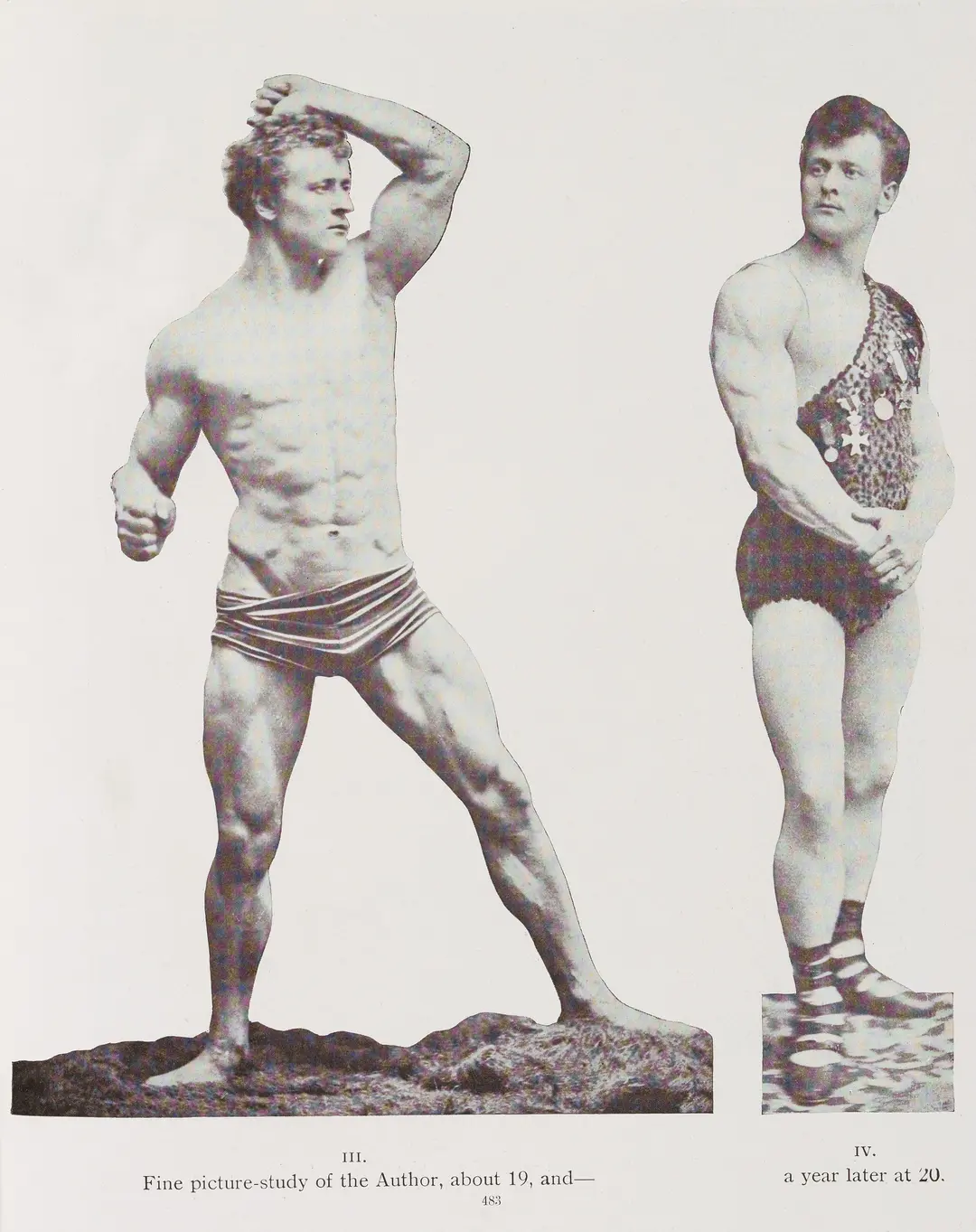
- - Eugen Sandow at nineteen and twenty. Two studies of Sandow at about 19 and 20, reproduced in his own book. Born Friedrich Wilhelm Mueller in Koenigsberg in 1867, he had left Prussia the previous year.
- - Eugen Sandow at twenty-one. A back study made when Sandow was 21, during the period he trained under Louis Durlacher, the Brussels strongman known as Professor Attila.
- - Eugen Sandow at twenty-one, arm development. Sandow photographed at 21. He first appeared in London around this period, in the music-hall challenge contests that made his name.
- - Strongwoman, from Acrobats and Mountebanks. From the 1890 volume Acrobats and Mountebanks. The music hall and circus were the only public venues where a muscular woman could perform, and the strongwoman act was a recognised bill item across Europe.
- - Sandow as a gladiator, painted by Aubrey Hunt. Reproduced from a painting by Aubrey Hunt, who met Sandow near Genoa. Sandow was 23. The classical framing was deliberate and central to his self-presentation.
- - Eugen Sandow at twenty-three. A study of Sandow in his early twenties from his own photographic autobiography.
- - Louis Cyr with his wife Melina Courtois and daughter Emiliana. Cyr photographed with his family. He toured with his wife and daughter as part of the act.
- - Louis Cyr, Canadian strongman. Louis Cyr of Quebec, born 1863, was the most celebrated strength athlete of the era. His feats were performed on the variety and circus circuit.
- - Eugen Sandow at twenty-five. Sandow at 25, the year before Florenz Ziegfeld brought him to the United States for the Chicago World's Columbian Exposition.
- - Eugen Sandow, statuesque pose with muscles relaxed. Sandow at about 26 in a relaxed classical pose. He derived his proportions by measuring Greek and Roman statuary in museums.
- - Sandow photographed by Napoleon Sarony in New York. A cabinet card by Napoleon Sarony, the leading American theatrical photographer, made during Sandow's first United States tour.
- - Bernarr Macfadden posing on a pedestal. Macfadden billed as Professor B. A. McFadden, posed in imitation of classical statuary. He founded Physical Culture magazine six years later and ran the Madison Square Garden contest of 1903 to 1904 won by Al Treloar.
- - Bernarr Macfadden with hands behind his head. A second study from the same sitting. The fig leaf was the convention that kept near-nude physique photography inside the law.
- - Eugen Sandow at twenty-seven. Sandow at 27, at the height of his American tour under Ziegfeld's management.
- - Sandow reclining, wearing a fig leaf. An albumen silver print. The fig leaf was the convention that allowed near-nude male physique images to circulate legally in the 1890s.
- - Sandow leaning on a pillar in a Samson pose. Sandow posed against a studio column in what contemporaries called a Samsonesque attitude, wearing a fig leaf.
- - Poster: Sandow lifting the human dumbbell. A lithographed poster for the Sandow Trocadero Vaudevilles under the direction of Florenz Ziegfeld Jr. The human dumbbell act had men hanging from each end of a bar.
- - Colour lithograph poster for the Sandow Trocadero Vaudevilles. A colour lithograph in poster format advertising Ziegfeld's Sandow touring company. The economy of the strongman era was theatrical entertainment, not sport.
- - Edison Kinetoscope souvenir strip of Sandow. A souvenir print of the Edison Kinetoscope film of Sandow, shot and copyrighted by W. K. L. Dickson at the Black Maria studio. Sandow was among the first people ever filmed.
- - Academic figure study of Sandow, Rijksmuseum cabinet card. A cabinet photograph held by the Rijksmuseum, catalogued as an academic figure study. Such prints were sold to artists as anatomical reference.
- - Sandow academic figure study, second pose. A second cabinet card from the same Rijksmuseum series of Sandow figure studies.
- - Sandow photographed by Steckel in Los Angeles. One of a series of cabinet cards made by the Steckel studio at 220 South Spring Street, Los Angeles, during Sandow's American tour.
- - Sandow from behind, hands on head. A rear study from the Steckel series, made to display back musculature. Poses like this became the template for competitive posing decades later.
- - Sandow leaning on a pillar, Steckel studio. A Steckel cabinet card. The studio column and drape were standard properties borrowed from classical portraiture.
- - Victorian Music Hall Act, 1890s - Archive Film 1000111. Archive film of a Victorian music hall act of the 1890s, tentatively identified as the eccentric comedian Will Evans. The bill on which Sandow appeared was this: variety turns, comic business and physical novelty, sold to a paying audience.
- - Sandow photographed by Benjamin Falk. A panel-card portrait by Benjamin J. Falk, a New York photographer known for theatrical portraiture.
- - Eugen Sandow at thirty, muscles in contraction. Sandow at 30 with the musculature contracted. Ziegfeld's innovation was to sell muscular display rather than feats of lifting.
- - Sandow being prepared for a plaster body cast. An unsigned photograph showing Sandow prepared for the moulding of a full body cast, made to serve sculptors and artists as a model of ideal proportion.
- - Burlot resistance apparatus. A resistance apparatus illustrated in a German manual of 1898. Spring and pulley devices dominated home training before the loadable barbell became cheap.
- - Madame H. Cloutier, strongwoman. A La Presse article on Madame H. Cloutier, a young Canadian athlete who set out to repeat the feats of Louis Cyr. Women performed strength acts on the same circuit as the men.
- - Charmion at the Folies-Bergere. Laverie Vallee, 1875 to 1949, performed as Charmion, a trapeze strongwoman act. The Folies-Bergere poster is the promotional face of a career that put a visibly muscular woman on a Paris stage nightly.
- - Laverie Cooper, seated. Charmion off stage. Her Edison-filmed Trapeze Disrobing Act of 1901 made her one of the earliest women photographed in motion for a mass audience.
- - Charmion at the Folies-Bergere, lithograph. A lithographic poster from the Musee Carnavalet collection. The strongwoman act was a paid stage engagement with no contest structure at all, and it preceded competitive women's bodybuilding by roughly seventy years.
- - Charmion, strongwoman. Laverie Vallee, 1875 to 1949, billed as a strongwoman. Her Edison-filmed Trapeze Disrobing Act of 1901 made her one of the earliest women recorded in motion for a mass audience.
- - Poster: Louis Cyr, strongest man on earth. A poster for John Robinson's circus billing Cyr as strongest man on earth, lifting 4,300 pounds at a salary of 2,000 dollars a week. The billing was advertising, not an adjudicated title.
- - Charmion at the end of her act. Photographed by Alfred Ellis, 7 September 1898. Charmion's act combined trapeze work with displays of strength and muscular development.
- - Plate from How to Get Strong. From the 1899 edition of How to Get Strong. Nineteenth century strength manuals mixed apparatus work, calisthenics and dietary advice in proportions a modern reader would recognise.
- - Exercise apparatus. A resistance apparatus of the period. Nineteenth century home apparatus ran to pulleys, springs and elastic straps rather than free weights.
- - Anna Abs. From the George Grantham Bain collection at the Library of Congress. Abs was one of a cohort of professional strongwomen working the American variety circuit at the turn of the century.
…and 1,016 more moments.
Full text archive: /loreline-text/bodybuilding.md