Books
A book is a technology for holding a mind still long enough to copy it. For most of the story that meant an animal skin, a quill and a room of monks working through a winter to produce one volume. Then a goldsmith in Mainz worked out how to cast reusable letters in metal, not the first movable type on earth, since China and Korea had got there centuries before, but the first system that scaled, and the price of a book collapsed. What followed was almost everything: mass literacy, the newspaper, the novel, the pamphlet war, and a permanent argument about who gets to read what. Books have been chained to desks, indexed as forbidden, burned in public squares by governments confident they were on the right side, and hidden under floorboards by people who disagreed. They have also been the most durable storage medium anyone has built: a codex written in the year 800 is still readable, which is more than can be said for a floppy disk from 1994. This archive is the whole of it, the making, the printing, the libraries, the trade, the banning, the individual books that moved something, and the strange private act of reading itself.
A chronological documentary of 1,511 moments spanning c. 332 BC–2026 on Loreline.
Curated by Olivier · last updated 2026-09-20
Eras
- Papyrus & Scrolls, Before the page there was the roll. Egyptian papyrus made from a river reed, the Dead Sea Scrolls sealed in jars, the carbonised Herculaneum library now being read by particle accelerator and machine learning, and the slow shift from the scroll to the bound codex that changed how anyone could look something up.
- Scribes, The people who made the marks, and what they made them with. Copyists at the desk, cuneiform pressed into wet clay, the reed and the quill, oak-gall ink and lapis ground into ultramarine, and the colophons where an exhausted monk complains in the margin about his cold hands.
- Parchment & Paper, The substrate. Animal skin scraped, stretched and limed into vellum; paper travelling from Han China through Samarkand and Baghdad to Fabriano and then everywhere; rag pulp, watermarks, the mill, and the acid-paper disaster that is quietly destroying most of what was printed after 1850.
- Manuscripts, Books written entirely by hand, and the objects that survived. Domesday, Magna Carta, the great codices, palimpsests where an earlier text was scraped off and read back centuries later, and the libraries and collectors who kept them intact.
- Illuminated Manuscripts, Gold leaf, miniature painting and the decorated initial. The Book of Kells and the Lindisfarne Gospels, books of hours made for people who could not read the Latin in them, bestiaries, and the marginalia, the knights fighting snails, the rabbits with trumpets.
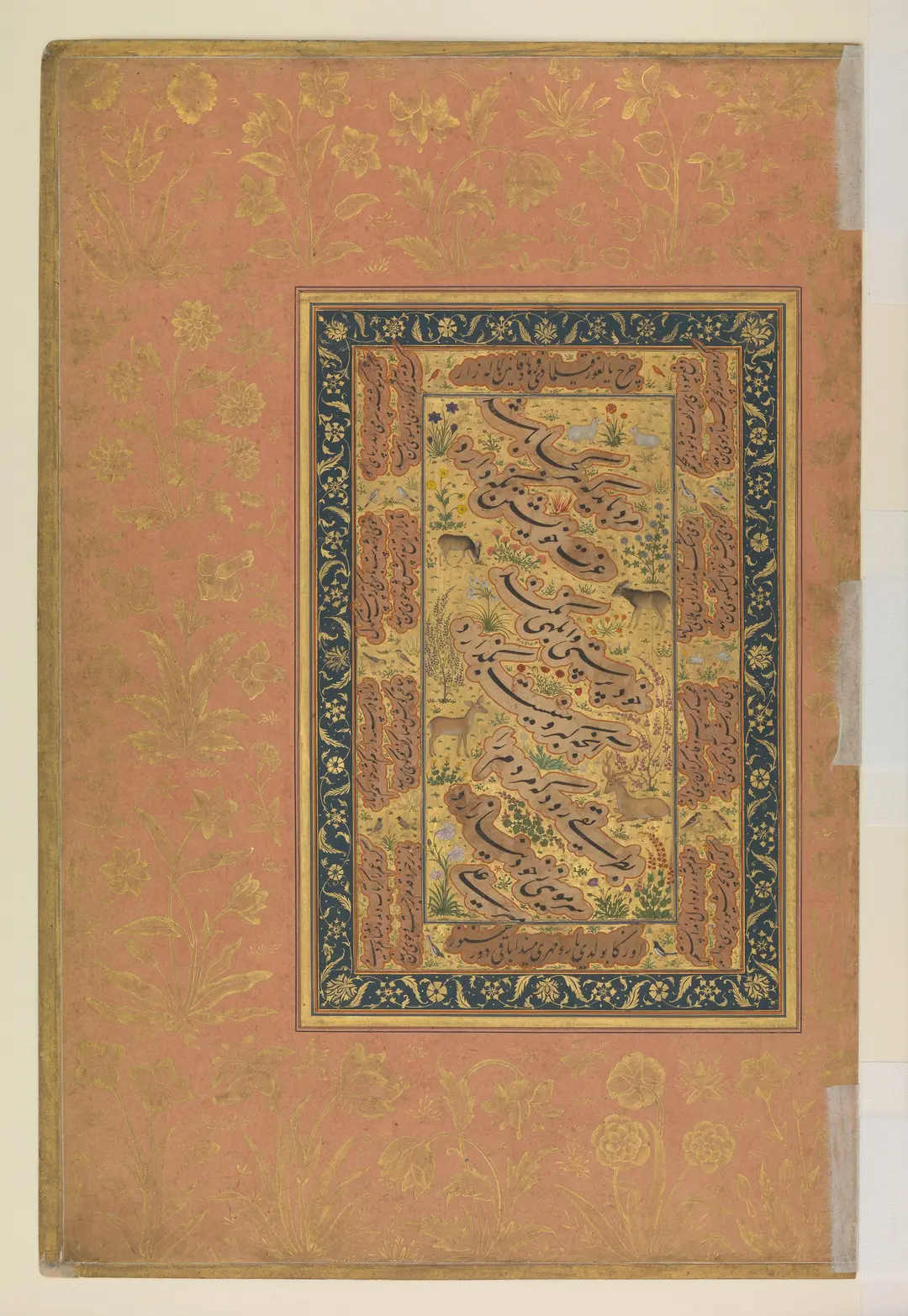
- Islamic Manuscripts, Calligraphy as the highest art form. Kufic and naskh, the Qur'an as an object, Persian and Mughal painting, the paper mills of Baghdad, the translation movement in the House of Wisdom, and the manuscript libraries of Fez, Cairo and Timbuktu.
- World Manuscripts, Hebrew, Armenian, Syriac, Ethiopian and Coptic books; Mesoamerican codices in bark paper and deerskin, most of them burned; the Timbuktu manuscripts smuggled out of Mali in rice sacks in 2012; and the writing traditions that never entered the European story at all.
- Asian Books, China, Japan, Korea and the wider region, where printing is older than Gutenberg by centuries. Bamboo slips, the Diamond Sutra of 868 as the oldest dated printed book, Korean movable metal type in 1377, the Tripitaka Koreana's 81,000 blocks, and the Japanese and Chinese book trades.
- Woodblock, Printing from a carved surface. East Asian woodblock and the European woodcut, engraving, etching and lithography, the image half of the book, and the technique that put pictures into print long before photography.
- Gutenberg, Mainz, around 1450: a goldsmith, a punch, a matrix, a hand mould, an oil-based ink and a converted press. The 42-line Bible, the lawsuit with Fust that took the business away from him, and the argument about what he actually invented and what he borrowed.
- Printing, The press and what it did. Incunabula, Aldus Manutius and the pocket book, Caxton in Westminster, Plantin in Antwerp, the hand press, the iron press, steam, stereotype, the Linotype, offset, and the print shop as the noisiest room in town.
- Typography, Letterforms and the people who cut them. Roman and italic, Garamond, Baskerville, Bodoni, Caslon, blackletter, the punchcutter's hand, Gill and Zapf and Frutiger, the Swiss grid, phototypesetting and the leap to digital type.
- Bookbinding, Turning sheets into a book. Sewing, the gathering and the signature, boards and leather and gold tooling, the fore-edge painting hidden until you fan the pages, the treasure binding in metal and jewels, and the conservators repairing all of it now.
- Bibles, The most printed book there is. The Vulgate, the Gutenberg Bible, Tyndale burned for translating it, Luther's German, the King James, the Geneva Bible and its footnotes, mass distribution by the Bible societies, and the translation work still going on in hundreds of languages.
- Libraries, Rooms full of books and how they were organised. Alexandria and what actually happened to it, the reading room, the card catalogue, Dewey and the Library of Congress classification, the stacks, and the fight over what a library is for now.
- Monastery Libraries, The chained library and the scriptorium. St Gallen, Admont, Strahov, Melk, Hereford, the Joanina at Coimbra, the Escorial, the rooms where books were copied, kept and read for a thousand years, and which mostly still look exactly as they did.
- National Libraries, The great deposit collections. The British Library, the Bibliothèque nationale, the Library of Congress, the Vatican Library, and the buildings, budgets, legal-deposit rules and cyberattacks that keep them going or nearly stop them.
- Librarians, The job. Reference work, cataloguing, prison and hospital libraries, bookmobiles and camel libraries, the ALA, funding fights, and the librarians who refused to hand over borrowing records.
- Archives, The record that was never meant to be published. Registries, national archives, the disaster of a burned or bombed archive, digitisation programmes, provenance and repatriation, and how you find one document among forty million.
- Publishing, The trade. The publisher, the editor, the agent, the advance, the imprint, paperback revolutions, Penguin, the airport bestseller, the conglomerate merger, self-publishing, and how a manuscript becomes a product.
- Bookshops, Where books are sold. The independent, the second-hand shop, Shakespeare and Company, the chain, the remainder table, the book fair, and the shops that closed and the ones that somehow did not.
- Readers, The other half of the act. Reading aloud, reading silently, marginalia, commonplace books, book clubs, the novel-reading panic, audiobooks, Braille and talking books, and what the eye and brain actually do on a page.
- Literacy, Learning to read, and who was allowed to. Hornbooks and primers, mass schooling, literacy campaigns, the alphabet wars and phonics, adult literacy work, and the parts of the world where the fight is still on.
- Censorship, Books stopped by authority. The Index of Forbidden Books, obscenity trials from Ulysses to Lady Chatterley, samizdat typed on onionskin, the fatwa against Rushdie, and state censors from Franco's Spain to the present.
- Book Bans, The modern wave. School-board removals and district lists, the titles pulled most often, the parents and librarians on both sides of it, lawsuits, and the counts published each year by the ALA and PEN.
- Book Burning, Fire as an argument. The Nazi bonfires of 1933, the National and University Library of Bosnia in 1992, the Jaffna library in 1981, Louvain twice in two wars, and the deliberate destruction of a written culture as a tactic.
- Encyclopedias, The attempt to hold everything. Pliny, the Chinese leishu, Diderot and d'Alembert's Encyclopédie as a political act, the Britannica and its door-to-door salesmen, Brockhaus, and Wikipedia, the largest of them all, written by nobody in particular.
- Landmark Books, Individual titles that changed something, and the copies of them that survive. The First Folio, Newton's Principia, Audubon's double elephant folio, and the rare-book world of auctions, forgeries and thefts that grew up around such objects.
- Children's Books, The books people remember longest. Picture books and the illustrator's craft, primers and fairy tales, Carroll and Sendak and Blyton, board books, banned children's titles, and the reading that decides whether anyone becomes a reader at all.
- - Book of the Dead of the Priest of Horus, Imhotep (Imuthes). Papyrus, funerary, Book of the Dead, Imouthes, Imhotep, Imuthes in the Metropolitan Museum of Art (Egyptian Art). Papyrus, ink. Digitised image of the artefact itself; dated to the object, ca. 332–200 BCE.
- - Muziris Papyrus P.Vindob. G 40822 verso Austrian National Library. Verso side of the Muziris Papyrus (P.Vindob. G 40822), a Greek papyrus document of the mid-2nd century CE preserved in the Austrian National Library. The verso contains an account of Indian cargo from the ship Hermapollon, including Gangetic nard.
- - Codex Sinaiticus Paralipomenon 9,27-10,11. Codex Sinaiticus, the fourth-century Greek Bible codex, one of the oldest substantially complete Christian books.
- - Codex Ink. Codex Sinaiticus, the fourth-century Greek Bible codex, one of the oldest substantially complete Christian books.
- - Codex Sinaiticus Petropolitanus (title). Codex Sinaiticus, the fourth-century Greek Bible codex, one of the oldest substantially complete Christian books.
- - Codex Sinaiticus. Pagina, GD009896. Title Codex Sinaiticus. Pagina Series EuroPhot. Art history. 4th century. Artifact EuroPhot. Kunstgeschiedenis. 4de eeuw. Artefact Extent 1 glasdia; 100 x 85 mm. Slide Language Undetermined Typographical details glass slide(s) Additional info General note: Fotograaf onbekend General note: Toegevoegde informatie op dia Biographical or historical data: Oorspronkelijke locatie/Vindplaats: Egypte, Si
- - Qur'an Manuscript Folio. 9th century. ink, gold, and color on parchment. Cleveland Museum of Art, 800s-900s. This is a reproduction of the object itself, not a modern photograph of a building.
- - Qur'an Manuscript Folio: a second folio. Qur'an Manuscript Folio (verso). Iran or Iraq, Abbasid period, 9th, 10th century. ink, gold, and color on parchment. Cleveland Museum of Art, 800s, 900s. This is a reproduction of the object itself, not a modern photograph of a building.
- - Trinity College - Book of Kells. The Book of Kells, the insular Gospel manuscript of about 800 now at Trinity College Dublin.
- - Qur'an Manuscript Folio (recto); left side of bifolio. 9th century. gold, ink and colors on parchment. Cleveland Museum of Art, 800s. This is a reproduction of the object itself, not a modern photograph of a building.
- - Dublin Trinity College Library Long Room Book of Kells 1. Book of Kells at the Long Room of the Library of the Trinity College, Dubline, Ireland.
- - The book of Kells library interior 3. The Book of Kells, Trinity College Library, Dublin, is an illuminated manuscript and Celtic Gospel book in Latin, containing the four Gospels of the New Testament together with various prefatory texts and tables.
- - Qur'an Manuscript Folio (verso), view 2. Qur'an Manuscript Folio. Iran or Iraq, Abbasid period, 800s, 900s. ink, gold, and color on parchment. Cleveland Museum of Art, 800s, 900s. This is a reproduction of the object itself, not a modern photograph of a building.
- - Bifolium Excised from a Carolingian Gradual. 9th century. gold and silver ink on purple parchment. Cleveland Museum of Art, c. 830–60. This is a reproduction of the object itself, not a modern photograph of a building.
- - Diamond sutra. Frontispiece of a printed dated copy of the Diamond Sutra. Ink on paper: woodblock print. Or.8210/P.2
- - E-codices csg-0728 004 max. The earliest manuscript catalogue of the monastery of St. Gall from the middle of the 9th century, followed by a collection of important law texts (capitularies of Ansegis, Lex Salica, Lex Ribuaria). (smu)
- - Diamond Sutra - Exhibits on the ground floor of Himalayan Tibet Museum in Darjeeling 12. This exhibit is a Diamond Sutra text (hand written with gold ink), part of precious gifts from His Holiness The Dalai Lama. On 26th August 2010, the President, General Secretary and the Office Secretary of MCTC had an audience with His Holiness the Dalal Lama at Dharamsala in connection with the museum project.
- - Himalayan Tibet Museum - Darjeeling - Diamond Sutra (1). The Diamond Sutra, the Dunhuang copy of 868 is the earliest dated printed book to survive complete.
- - Tibetan Diamond Sutra. The Diamond Sutra, the Dunhuang copy of 868 is the earliest dated printed book to survive complete.
- - Gospel Book with Commentaries. 1000–1100. This is a reproduction of the object itself, not a modern photograph of a building.
- - Text, folio 110 (recto), from a Gospel Book with Commentaries. 1000–1100. This is a reproduction of the object itself, not a modern photograph of a building.
- - Text, folio 121 (verso), from a Gospel Book with Commentaries. 1000–1100. This is a reproduction of the object itself, not a modern photograph of a building.
- - Syriac manuscript 11 century liturgy - 2. 11 century leaf from Syriac liturgical manuscript. Found online, auction of a collection by John Ingels (1925-2016).
- - Syriac Orthodox icon of Jesus Christ, St. Peter, and St. Paul. A Syriac manuscript in the Aramaic script used by the Churches of the East.
- - Funerary Papyrus of Tayuhenutmut (1894.180). Potent symbols, sacred words, and divine protection helped ancient Egyptians transition from the earthly realm to an eternal existence. Interactions between mortals and the gods were depicted on funerary objects including papyri, like this example made for temple singer Tayu-henut-Mut (“the mistress of [the goddess] Mut”). This papyrus shows Tayu-henut-Mut standing with raised hands before an offe
- - Papyrus with the Instruction of Amenemope. (1077-664 BC). It was discovered at Thebes, and was purchased by the British Museum through Wallis Budge in 1888.
- - Leaf from a Greek Psalter and New Testament. 1084. This is a reproduction of the object itself, not a modern photograph of a building.
- - Domesday Croydon Cheam. Domesday Book entries for Croydon and Cheam, Surrey, as published in 1783 by Abraham Farley using record type.
- - Selseydomesday. The Domesday Book, the 1086 survey of England ordered by William the Conqueror.
- - Domesday zinco Somerset Glastonbury. A page from the photozincographic edition of Domesday Book for Somersetshire (published 1862), showing the landholdings of Glastonbury Abbey.
- - Plate XXIV 2 Domesday Book Guilford 1086. Terra Regis. In Wochinges Hundredo. In Gildeford habet Rex Willelmus 75 hagas in quibus manent 175 homines. Tempore Regis Edwardi reddebat 18 libras et 3 denarios. Modo appreciatur 30 libris et tamen reddit 32 libras. De supradictis hagis habet Rannulfus clericus tres hagas ubi manent sex homines, et inde liabet isdem Rannulfus sacam et socam, nisi commune geldum in villa venerit, undo nullus cv
- - Bilingual Syriac-New Persian psalter in Syriac script, Bulayik, 12th-13th century AD, paper - Ethnological Mus. Exhibit in the Ethnological Museum, Berlin, Germany. Photography was permitted in the museum without restriction.
- - Page from a Qur'an, Sura al-Nisa 4, verses 159–60. 1100s. This is a reproduction of the object itself, not a modern photograph of a building.
- - Fragment of the Cairo Genizah - The Passover Haggadah, pages 3&4 plus ruler. A fragment from the Cairo Geniza, the storeroom of the Ben Ezra Synagogue that preserved roughly 400,000 discarded Jewish manuscript fragments.
- - Solomon Schechter studying the fragments of the Cairo Genizah, c. 1898. A fragment from the Cairo Geniza, the storeroom of the Ben Ezra Synagogue that preserved roughly 400,000 discarded Jewish manuscript fragments.
- - Double-Sided Leaf from a Qur'an. 1100s. This is a reproduction of the object itself, not a modern photograph of a building.
- - Fragment of the Cairo Genizah - The Passover Haggadah, pages 1&2 plus ruler. A fragment from the Cairo Geniza, the storeroom of the Ben Ezra Synagogue that preserved roughly 400,000 discarded Jewish manuscript fragments.
- - Ephrem's Commentary on the Diatessaron. A Syriac manuscript in the Aramaic script used by the Churches of the East.
- - Meta-Discourse on the Teachings from the Treasury (Abidharmakosha-Bhashya). ). Japan, Heian period (794–1185). handscroll; gold and silver on indigo-dyed paper. Cleveland Museum of Art, 1100s. This is a reproduction of the object itself, not a modern photograph of a building.
- - Folio from a Qur'an. (1037–1194). ink, gold, and colors on paper. Cleveland Museum of Art, 1100s. This is a reproduction of the object itself, not a modern photograph of a building.
- - Title Page of St. Gregory's "Moralia": Job Visited by His Three Friends (above) and Gregory the Great and His. (below). Switzerland, Monastery of Engelberg, 12th century. ink, tempera, and gold on vellum. Cleveland Museum of Art, c. 1143–1178. This is a reproduction of the object itself, not a modern photograph of a building.
- - Aethicus, Handschrift, Benediktinerstift Admont, Stiftsbibliothek, Fragm. C 472 (Ende des Werks und Alphabet). Admont, Benedictine Abbey, Fragment C 472 (formerly Cod. 472, fol. 1f/2r): This fragment was embedded for centuries in Codex 472 of the Benedictine Abbey of Admont, a Sedulius manuscript from the 12th century. During the restoration of the binding in 1952, it was removed. Winfried Stelzer identified the fragment as an early version of the Cosmography of Aethicus, dating to the late 9th century. He
- - T-S NS 163.57. A fragment from the Cairo Geniza, the storeroom of the Ben Ezra Synagogue that preserved roughly 400,000 discarded Jewish manuscript fragments.
- - Lalitwistra Waipulya Sutra. A Buddhist sutra manuscript or printed text, the copying of sutras was itself a devotional act. Low-resolution scan retained as scarce primary material.
- - SMT D119 Facsimile of f plate 21 of the manuscript Troano. Maya codex material. Only four pre-conquest Maya codices survive; much of what circulates is nineteenth-century facsimile plates.
- - 4Q41 2. The second of two parchment sheets making up 4Q41 or 4QDeuteronomyn, also known as the "All Souls Deuteronomy", one of the Dead Sea Scrolls, dated to the first century BC. This second sheet contains Deuteronomy 5:1-6:1, and thus preserves one of the oldest extant copies of the Ten Commandments.
- - Dharmakīrtisāgara.. A Buddhist sutra manuscript or printed text, the copying of sutras was itself a devotional act. Low-resolution scan retained as scarce primary material.
- - Entire Tanakh scroll set. A Hebrew biblical manuscript or scroll, the text tradition copied by hand for two millennia.
- - Detail of Maya Codex - Museum of Anthropology - Mexico City - Mexico. Maya codex material. Only four pre-conquest Maya codices survive; much of what circulates is nineteenth-century facsimile plates.
- - GYANTSE Bibliotheque. A Buddhist sutra manuscript or printed text, the copying of sutras was itself a devotional act.
…and 1,461 more moments.
Full text archive: /loreline-text/books.md